







Neroli smells like bitter orange blossom captured at its brightest: a clean white floral with a sharp green stem edge, a cool metallic shimmer, honeyed sweetness underneath, and a citrus peel lift on top. It is fresher and far less sugary than most white flowers, closer to a sunlit orchard in bloom than to a florist's bouquet.
Start with what it is not, because that is where nearly everyone goes wrong. Neroli does not smell like oranges. It comes from the blossom of the bitter orange tree rather than from the fruit, and flowers and fruit of the same plant frequently share almost no aromatic chemistry, so the citrus brightness here is peel-oil brightness and never juice. It is not a sweet white floral either, despite being shelved beside jasmine and tuberose: it is drier, greener, sharper, and far more volatile than both.
Neroli is one of the few materials in perfumery where the same flower, picked from the same tree on the same morning, yields two completely different smells depending on how you get the oil out of it. That single fact explains almost all the confusion people have about neroli, orange blossom, and petitgrain.
The short version
- Smells like: a cold snapped green stem and metallic shimmer first, then waxy honeyed petal threaded with bitterness, thinning to a dry woody-green trace after about an hour.
- The surprise: the artificial grape smell of boiled sweets and soda is methyl anthranilate, a trace blossom molecule once sold as artificial neroli before it became grape flavoring.
- The chemistry: linalool and linalyl acetate build the fresh floral spine, light limonene and beta-pinene fire the citrus opening, and heavier nerolidol and farnesol hold the short tail.
- Where it comes from: hand-picked bitter orange blossom, North African with Tunisia foremost, in a four to six week spring window, where a tonne of flowers yields roughly a kilogram of oil.
- In a room: under cold-air diffusion it registers within twenty to forty seconds, blooms through the first fifteen minutes, and suits about 150 to 500 square feet on short repeated bursts.
- Often confused with: orange blossom absolute (heavier, sweeter, more animal), petitgrain from the leaves and twigs (green, dry, woody), and orange flower water (soft, aqueous, faintly bready).
What is neroli? The quick profile
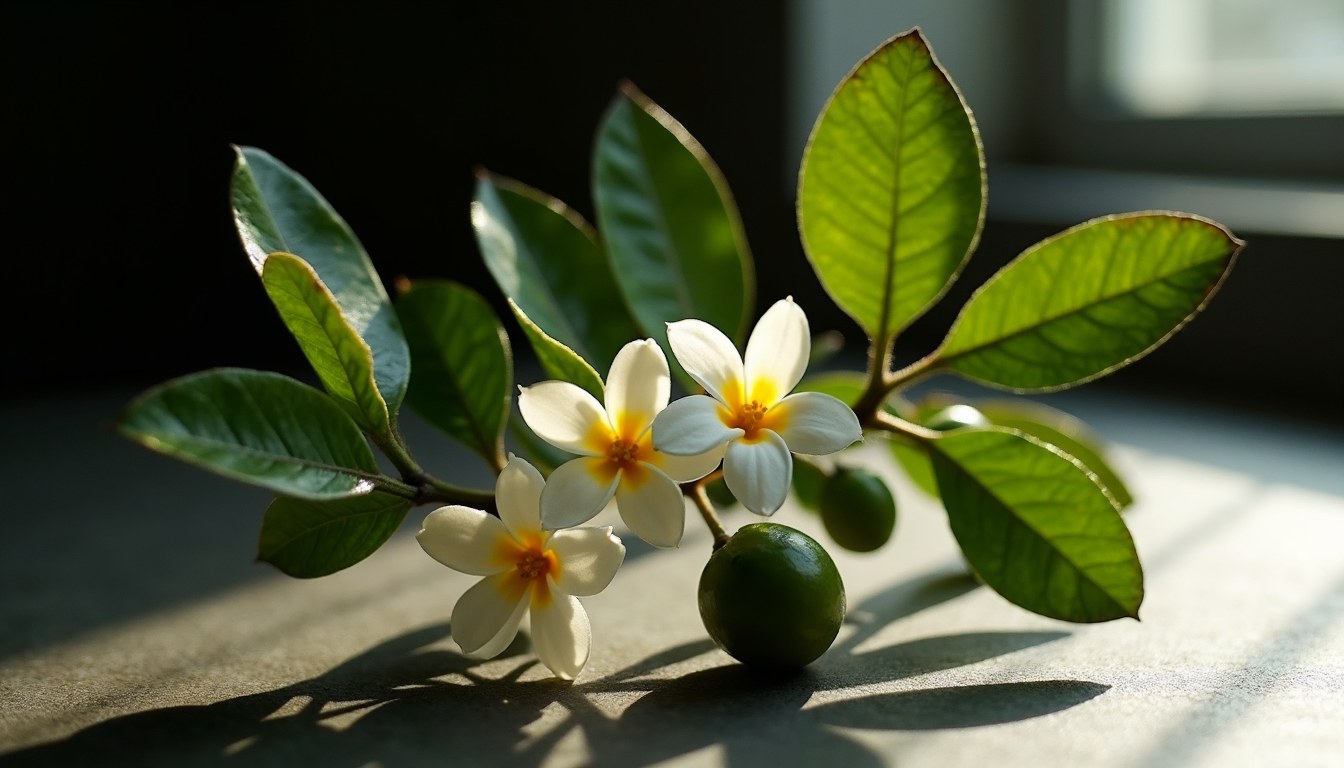
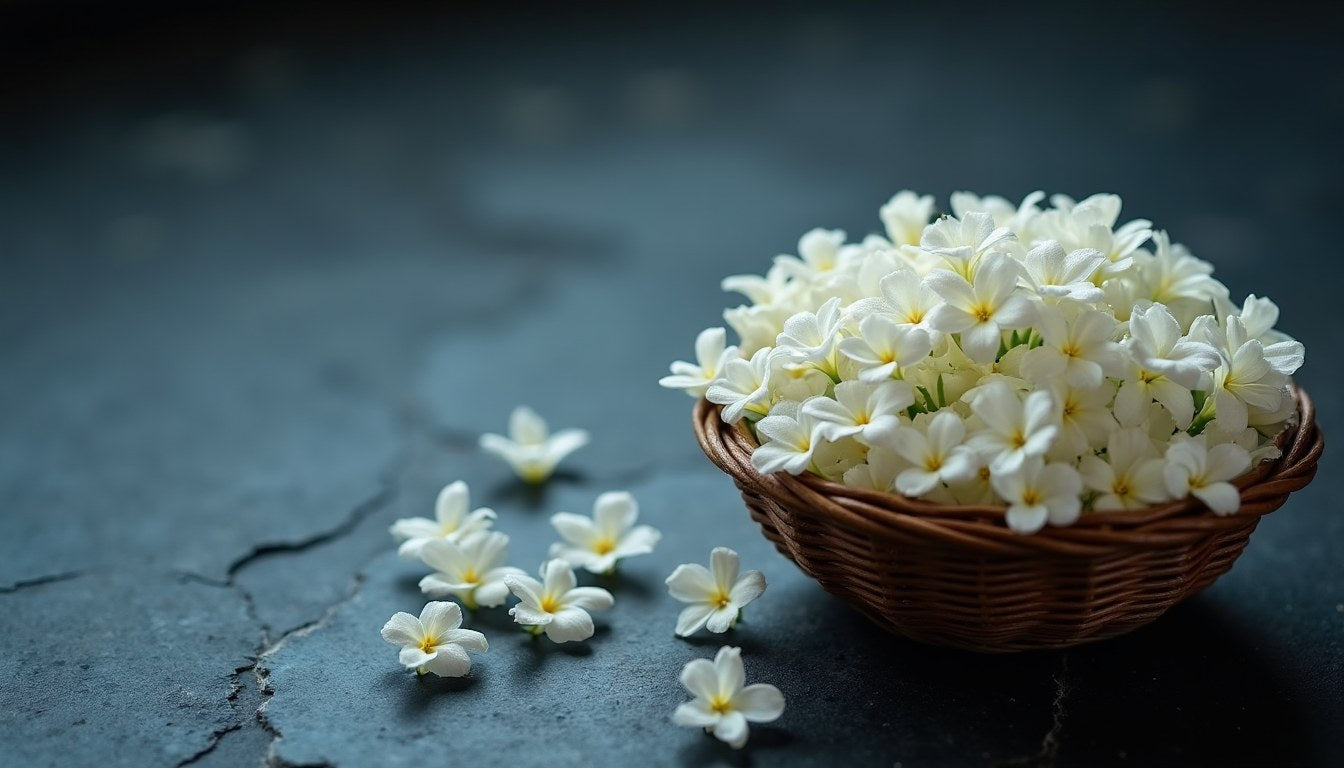
Neroli is the essential oil obtained by steam distilling the fresh white flowers of Citrus aurantium var. amara, the bitter orange tree, also called the Seville orange. Not the fruit. Not the peel. The blossom, and only the blossom, picked by hand during a harvest window of roughly four to six weeks in spring.
In the classic scent pyramid, neroli refuses to sit still. It is usually filed as a heart note because it is a flower, but it behaves like a top note in the first minutes: quick, bright, volatile, arriving before you have finished walking into the room. Neroli is better understood as a bridge material, sitting in the seam between the citrus opening and the floral heart. If you are still mapping how the broad categories relate, our guide to fragrance families lays out where the white florals sit relative to citrus, woods, and ambers.
- Family: floral, specifically a white floral with strong citrus and green facets
- Botanical source: the blossoms of Citrus aurantium var. amara, the bitter orange
- Extraction: steam distillation of freshly picked flowers, usually within hours of harvest
- Pyramid position: a bridge between top and heart, more volatile than jasmine or tuberose
- Key molecules: linalool, linalyl acetate, limonene, beta-pinene, alpha-terpineol, nerolidol, traces of methyl anthranilate
- Yield: a fraction of one percent of the blossom weight, among the lowest in perfumery
- Pairs with: bergamot, lemon, petitgrain, jasmine, lavender, cedar, vetiver
Two things follow from that profile, and they run through everything below. Neroli's dominant molecules are light, so it travels fast and fades faster than the heavier white flowers it gets grouped with. And the blossom is only one of the things this tree is harvested for, which is where almost all the confusion around the name begins.
One tree, six aromatic materials, and three that smell nothing alike
The bitter orange tree is unusual among fragrance plants because it is harvested for several different aromatic materials, and those materials do not smell alike. People assume neroli and orange blossom are two words for the same substance. They are not. They are two different extractions of the identical flower, and a trained nose separates them across a room.
Six materials come off this one species, and setting them side by side is the fastest way to see how far apart they sit.
| Material | Plant part | Extraction | How it smells |
|---|---|---|---|
| Neroli | Fresh white blossom | Steam distillation | Green, metallic, honeyed, bitter |
| Orange blossom absolute | Fresh white blossom | Hexane, then ethanol wash | Heavier, sweeter, jammy, animal |
| Petitgrain | Leaves and young twigs | Steam distillation | Green, woody, dry, bitter, peel snap |
| Orange flower water | Blossom, via the still | Water condensed off the neroli | Soft, aqueous, bready, gently sweet |
| Orange flower water absolute | Blossom, via the still | Solvent extraction of that water | Rich, honeyed, close to living flower |
| Bitter orange oil | Ripe fruit peel | Cold pressing | Sharp, dry, bitter citrus, not sweet |
Neroli: the distilled blossom
Steam passes through the fresh flowers, water vapor carries the volatile molecules out of the petals, the mixture is condensed, and the oil separates from the water. Of everything in the result, the bitterness is the part worth naming, because it reads as freshness rather than as a fault, and it is what stops the honey from tipping over into sugar.
The steam acts as a filter. Only molecules that co-distill with water at around 100 degrees Celsius reach the oil. Anything too heavy, too polar, or too fragile stays behind or dissolves in the condensed water. That filtering is the entire reason neroli smells the way it does.
Orange blossom absolute: the solvent-extracted blossom
Take the same flowers and wash them at ambient temperature with a hydrocarbon solvent, typically hexane, which dissolves the fragrant oil along with plant waxes and pigments. Evaporating the solvent leaves a waxy semi-solid called a concrete. Washing that with ethanol, chilling it so the waxes drop out, filtering, and removing the ethanol under reduced pressure leaves the absolute: a viscous, deep amber, intensely fragrant liquid.
There is no heat filter here and no water, so the absolute keeps everything the distillation left behind, and the difference is not subtle.
What does orange blossom smell like?
Orange blossom absolute smells heavier, rounder, sweeter, and considerably more animal than neroli. Where neroli is a snapped green stem in cold morning air, the absolute is the same flower at four in the afternoon in full sun: jammy, faintly overripe, with a grape-like fruitiness and a warm, slightly dirty floral hum that perfumers call indolic. It has more body, it lasts longer, and it smells much closer to a living orange tree in bloom when you stand underneath it.
If neroli is the photograph, orange blossom absolute is the room the photograph was taken in.
Petitgrain: the leaves and twigs
The third material comes from the green parts of the tree rather than from the flower, which is why it keeps almost none of the blossom's honeyed sweetness. Petitgrain is the sharp, slightly herbal, almost stemmy relative of neroli, and it is by a wide margin the cheapest of the three, because leaves and young twigs are a prunings crop rather than a hand-picked one.
The name preserves an abandoned practice. Petitgrain means "little grain" in French, because the oil was originally distilled from the tiny unripe green fruits. Producers realized that stripping immature fruit destroyed the mature crop, so distillation shifted to leaves and twigs while the old name stayed. Much of the world's petitgrain now comes from Paraguay, where bitter orange naturalized into semi-wild stands and commercial distillation is commonly dated to the 1870s.
The three materials most people never hear about
The tree is more generous still, and the last three materials all come out of what another process would treat as leftovers. The water that separates from the oil after distillation is not waste: it is orange flower water, and it carries the small water-loving molecules that never reached the oil at all. That water has been used in Mediterranean and Middle Eastern cooking for centuries, and producers extract it a second time to recover the rare orange flower water absolute. Add the cold-pressed peel of the ripe fruit and one species has yielded six aromatic materials, which is an unusually thorough use of a single fragrance plant.
The scent, decomposed
The first ten seconds
The opening of neroli is not floral, which surprises people. The first impression is a cold, green, faintly bitter snap, the smell of a stem broken between your fingers, over a citrus lift that reads more like zest oil than juice. Almost immediately a cool brightness arrives that perfumers describe as metallic, the way a clean steel spoon or a wet stone smells. That shimmer is one of the fastest ways to tell genuine neroli from a simplified imitation.
The heart, from about one minute onward
The green cools and the flower opens. This is where neroli earns its place among the white florals: a soft, waxy, petal-like sweetness with honey under it, never sugary, always threaded with bitterness. There is a soapy quality here, and that is not an insult. Soapiness in perfumery means a clean, slightly powdery, slightly fatty floral character, and neroli has it naturally, which is why so many soaps and colognes were built around it.
The drydown
Neroli's tail is short by floral standards and more woody-green than sweet: after an hour, a faint, dry, slightly bitter floral trace with a whisper of soft wood. Compared with jasmine or tuberose, which leave a warm sticky residue for many hours, neroli fades out cleanly rather than lingering.
The facet vocabulary
Six facets do most of the descriptive work here, and they are worth learning for every floral, not only this one.
- Green: the cut-stem, crushed-leaf character, cool and slightly sappy
- Metallic: a cold, mineral, almost electric brightness, like clean cutlery or wet slate
- Honeyed: a warm, waxy, nectar-like sweetness that is not the same as sugary
- Bitter: the pithy, orange-rind edge that keeps the flower from turning cloying
- Soapy: a clean, powdery, faintly fatty floral quality, distinct from detergent
- Indolic: the heavy, warm, faintly animal side of white flowers, strong in the absolute and largely absent in distilled neroli
What neroli does not smell like
Four misconceptions attach themselves to this note, including the two flagged at the top of this page, and clearing all four is the fastest way to understand it.
It does not smell like oranges. Neroli comes from the flower, and flowers and fruit of the same plant frequently share almost no aromatic chemistry. There is citrus brightness in neroli, but it is peel-oil brightness, not juice. For the smell of a peeled orange you want sweet orange or mandarin.
It is not a sweet floral. Neroli gets shelved next to jasmine and tuberose and behaves nothing like them: drier, greener, sharper, far more volatile. If something sold as neroli smells thick and sugary, it is probably built on orange blossom absolute, or on an accord that kept the sweet parts and dropped the green.
It is not orange flower water. The hydrosol is soft, aqueous, faintly bready, and because most people meet it first in confectionery they carry a pastry association into the note. Neroli oil is far more concentrated, greener, and more bitter than that memory suggests.
It is not a cleaning smell, although it lives near that neighborhood. The soapy facet is real, but the metallic and honeyed facets separate an orchard-in-bloom impression from a surface spray, and losing them is how weak imitations end up smelling like bathroom cleaner.
The chemistry: which molecules actually make this smell
Neroli contains hundreds of identified compounds, but a handful do the heavy lifting, and their proportions shift with origin and season. Published analyses vary widely, so treat every percentage below as a typical range rather than a fixed recipe.
The chemical signature at a glance
The molecular data sits in one place here so the rest of this section can stay on how things smell and why. Every figure in this block is a published constant for the pure molecule rather than a measurement of any particular oil, and every boiling point is at ordinary atmospheric pressure. Nerolidol is given as a range because commercial material is a mixture of two isomers. What each molecule actually smells like is taken up in the subsections below.
| Molecule | Formula | Molecular weight | Boiling point |
|---|---|---|---|
| Beta-pinene | C10H16 | 136.23 | 166 C |
| Limonene | C10H16 | 136.23 | 176 C |
| Linalool | C10H18O | 154.25 | 198 C |
| Linalyl acetate | C12H20O2 | 196.29 | 220 C |
| Indole | C8H7N | 117.15 | 254 C |
| Methyl anthranilate | C8H9NO2 | 151.16 | 256 C |
| Nerolidol | C15H26O | 222.37 | 263 to 266 C |
Indole is the odd one out in that list, and usefully so. It has the lowest molecular weight of the seven and yet one of the highest boiling points. The two facts have separate causes: the weight is simply what a small two-ring molecule weighs, while the boiling point is high because indole is a crystalline solid melting at about 52 degrees Celsius rather than a free-running oil. It is also the single most reliable marker of which extraction you are smelling: plentiful in orange blossom absolute, scarce in distilled neroli.
Linalool and linalyl acetate: the fresh-floral backbone
Linalool is the single largest component of most neroli oils, commonly reported anywhere from roughly a quarter to more than half of the oil. It is a small alcohol molecule, and it smells fresh, floral, faintly woody, and slightly citrusy. It is also one of the most widely distributed fragrance molecules in nature, present in lavender, coriander seed, rosewood, basil, and hundreds of other plants. It was first obtained in commercial quantity in the 1870s from tropical wood oils, and its name derives from lináloe, the Spanish name for a fragrant Mexican wood, plus the suffix -ol that marks an alcohol.
Linalyl acetate is linalool's ester, linalool with an acetate group attached. Esters generally smell sweeter and fruitier than the alcohols they come from, and this one is the smooth, pear-and-lavender-like softness that rounds off linalool's edges. In neroli it typically runs from a few percent up to the high teens. Together these two are the note's structural spine.
Limonene, beta-pinene and the citrus lift
The green-citrus flash at the start comes largely from terpene hydrocarbons: limonene, which gives citrus peel its characteristic smell, and beta-pinene, which contributes a dry, resinous, pine-like freshness. Both are small, and both boil well below the alcohols, so they leave a droplet first and reach your nose first. They are why neroli's opening reads as citrus before it reads as flower.
Methyl anthranilate: the grape-jam facet
This is the molecule that explains why some orange blossom materials smell faintly like grape candy. Methyl anthranilate is a nitrogen-containing ester with a sweet, fruity, slightly dusty floral character. It is present in distilled neroli only in traces, often well under one percent, but in orange blossom absolute it can reach several percent, and that difference is unmistakable in the smell.
The molecule had a second career outside perfumery. Identified as a component of neroli in the 1890s, it was soon manufactured for perfumery and sold for a time as artificial neroli oil, then adopted as the backbone of artificial grape flavoring. In 1921, chemists working on grape juice authenticity found the same molecule occurring naturally in North American grape varieties, Concord grapes especially, and absent from the European wine grape. The "fake grape" smell of boiled sweets and soda is, in a real sense, a fragment of orange blossom.
Indole: the molecule that separates the two extracts
Indole is a small aromatic compound built on a fused two-ring structure containing nitrogen. A white crystalline solid at room temperature, it is responsible for the heavy, warm, faintly animal undertone that gives white flowers their carnal quality. In high dilution it reads as lush and living. Undiluted it is genuinely unpleasant.
Indole was first isolated in 1866 by the German chemist Adolf von Baeyer, who obtained it by treating oxindole, a derivative of the indigo dye molecule, with zinc dust. The name compresses indigo and oleum. Baeyer's indigo work eventually earned him the 1905 Nobel Prize in Chemistry.
Orange blossom absolute contains indole. Distilled neroli contains very little. That single difference accounts for much of the gap in character between the two.
Nerolidol and farnesol: the quiet tail
Both are sesquiterpene alcohols, larger fifteen-carbon molecules. Nerolidol, named after neroli oil itself, smells faintly woody, waxy, and green-floral. Published analyses put it anywhere from about one to ten percent of the oil depending on origin, and one Tunisian sample reported about 17 percent, so treat any single figure as a snapshot rather than a constant. Farnesol is softer and more delicately floral, and published analyses run it from roughly one to nine percent. Worth knowing that the specification bands used in the trade sit lower than the analytical spread, which is why quoted figures for both molecules vary so much depending on whether the source is a standard or a laboratory report. Being heavier and less volatile than everything above them, they evaporate slowly and form neroli's short woody-green drydown. They are why the note does not simply vanish.
Why extraction method changes the smell so much
Steam distillation works because water vapor passing through plant material carries volatile compounds with it, and the mixture boils below the boiling point of the fragrant molecules themselves. That has three consequences: it excludes molecules too heavy to travel with steam, it exposes fragile compounds to heat and hot water, and it lets water-loving molecules dissolve into the condensed water instead of joining the oil layer.
Indole and methyl anthranilate both carry nitrogen atoms, which makes them more polar and more water-soluble than a typical terpene. Indole is also a solid at room temperature, and it boils well above the terpenes and alcohols that make up the bulk of the oil, so it is not an eager traveler in a still. A substantial share of the flower's indole and methyl anthranilate therefore never reaches the oil.
Solvent extraction has none of those gates. Hexane at room temperature dissolves light and heavy without discrimination, and there is no water phase for polar molecules to escape into. The absolute keeps the indole, most of the methyl anthranilate, and a range of heavier waxy floral compounds. It smells heavier and sweeter because it contains more heavy, sweet material.
The clinching evidence sits in the still. Producers recover an absolute from the leftover distillation water, and that orange flower water absolute is rich in exactly the molecules distilled neroli lacks. The missing pieces did not evaporate into nothing. They dissolved in the water, and you can go and fetch them.
Neroli in a home diffuser
Almost everything written about neroli describes it as a perfumery ingredient. Filling a room with it is a different problem, and it is the point where the chemistry above stops being background detail. Those boiling points decide, minute by minute, what a room actually smells like.
Why cold-air diffusion changes the equation
Because cold-air atomization applies no heat, the profile that reaches the room stays close to the profile in the bottle. For a robust woody or amber note that is a modest gain. For neroli it is decisive. The facets that identify this note, the snapped green stem and the cold metallic shimmer, sit at the light, fragile end of its range, and they are the first things any warm delivery method blurs. Everything that makes neroli recognizable is carried by its most vulnerable molecules, which is why the same accord judged from a heated source and from a nebulizer can read as two different materials.
Volatility, throw, and the shape of the fade
Neroli's molecules span a wide but relatively light range, and the boiling points in the signature block above sort everything present in quantity into three groups. The terpene hydrocarbons that open the note boil lowest and leave first. The linalool and linalyl acetate pair that forms its spine follows, the two boiling within a fairly narrow band of each other. Only the sesquiterpene alcohols, boiling more than forty degrees above the top of that spine, are still working once the rest has gone. Indole and methyl anthranilate boil in between, but in a distilled oil there is too little of either to shape the arc.
Translate that into room behavior and the picture is clear. Neroli announces itself early, usually perceptible within the first twenty to forty seconds of a cold-air cycle, reaching full impression faster than a heavy floral or a woody base. Then it fades faster too, because most of its mass sits in the light and medium fractions. Jasmine, whose defining materials are heavier and stickier, unfolds over a much longer arc, and the answer to what does jasmine smell like goes further into those mechanics.
The first two hours in a room
What follows is a reasoned map derived from the relative volatility of neroli's own constituents rather than a laboratory measurement, so every time band is approximate. A cool, still room stretches the whole sequence, and a warm or draughty one compresses it.
Zero to two minutes. Beta-pinene and limonene arrive first, because they boil lowest and leave a droplet fastest. The room reads as citrus rather than floral at this stage: bright, dry, faintly resinous, with the cut-stem green note showing up almost immediately alongside them. Walk in during this window and you may not identify the note as a flower at all.
Two to fifteen minutes. The hydrocarbons thin out over the first few minutes of this band, and linalool and linalyl acetate take over what is left in the air. This is the bloom, and it is the phase most people mean when they say a room smells of neroli: waxy petal sweetness over honey, with the bitter thread still running through it. The metallic shimmer is present but no longer leads. A burst-and-rest cycle is really an attempt to keep a room sitting in this band.
Fifteen minutes to an hour. The bloom holds but narrows. Linalyl acetate boils about twenty degrees above linalool, so it outlasts it, and the soft pear-like sweetness stays on after the fresher floral edge has gone. The green snap is finished by now, and the first woody traces of the sesquiterpene alcohols begin to show underneath. A room in this band still reads as floral, but as a quieter and rounder version of what it read as ten minutes earlier.
One to two hours and beyond. Everything boiling below roughly 220 degrees Celsius has thinned out, and in distilled neroli that is the large majority of the oil, so only the sesquiterpene alcohols are evaporating in any quantity. What is left is the drydown: a faint, dry, woody-green floral trace with very little sweetness in it, closer to petitgrain than to the flower. That is a genuinely short tail by white-floral standards, and it is why a neroli-forward room needs either a fresh burst or a heavier partner underneath to hold through an evening.
The practical rule that follows from that shape: favor shorter, more frequent bursts over long continuous runs. A thirty-second burst every four or five minutes keeps a room in the bright, green, honeyed phase of the middle band. A long uninterrupted run only raises the concentration, which for a sharp floral reads as strident rather than richer.
Rooms and square footage
Bathrooms come first. Tile and glass do not absorb fragrance the way upholstery and carpet do, humidity is high, and air exchange is frequent, all of which punish heavy notes needing dwell time and reward a fast-arriving one like neroli. The soapy-clean facet also reads as freshly cleaned without reading as cleaning product.
Kitchens are the second natural home, because neroli's citrus and green facets cut across cooking residue rather than sitting on top of it. Entryways suit it because people pass through in seconds and only a fast-arriving note registers, and sunrooms and breakfast rooms suit its brightness.
On size, neroli-forward blends perform cleanly in roughly 150 to 500 square feet. Push past that into an open-plan great room with high ceilings and the note thins out, because it does not carry enough heavy material to hold a large volume of air. In a big space, keep neroli as the opening and pair it with something with more mass to carry the room afterwards.
How it layers
Think of layering as filling gaps in the volatility ladder. Neroli occupies the upper-middle rungs strongly and the bottom rungs barely at all, so the useful partners hold the bottom. Woods and roots are the classic answer: cedar, vetiver, and sandalwood-type materials give a room something to stand on after neroli has left, and they flatter its bitterness rather than fighting it. Lavender and clary sage push it drier and more classical.
The one pairing to watch is a heavy sweet amber or a dense gourmand. Neroli's honey facet is thin and bitter-edged, and parking it on a thick sweet base tends to smother the green and metallic qualities that made it worth using.
Why neroli keeps a citrus room from smelling like a cleaning product
Household cleaners have trained everyone to associate limonene and pine-type terpenes with disinfectant. Diffuse a pure citrus oil on its own and a large share of people will read the room as recently mopped rather than pleasantly scented, because their nose is matching a pattern it has met thousands of times.
Neroli breaks the pattern. Its green, honeyed, waxy floral facets do not appear in cleaning products, and the moment they show up alongside citrus terpenes the brain reclassifies the room from "just cleaned" to "there is a flowering tree nearby". A very small proportion of a neroli-type accord flips that reading. If you have wondered why some citrus room scents feel expensive and others feel like a supermarket aisle, this is usually the difference, and we go further into building that structure in citrus notes in a home blend.
How diffused neroli differs from a candle
A candle delivers fragrance from a heated wax pool, typically in the 50 to 65 degrees Celsius range, with much hotter air directly above it. Heat drives the lightest and most fragile molecules off first, and neroli's green and metallic top facets are the least able to survive that. The result is that neroli in a candle smells sweeter, softer, and more generically floral-soapy than the same note in a cold-air diffuser, which keeps the sharp opening intact.
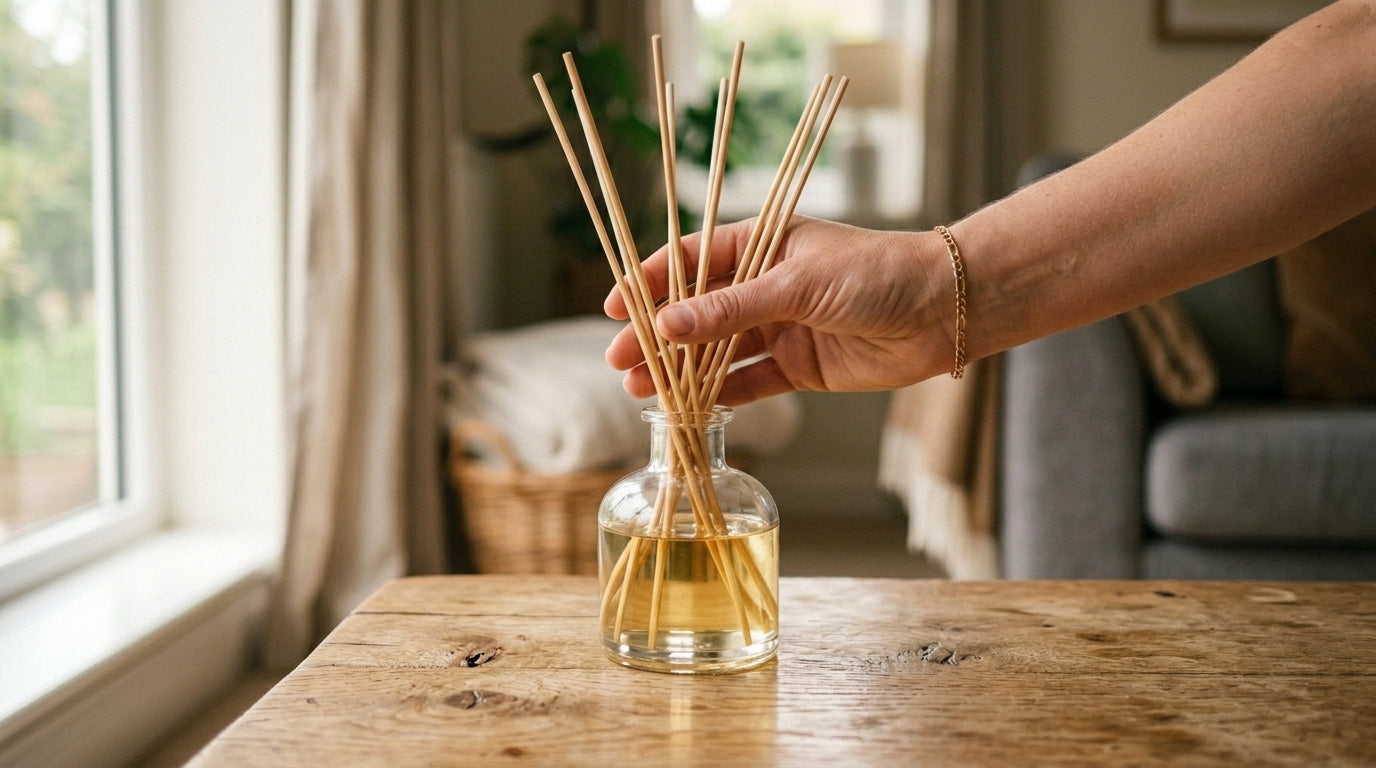
The same logic sorts every other delivery format by how much heat or water it introduces. A wax warmer or a heated melt sits in a similar temperature band to a candle without the flame, so it flatters heavy sweet material and quietly erases the snapped-stem facet that makes neroli recognizable in the first place. An ultrasonic diffuser adds no heat but adds a great deal of water, and dispersing a few drops into a visible mist softens the whole picture rather than any one part of it, so the note reads rounder and less defined. A reed diffuser sits at the other end of the scale: evaporation is passive and continuous, the lightest molecules leave the reeds first and are largely gone within days, and what remains in the bottle drifts steadily toward the heavier tail. That is why a reed set that opened green and bright often finishes woody and faintly sweet several weeks later.
Ranked by how much of neroli's opening actually reaches the room, the order runs cold-air atomization first, then a reed diffuser in its early days, then an ultrasonic mist, then anything heated. That is not a verdict on the other formats, which suit heavier compositions perfectly well. It is a statement about which parts of this particular note survive the trip, and neroli loses more than most notes do the moment heat enters the picture.
The history, the legend, and the modern trade
Every one of those delivery formats is recent. The material they carry is not, and none of the behavior described above is new either. Bitter orange blossom was being distilled centuries before any of this equipment existed, and in that time it has been named after a princess, built into an entire genre of scent, and traded as one of the scarcer commodities in perfumery. The last of those explains most of what the material costs today.
How the bitter orange reached the Mediterranean
Citrus aurantium is not a wild original species but a hybrid, generally understood to descend from the pomelo (Citrus maxima) and the mandarin (Citrus reticulata), with deep origins in south and southeast Asia. It traveled west through India and Persia, and its spread across the southern Mediterranean is usually attributed to Arab agricultural and trading networks around the ninth and tenth centuries. It reached al-Andalus in southern Spain and then Sicily, both of which had the climate and the irrigation knowledge to grow it well.
Seville became so identified with the fruit that the bitter orange is still called the Seville orange in English, and its high pectin content is why it remains the traditional marmalade fruit. The sweet orange, Citrus sinensis, arrived in Europe considerably later through Portuguese maritime trade in the fifteenth and sixteenth centuries. For several hundred years, when a European said "orange", they meant the bitter one.
The princess who gave the oil its name
The name is traditionally traced to Anne Marie Orsini, a late seventeenth century aristocrat who held the titles Duchess of Bracciano and Princess of Nerola, Nerola being a hill town northeast of Rome. The account, repeated in perfumery literature for centuries, holds that she made distilled bitter orange blossom fashionable at the Italian and later Spanish courts by scenting her gloves, her bathwater, and her stationery with it.
It is a good story and may well be substantially true, though the word neroli turns up in correspondence dated 1672, earlier than the legend allows for her introducing the material. The likeliest reading is that she made fashionable something already known rather than inventing it. Either way, the name of a small Italian town has been attached to a distilled flower oil for roughly three and a half centuries.
The cologne tradition
In 1709 an Italian-born distiller working in the German city of Cologne introduced a light spirit-based scented water that would define a genre. It was built on citrus oils, bergamot and lemon foremost, over a heart of neroli and petitgrain, with herbal touches such as lavender and rosemary, carried in high-proof grape spirit. Against the heavy animalic and resinous perfumery of the period, it was startlingly transparent.
The structure proved almost unimprovable. Three centuries later the citrus-plus-neroli skeleton is still the architecture of eau de cologne, and neroli does a specific job inside it: citrus oils alone are thin and gone within minutes, while neroli extends the citrus impression into something with floral body without adding weight or sweetness. It is a hinge, not a decoration.
Orange blossom and the bride
The association between orange blossom and weddings is old, geographically wide, and unusually well grounded in the botany. The bitter orange is evergreen, flowers profusely, and commonly carries blossom and ripening fruit on the branch at once, which made it a convenient emblem of enduring love and fertility together. The custom of the bridal wreath is generally traced through Spain into France and then Britain, and its popularity in the English-speaking world was cemented in 1840, when Queen Victoria married wearing a wreath of orange blossom. Fresh blossom could not be supplied year-round in a northern climate, which is why so many nineteenth-century brides wore crowns of molded wax instead.
The modern commodity story
Neroli is one of the more expensive materials in commercial perfumery, and the arithmetic is straightforward. Reported extraction yields cluster around 0.07 to 0.12 percent, which is the industry's polite way of saying that roughly a tonne of hand-picked blossom produces about one kilogram of oil. The flowers are picked by hand, ideally in the cool of early morning, and distilled quickly because they deteriorate fast off the tree.
Production is concentrated in North Africa. Tunisia, especially the Cap Bon peninsula around Nabeul, is widely described as the largest single producer, with Morocco a significant second and Egypt also contributing. Combined annual world output of true neroli is frequently reported somewhere between roughly one thousand and eight thousand kilograms depending on the source, a startlingly small number either way for a material this famous. The harvest window is four to six weeks in spring, orchards are often smallholdings picked village by village, and there is no mechanized shortcut: the blossom is taken by hand, picked selectively as the flowers open. A late frost or heavy rain during bloom moves the world price sharply.
Why the two blossom extracts sit at different prices
The same flower, picked on the same morning, gives two materials that do not cost the same, and the reason is less about prestige than about what each process recovers and what it costs to run. Steam distillation is the stingier route, sitting in the 0.07 to 0.12 percent band already quoted, with suppliers reporting a wide spread either side of it depending on the season. Solvent extraction generally recovers a little more, though by a much narrower margin than the gulf between the two smells would suggest. Published figures disagree enough that any single number should be read as one producer's experience rather than a constant, and they disagree on direction too: Arctander, the standard mid-century reference on natural raw materials, recorded the absolute yield as lower than the distilled yield and noted that the reason was not then understood.
What the absolute gains is not weight so much as breadth. Steam leaves the heavy, the polar and the water-soluble behind, and a good share of what it leaves behind is fragrant. Hexane does not discriminate, so the waxes, the indole, the methyl anthranilate and the heavier floral molecules all reach the concrete, and most of them survive the ethanol wash into the absolute. A wider range of the flower ends up in the bottle.
Price is where it becomes genuinely unsettled. For most botanicals that yield both an oil and an absolute, the distilled oil is the dearer of the two, precisely because distillation recovers less: rose is the standard illustration, with rose otto routinely quoted at a multiple of rose absolute. Orange blossom is repeatedly named as the material that breaks that rule. The catalogues bear that out only in part. Some houses price neroli comfortably above the absolute; others price a fine Moroccan absolute at several times the neroli. Grade, origin and harvest year move each material more than the extraction method does, so the two ranges overlap heavily and which one is dearer depends on the particular pair set side by side. Anyone stating it flatly in either direction is overreaching.
Two costs sit outside the yield arithmetic altogether, and they explain more of the gap than the yields do. Distillation is fuel-hungry and needs the flowers processed within hours of picking, so stills sit beside the orchards and run flat out for the few weeks of bloom. Solvent extraction runs at ambient temperature, which saves fuel, but it requires a recovery plant, a two-stage process and residual-solvent control, capital that a small orchard cooperative may not have. The distiller also has a second product the extractor does not: the water leaving the still is orange flower water, sold in volume for cooking and extractable again for orange flower water absolute. Some of what distillation appears to discard is recovered and sold.
Natural versus synthetic today
Given the price and the supply constraints, most products that advertise neroli are built on reconstructions rather than on neat distilled oil. Understanding how those reconstructions are assembled explains a great deal about why two things labelled neroli can smell so unalike.
There is no single synthetic molecule that smells like neroli. Nothing in a catalogue stands in for it the way vanillin stands in for vanilla. A neroli accord has to be built from the components the natural oil contains: linalool and linalyl acetate for the fresh-floral spine, nerol and neryl acetate for a sweeter petal quality, geraniol for a rosy edge, a green leaf alcohol for the snapped-stem opening, a trace of methyl anthranilate for the fruity dust, and in richer orange blossom accords a measured whisper of indole. Weak reconstructions collapse into generic sweet floral because they keep the sweetness and skip the green and metallic facets that give the note its identity.
The comparison runs like this. Natural neroli has a complexity no reconstruction quite reproduces, because it contains hundreds of trace compounds nobody has bothered to add back. It also varies by harvest, oxidizes over time, and costs a great deal. Reconstructions are consistent, affordable, and easier to build a product around. Well-made fragrances tend to use both.
The sustainability picture for neroli is comparatively benign. Harvesting blossom does not kill the tree, orchards are long-lived plantings, and the same trees yield petitgrain from prunings and bitter orange oil from the fruit, so one planting supports several income streams. The real problem in this corner of chemistry involved linalool: for decades it was extracted from the wood of tropical rosewood trees, which meant felling them, and Amazonian populations of Aniba rosaeodora were seriously depleted before the industry moved to coppiceable ho wood and to synthetic linalool. There, synthesis relieved pressure on a wild species rather than adding to it.
Notes that pair with neroli
Three companions do most of the work, and each solves a different problem.
Bergamot is the historically proven partner. It is a citrus with a floral-tea complexity of its own, so it extends neroli's opening rather than adding more zest, and together they form the backbone of the cologne genre. If you want the full picture of that note, including why it behaves so differently from lemon, the answer to what does bergamot smell like covers exactly that ground.
Jasmine is the counterweight. Where neroli is fast, green, and bitter-edged, jasmine is slow, warm, and indolic, and together they cover a far wider stretch of the evaporation curve, which is why the pairing still reads as floral an hour in.
Petitgrain and the woods supply dry structure. Petitgrain, neroli's sibling from the same tree, reinforces the stem-like quality, while cedar and vetiver give the composition a floor.
Where the orange family appears in our range
There is no neroli-led blend in our range. The blend that carries orange-family character is Citrus Grove, our citrus diffuser oil, which is built on peel and zest rather than blossom. It is a citrus composition, not a white floral, so it sits at the top of the volatility ladder rather than in the floral heart, and it behaves the way the two-hour timeline above predicts: fast arrival and a short tail. Kitchens, bathrooms, and entryways suit it for the same reasons they suit a neroli-style accord.
A 5-scent sample set can be assembled from the range, with a five-sample minimum. Bright compositions behave differently from room to room, since air movement, ceiling height, and soft furnishings all change how quickly a light note disperses.
Frequently asked questions
Is neroli the same as orange blossom?
Same flower, different materials. Neroli is steam distilled from bitter orange blossom and smells green, bright, metallic, and honeyed. Orange blossom absolute is solvent extracted from the identical flower and smells heavier, sweeter, and more animal, because solvent extraction keeps the indole and methyl anthranilate that distillation largely leaves behind in the water.
Does neroli smell like oranges?
No, and that is the usual misunderstanding. Neroli comes from the blossom, not the fruit, and flowers and fruit of the same plant often share very little aromatic chemistry. Neroli has a citrus brightness closer to peel oil than juice, but its dominant character is a green, honeyed white floral. For orange smell you want sweet orange or mandarin.
Why is neroli so expensive?
Arithmetic, not marketing. Reported yields sit around 0.07 to 0.12 percent, so roughly a tonne of blossom gives about a kilogram of oil. Flowers are hand-picked, ideally at dawn, and distilled quickly before they deteriorate. The harvest window runs only four to six weeks in spring, and estimates of world production run from about one thousand to eight thousand kilograms a year.
Which costs more, neroli or orange blossom absolute?
Sources disagree, and the honest answer is that it depends on the pair being compared. Steam distillation of the blossom is commonly reported at 0.07 to 0.12 percent and solvent extraction of the identical blossom between roughly 0.1 and 0.2 percent, so on the modern figures a tonne of flowers gives somewhat more absolute than oil, though Arctander recorded the opposite and could not account for it. In the catalogues some suppliers price neroli above the absolute and others price the absolute above neroli, with a fine absolute from a sought-after origin sitting at several times the price of a workaday distilled neroli. Grade, origin and harvest year move both materials more than the extraction route does.
Does neroli smell different in a candle than in a diffuser?
Noticeably different. A candle works from a wax pool at roughly 50 to 65 degrees Celsius, and heat sends the lightest molecules off first, so the green and metallic facets that define neroli are the first to thin out. What is left reads sweeter, softer, and more generically floral. Cold-air diffusion applies no heat and no water, so the opening arrives whole and the note keeps the bright green edge it has in the bottle.
How long does neroli last in a cold-air diffuser?
Less time than a woody or amber blend. Most of neroli's mass sits in molecules with molecular weights between roughly 136 and 196, which evaporate readily, so the note arrives within the first minute of a cycle and thins noticeably once diffusion stops. Only its sesquiterpene alcohols linger. Short, frequent bursts hold the character better than long runs.
Which rooms suit a neroli-style scent?
Bathrooms first, because hard surfaces and frequent air exchange favor a note that establishes itself quickly. Kitchens next, since the green and citrus facets work across cooking residue. Entryways, sunrooms, and breakfast rooms suit it too. Roughly 150 to 500 square feet is the comfortable range, and larger spaces want a heavier partner underneath.
Is petitgrain a cheaper substitute for neroli?
Far cheaper, since it comes from leaves and twigs rather than blossom, but not a substitute. Petitgrain is green, woody, dry, and bitter, with almost none of neroli's honeyed sweetness. Perfumers frequently use the two together, letting petitgrain reinforce the green stem quality while neroli supplies the flower. Alone, petitgrain reads herbal rather than floral.
What does orange blossom water smell like?
Orange blossom water, also sold as orange flower water, is the aromatic water left behind after neroli is distilled, and it smells softer, more aqueous, and gently sweet, holding the small water-soluble molecules the oil never captured. It is widely used in Mediterranean and Middle Eastern cooking, which is why many people associate it with pastry. Orange blossom water is far more delicate than neroli oil, and it is not a concentrate of it.
Does a neroli-forward blend change as the bottle ages?
Slowly, yes. The light terpenes that carry neroli's citrus lift, limonene and beta-pinene in particular, react with oxygen over time, so a bottle that has been open for many months loses some of its snap and reads flatter and slightly heavier than it did on the first day. Cool, dark storage with the cap closed tight slows that down considerably. Buying in smaller volumes helps too, since a bottle that gets used up in a season never has the chance to dull.