








Patchouli smells dark, earthy and woody: damp soil and dry cocoa, with a wine-like sweetness underneath and a faint camphor lift on top. Good modern patchouli reads clean and chocolatey rather than musty or dusty. It is a deep base note, quick to fill a room and very slow to leave it, and it can hold on fabric for days.
Almost everything people think they know about that smell comes from something other than the oil. The patchouli lodged in Western memory is patchouli set on fire: cheap 1970s material burned as incense, and combustion tears a heavy molecule apart and adds smoke and char before anything reaches the nose. It is not a mint either, despite the plant being a mint relative, because the small cooling molecules that define culinary mints are essentially absent from it. And it is not a period piece. Refined patchouli fractions sit at the center of the fruity, sweet, woody accords that have dominated the last twenty-five years of mainstream perfumery, so the people most certain they dislike it are frequently wearing it.
That gap between the reputation and the material is the whole story of this note. Say the word and half your audience pictures a beaded curtain and a dish of smoldering incense in 1971. The other half, if they read ingredient lists, knows that patchouli sits quietly inside an enormous share of the fragrances they actually buy. Both groups are right about something, and what separates them is that the patchouli that built the bad reputation and the patchouli used today are, in chemical terms, meaningfully different materials.
The short version
- Smells like: a few seconds of cool camphor and green stem, then damp earth, the wood of an old chest, and dry unsweetened cocoa that barely shifts for hours.
- The surprise: Kashmir shawls traveled to Europe packed in dried patchouli leaves against moths, and around 1830 the smell reportedly served as the test for a genuine import.
- The chemistry: heavy fifteen-carbon sesquiterpenes, mostly patchoulol at 25 to 40 percent for the body, while trace molecules such as norpatchoulenol carry the recognizable signature.
- Where it comes from: steam-distilled leaves of Pogostemon cablin, wilted and dried before the still, with Indonesia supplying 80 to 90 percent of world oil from smallholder plots.
- In a room: a cold-air diffuser builds it in roughly fifteen minutes, then it settles onto soft furnishings and releases for days, suiting 300 to 800 square feet.
- Improves with age: unlike citrus oils, it rounds out in storage as sharp fractions leave and alpha-guaiene oxidizes into peppery rotundone, so aged lots cost more.
What is patchouli? The quick profile
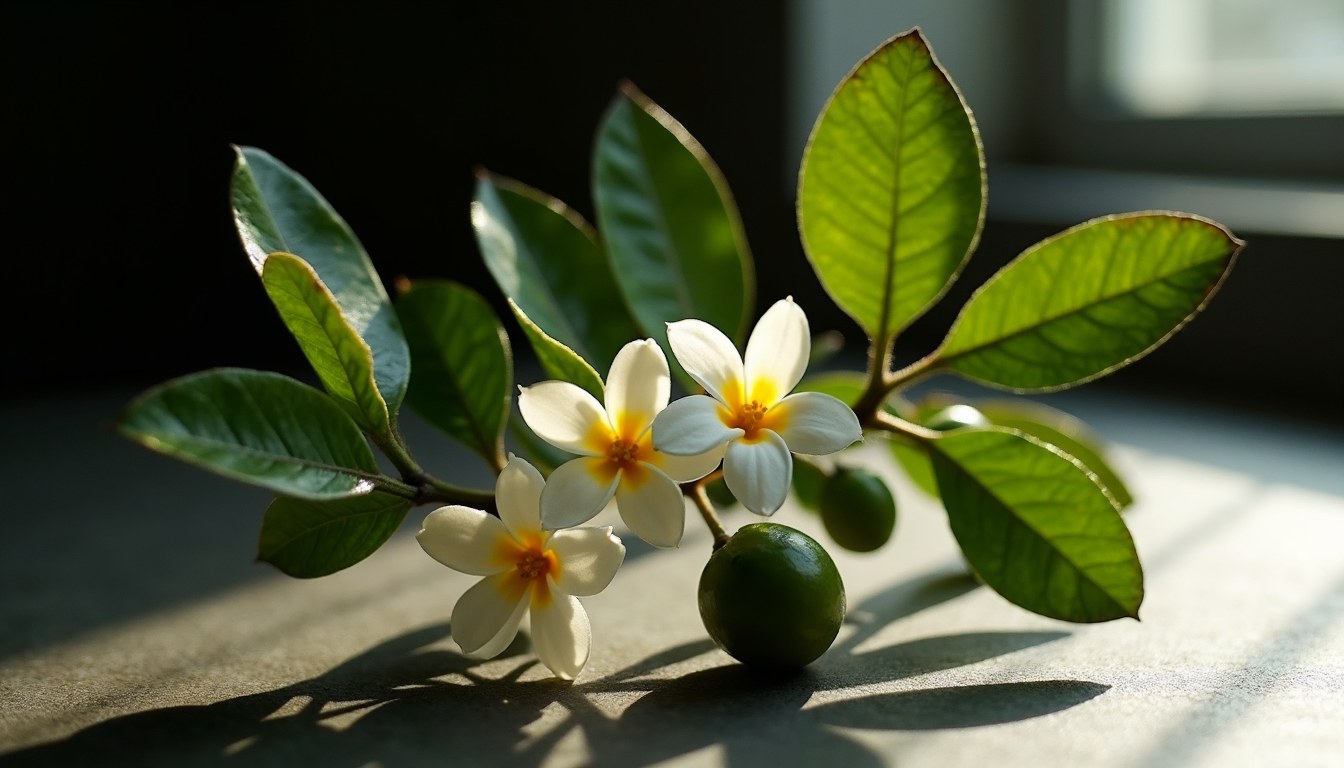
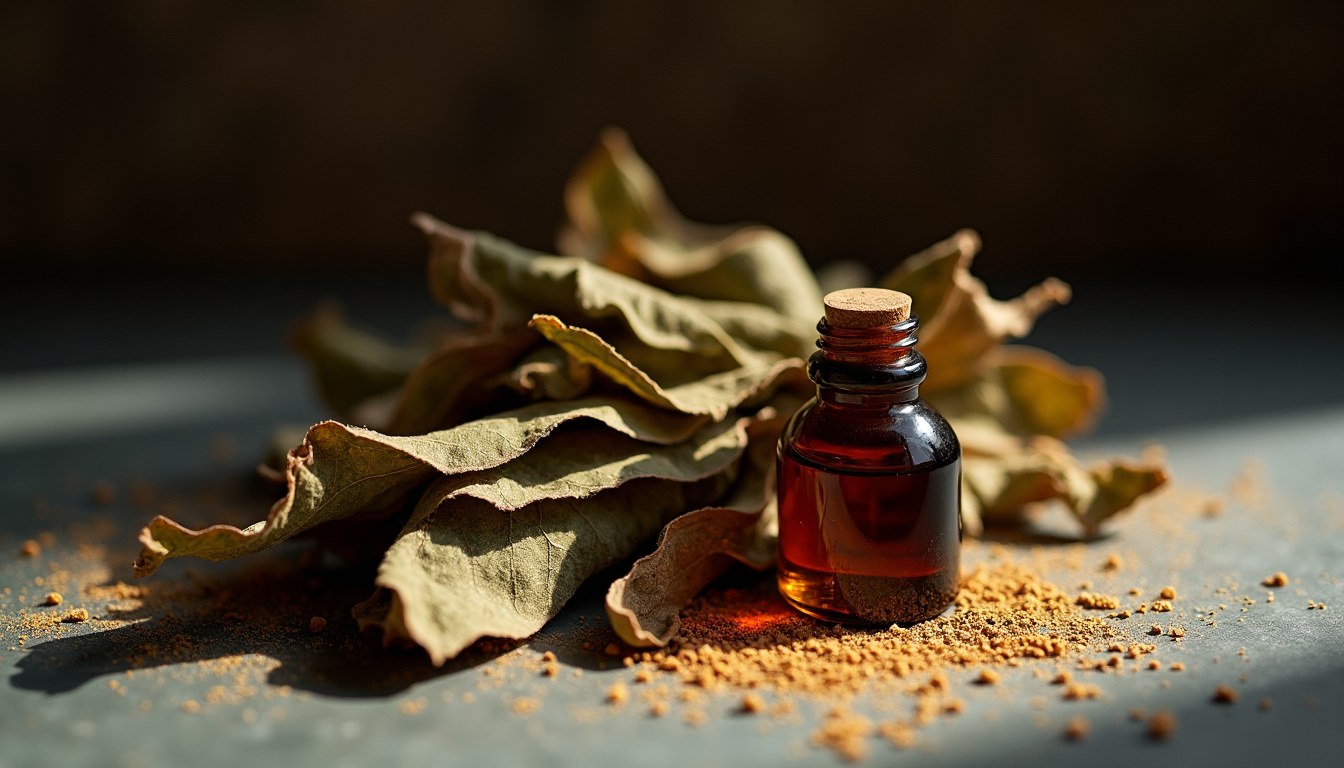
Patchouli is the distilled oil of the leaves of Pogostemon cablin, a soft, broad-leaved tropical shrub in the mint family. It grows roughly waist high, prefers hot humid conditions with plenty of rain, and is cut several times a year. Nothing about the living plant prepares you for the oil. The transformation happens after harvest, in a deliberate wilting and drying step, in many places followed by a spell of heaping and mild fermentation, which has no close equivalent in most other aromatic crops and which decides how much of the leaf's oil the still can reach at all.
In a composition, patchouli is a base note and among the heaviest in general use. It is structural rather than decorative: it holds other materials in place, gives a blend a floor to stand on, and supplies the shadow that makes brighter notes read as bright. If the vocabulary of woody, chypre and amber groupings is unfamiliar, our overview of fragrance families explains how those categories relate to one another and where a material like this one belongs.
- Family: woody, with earthy, balsamic and cocoa facets; a load-bearing member of chypre and amber structures
- Position in the pyramid: base note, among the slowest and most tenacious materials in common use
- Natural source: steam-distilled leaves of Pogostemon cablin (Lamiaceae, the mint family)
- Principal molecules: patchoulol, norpatchoulenol, alpha-bulnesene, alpha-guaiene, seychellene, pogostol
- Main growing regions: Indonesia above all (Sulawesi, Sumatra, Java), with production also in India and China
- Pairs with: sandalwood, vetiver, rose, vanilla, labdanum, citrus, oud
- Behavior in a room: full in the air within minutes, then keeps building on surfaces over days; extremely long-lasting, autumn and winter leaning
The scent, decomposed
The opening impression
Smell good patchouli straight from the bottle and the first thing that registers is not earth at all. It is a cool, slightly medicinal lift, a whisper of camphor and green stem that hits the front of the nose and vanishes within seconds. Fresh oil has more of this than aged oil. It is why people expecting a heavy brown smell are momentarily confused: the entry is sharper and cleaner than the reputation suggests.
Underneath that, arriving almost immediately, is the body of the material: dry, dense, mineral-earthy, with the specific quality of soil after rain rather than soil in a plant pot. There is wood in it, but not sawn timber. It is closer to the inside of an old wooden chest, or the bark side of a piece of cork. Running through it is a sweetness most people name as cocoa before anything else, unsweetened cocoa powder rather than milk chocolate, with a faint bitter edge.
The drydown
Patchouli barely has a drydown in the usual sense, because it barely goes anywhere. Most notes evolve because their lighter components leave first, and patchouli's components are almost all heavy. What you smell after six hours is close to what you smelled after twenty minutes, only warmer and rounder: camphor edge gone, earth softened, cocoa gaining ground. On fabric after a day or two, what remains is a low, dry, faintly sweet woodiness most people cannot name but recognize instantly.
The facet vocabulary
Professional descriptions of patchouli lean on a small set of recurring words, and each one points to something real in the oil. Earthy covers the damp-soil quality, the closest thing in fragrance to the smell of a forest floor. Camphoraceous describes the cool medicinal top, strongest in freshly distilled oil. Balsamic means the resinous, slightly sticky sweetness that sits between earth and wood. Cacao or chocolatey names the dry bitter-sweet facet that dominates well-refined material. Winey or fermented points at a fruity depth reminiscent of red wine lees. Musty and dusty are the negative descriptors, used for oil that is crude, poorly stored or badly distilled.
Learning to separate those facets is trainable, and it changes how a fragrance description reads. For a general method of putting language to what your nose is doing, our guide on how to describe a scent works through the same approach applied to any material.
What patchouli does not smell like
The misconceptions are specific, and each one has a traceable source.
It does not smell like mint. The plant is a mint relative, and people who learn that expect something cooling and green. The oil has none of that, because menthol and the other small cooling molecules of true mints are essentially absent. Patchouli's chemistry is built almost entirely from larger, heavier molecules, and the post-harvest curing step drives off much of what little fresh green character the leaf had while releasing the heavy fraction stored inside it.
It does not smell like cheap incense. The association most Western readers carry is not really an association with patchouli oil. It is an association with patchouli oil set on fire. Combustion does not lift a heavy material cleanly into the air; it breaks the molecules apart and adds smoke, char and the smell of whatever the stick itself is made of, so what reaches the nose from a burning incense stick has only a loose relationship to what was in the bottle. Diffused cool, the same material reads quite differently. The remembered smell is real. It is a memory of a burnt product rather than of the oil, and the history section covers where that product came from.
It does not smell like patchouli-scented mass-market soap. Much of what is labeled patchouli in inexpensive personal care is a reconstruction: a simplified accord of woody and earthy synthetics that hits the shape of the note without the depth or the cocoa. It is to real patchouli what grape candy is to a grape.
It is not inherently unclean. Patchouli is often called dirty, and the word does two jobs at once. Perfumers use "dirty" for a note with animalic or earthy weight that resists a soapy, laundered impression, which patchouli has. Everyone else means it smells like a person who has not washed. That second reading comes from patchouli's history as a scent used to cover other smells, not from the material.
It is not old-fashioned. This is the strangest part of the reputation. The refined fractions are structural in a quarter century of fruity-woody and sweet-woody releases, most of them bought by people who would never describe themselves as patchouli wearers. People who say they hate patchouli routinely own three fragrances built on it.
The chemistry: what actually makes patchouli smell like patchouli
Patchouli oil is unusual in being almost entirely sesquiterpenes. A terpene is a building block of plant scent assembled from five-carbon units; the quick-evaporating terpenes of citrus and pine have ten carbons. Sesquiterpenes have fifteen, and that extra mass changes everything: they are heavier, far less willing to evaporate, and they stay put. Patchouli is essentially a bottle of sesquiterpenes with a few oxygen atoms attached in the right places.
The chemical signature
Four molecules do most of the explaining, and it helps to have them in one place.
| Molecule | Formula | Molecular weight | Odor character |
|---|---|---|---|
| Patchoulol (patchouli alcohol) | C15H26O | 222.37 | Woody, earthy, balsamic: the body |
| Norpatchoulenol | C14H22O | 206.32 | Intensely patchouli at 1% or less |
| Alpha-guaiene | C15H24 | 204.35 | Faint alone; ages into rotundone |
| Rotundone | C15H22O | 218.33 | Peppery; forms on ageing |
The proportions are not in that block, and they are the striking part. Patchoulol is the single largest constituent of the oil and norpatchoulenol a trace, and yet the classical account credits that trace molecule with the note's identity. Rotundone belongs to the list for a different reason: it is barely present in fresh oil at all and arrives later, which the ageing section takes up.
Patchoulol, the principal odorant
The dominant compound is patchoulol, also written as patchouli alcohol. Depending on origin, harvest and processing, it typically makes up somewhere between 25 and 40 percent of the oil. It is a tricyclic sesquiterpene alcohol, meaning three fused carbon rings with a single oxygen-hydrogen group attached, and in pure form it is not a liquid at all but a white crystalline solid that melts at around 55 to 56 degrees Celsius.
Patchoulol was first isolated in 1869 by the chemist Gal, and its molecular formula was established shortly after by Montgolfier. Working out what that formula looked like in three dimensions took almost another century. In the early 1960s, George Büchi and co-workers proposed a structure from painstaking degradation work, and a synthesis appeared to confirm it. It later emerged that the synthesis had involved an unintended rearrangement of the carbon skeleton, so the confirming evidence was itself an artifact. The true structure was settled in 1963 by X-ray crystallography, in work by Dobler, Dunitz, Gubler and Weber with Büchi and Padilla. The molecule was awkward enough that chemists had to look at its crystal directly to believe it.
Patchoulol carries the woody, earthy, sweetly balsamic core of the note. It is also a fixative, meaning it slows the escape of the lighter materials blended with it, and this is not a matter of magic but of physics. Published figures for its vapor pressure at room temperature disagree by roughly a factor of four: the estimated value carried by the chemical databases is about 0.0003 millimeters of mercury, while a measured value of 0.14 pascals at 24 degrees Celsius works out at about 0.001. On either figure it sits well over a thousand times below a citrus terpene like limonene, which is around 1.5 millimeters of mercury at the same temperature. It simply does not want to become a gas.
Norpatchoulenol, the trace compound that punches above its weight
The classical account of patchouli's smell credits a much rarer molecule. Norpatchoulenol was reported in patchouli oil in the early 1970s by the French chemist Paul Teisseire and colleagues. The prefix "nor" in chemistry means a molecule missing one carbon relative to its parent skeleton, and norpatchoulenol is exactly that: a fourteen-carbon relative of the fifteen-carbon patchoulol. It is usually present at around one percent or less, a sliver of the patchoulol content, yet its odor detection threshold is so low that even that little registers strongly. For decades it was described as the character-impact compound of patchouli, the molecule that makes the smell recognizable as patchouli rather than merely woody.
That neat attribution has not survived unchallenged. A wide-ranging 2018 review of the published work on patchouli, drawing on several hundred papers and cataloging over seventy well-characterized compounds in the oil, sets the single-molecule story against a far more crowded picture. Several minor constituents have been shown to smell powerfully of patchouli in their own right, among them nortetracyclopatchoulol, first described at around one thousandth of a percent, though later work found it can occur at half a percent or higher. The current picture is less tidy and more interesting: patchoulol supplies the mass and the body, and a small committee of trace molecules supplies the signature.
The supporting cast
Beyond the alcohols, patchouli oil is loaded with sesquiterpene hydrocarbons that have relatively little smell on their own: alpha-bulnesene (often around 10 to 20 percent), alpha-guaiene, seychellene, the alpha and beta patchoulenes, and the alcohol pogostol. Seychellene takes its name from patchouli grown in the Seychelles, a long way from where the plant is native and one of several places it was once tried. These hydrocarbons matter enormously, but not for how they smell today. They matter for what they turn into.
Why patchouli improves with age
Almost every aromatic oil deteriorates in storage. Citrus is the standard example: its limonene oxidizes within months into harsh, sour compounds, and an old bottle of lemon oil smells like furniture polish gone wrong. Patchouli does the opposite. Freshly distilled, it is sharper, greener and more camphoraceous, with a raw edge perfumers dislike. Left in a partly filled container for a year, three years, ten years, it darkens, thickens and rounds out. Aged lots are sought after and priced accordingly.
Two things are happening at once. The light, sharp fractions evaporate away or convert, which raises the effective proportion of the heavy, sweet material. And the hydrocarbons oxidize into oxygenated compounds that smell far more interesting than their precursors. The clearest documented example is alpha-guaiene, which oxidizes in air at a specific position on its ring to form rotundone. Rotundone is the molecule behind the aroma of black pepper and of certain peppery red wines, and its odor threshold is exceptionally low, commonly cited at around 8 nanograms per liter in water, so vanishingly small amounts are detectable. Patchouli oil, in other words, leaves the still chemically unfinished. Time completes it.
Curing: why fresh leaf does not smell like patchouli
A fresh patchouli leaf does not smell like patchouli, and the gap is not a subtle one. Distill that leaf straight off the field and the yield is poor and the oil is thin. What turns one into the other is not the still. It is what happens to the cut plant in the days before it reaches the still, which determines how much of the leaf's oil the still can get at and which fraction of it comes over.
The three states the leaf passes through are worth separating, because the smell only arrives at the second of them and is only complete at the third.
| Stage | What happens in the leaf | What it smells like |
|---|---|---|
| Fresh leaf, from the field | Oil sealed in glands and inner cells | Thin, green, faintly herbaceous |
| Wilted and dried leaf | Membranes fail, cell walls crack | Sweeter, drier, recognizably patchouli |
| Cured leaf, distilled | Steam reaches the buried inner store | Dense and brown: earth, cocoa, camphor |
The reason sits in leaf anatomy. Patchouli keeps its volatile material in two quite different places. Some is held in glandular trichomes, the microscopic stalked and stalkless glands studding the leaf surface, reported to sit roughly twice as densely on the underside of the leaf as on the upper face. The rest is held inside the leaf, in internal cells rather than at the surface, and that interior store is described as the more sesquiterpene-rich of the two. Surface glands are easy: they rupture at a touch and steam carries off what they release. The interior is the problem. It sits behind intact cell walls and gland membranes that steam does not readily cross, so a still charged with fresh green leaf takes the accessible surface fraction and leaves much of the total behind. Published estimates put roughly half the available oil in that hard-to-reach interior.
Drying is what opens it. As water leaves the tissue the leaf loses turgor, membranes lose their integrity, and cell walls buckle and crack, turning a sealed compartment into a leaky one. The usual trade description is drying the cut herb over a few days down to somewhere in the region of 15 to 20 percent moisture, traditionally under shade rather than in open sun. The shade is not fussiness. Comparative drying trials repeatedly find sun-dried material yielding measurably less oil than shade-dried material from the same crop, on the order of a fifth less in some published comparisons, because the light volatile fraction leaves along with the water when the leaf is driven too hard. Reported figures move around with cultivar, climate and method, so those numbers are best read as indicative rather than fixed.
Fermentation is the second half of the process as it is usually described, and it is both gentler and less settled than the word suggests. Partly dried leaf is heaped, and the warmth and residual moisture in the pile let resident molds and bacteria work on the tissue, degrading the polysaccharides that build the cell wall. Calling that a fermentation is trade usage rather than strict chemistry: there is no sugar-to-alcohol conversion, and the review literature specifically reports finding no enzymatic action on stored non-volatile precursors, which had been an earlier hypothesis for where the smell came from. What is happening is a mild microbial loosening of plant structure.
Indonesian process work has tested it deliberately rather than leaving it to whatever happens to be living on the leaf, seeding piles with Rhizopus oligosporus, the mold used to make tempeh, at around two grams per kilogram of raw material, then running the pile for two, four, six, eight and ten days before distillation. Oil volume rose with fermentation time out to eight days and fell back by ten, while patchouli alcohol stayed above the 30 percent floor set by the Indonesian national standard, so the additional yield did not come at the expense of the compound buyers grade on. Past the optimum the pile begins consuming what it was meant to release.
Set against that, the 2018 review reports a comparison in which dried leaf and dried-then-fermented leaf gave the same yield, roughly two and a half times the yield from distilling fresh leaf, which puts the demonstrated work on the drying rather than on the microbes. The same review warns that fermentation can leave a moldy odor in the oil and treats it as a step to be careful with rather than a step to insist on. Sources genuinely disagree here. The defensible summary is that drying is the part with the clearest evidence behind it, heaping is traditional and may add yield when it is controlled, and the popular account of fermentation as the origin of patchouli's smell runs ahead of what has been measured.
The analytical evidence points the same way. Curing is often described as conjuring patchouli's smell out of a leaf that had none, and what has been measured is more modest than that. Thin-layer chromatography, as the same review notes, showed no qualitative change in the oil as a result of drying or fermentation, which points at curing acting on access and proportion rather than inventing new odorants wholesale. That is still enough to account for the difference. Freeing the buried, sesquiterpene-heavy interior while part of the light green surface material escapes to the air changes the ratio of what reaches the receiver, and ratio is most of what a nose reads. The fresh leaf is not withholding a secret so much as presenting the wrong fraction of itself, and curing corrects the balance before distillation begins.
Two consequences follow. Curing happens on the farm, carried out by smallholders working without instruments, and it sits among the main sources of lot-to-lot variation in patchouli oil, alongside cultivar, growing conditions, harvest age and distillation practice. Two neighbors cutting the same cultivar on the same day can deliver noticeably different material depending on how the leaf was dried, how long any heap sat and how wet it was when it went in. And dried leaf is far cheaper to move than fresh leaf, which is part of why distillation settled close to the fields rather than at the port.
From village stills to molecular distillation
Distillation itself has changed as much as the curing that precedes it. Traditional village distillation, historically carried out in crude iron vessels, produces a dark, viscous, opaque oil. Contact with iron leaches metal ions into the oil, which darkens it and can cause discoloration in finished products, so lighter grades are now distilled in stainless steel or glass. Reported iron content in light grades sits in the low parts per million.
Beyond that, much of the patchouli used in modern fragrance has been through molecular distillation, sometimes labeled MD. This is short-path distillation under very high vacuum: the oil is spread as a thin film on a heated surface, and the vapor travels only a few centimeters to a chilled condenser without colliding with other molecules on the way. Because separation depends on how far a molecule can travel rather than on boiling at atmospheric pressure, the process runs cooler and faster than ordinary redistillation, so heat-sensitive material survives intact.
What comes off is pale, sometimes nearly colorless, and dramatically cleaner. Molecular distillation strips out color bodies, non-volatile residues and much of the sharp, musty, "dirty" high end. What remains concentrates the patchoulol-rich heart: dry, woody, cocoa-forward, sweet, with the earthiness reduced to a suggestion. This material, and the still narrower heart fractions taken from it, is what powers the clean patchouli of contemporary perfumery. It is why a composition can carry a very high proportion of patchouli fractions and still read as fruit and wood rather than as patchouli, with no whiff of the 1970s about it.
The note in a home diffuser
How patchouli behaves in a room follows directly from that sesquiterpene chemistry, and the practical consequences are unlike those of any lighter note.
Why cold-air diffusion changes the rules
Because a cold-air diffuser atomizes neat oil rather than waiting for heat or evaporation to lift it, the usual gatekeeper on heavy molecules is removed: patchoulol enters the room whether or not it is willing to become a gas. For a material this heavy that is the whole difference. Methods that depend on a molecule volatilizing unaided deliver patchouli weakly, which is why the same composition reads far fuller here than it does through a reed or a wick.
Once airborne, physics reasserts itself. Patchoulol weighs 222 and barely evaporates at all; a citrus terpene weighs about 136 and leaves a surface well over a thousand times more readily, and the difference in behavior follows. The light molecule disperses as a true vapor, saturates the air, and is gone within the hour. The heavy molecule largely does not evaporate at all: it travels as micro-droplets, settles onto whatever it meets, and releases from those surfaces slowly over hours and days. Patchouli in a diffuser is not really a scent in the air. It is a scent on your room.
How the note unfolds in a room
What follows is a reasoned map rather than a laboratory measurement, derived from the relative volatility of patchouli's own constituents, so the time bands are approximate and a real room will stretch or compress them according to its temperature and air exchange.
The first minute or two. What reaches you first is the lightest material in the bottle: the camphoraceous top and the smallest of the sesquiterpene hydrocarbons, the same fraction responsible for the sharper entry of freshly distilled oil. The room reads sharp, green and slightly thin, and anyone waiting for the earth and the cocoa to arrive will assume the machine is underdosing.
Five to fifteen minutes. The camphor edge clears and the hydrocarbon bulk, alpha-bulnesene, alpha-guaiene, seychellene and their relatives, spreads through the room with the earth and cocoa building underneath it. This is the window to judge dosing by, because the note has assembled and what follows is redistribution rather than more of it.
One to two hours. Airborne concentration is now falling rather than holding. The atomized droplets have largely landed, and what is still reaching the nose is patchoulol and the other heavy alcohols releasing slowly from the surfaces they settled on. The impression goes quieter, drier and warmer, with the cocoa facet more prominent than the earth.
That evening and the days after. The note has moved out of the air and into the room. Soft materials hold the settled heavy fraction and give it back gradually, so a quiet, dry sweetness of wood outlasts the last run by a wide margin. There is no equivalent band for a citrus or a herbal blend, and it is the reason patchouli has to be judged over days rather than over an evening.
What that means in practice
First, it accumulates. Run a citrus-led blend on the same daily schedule and the intensity plateaus quickly, because what you added yesterday is gone. Run a patchouli-structured blend that way and day four is noticeably stronger than day one. Use short cycles at low intensity with generous off periods, and expect to reduce after the first week rather than increase.
Second, it binds to soft materials. Rugs, curtains, upholstery, bedding and clothing hold patchouli tenaciously and give it back for days, while wood, stone, glass and plaster release it far faster. A room with a large wool rug and heavy curtains reads patchouli-heavy long after the machine is off. A tiled entryway does not.
Third, the errors are asymmetric. A blend under-dosed with patchouli reads slightly thin, which you can fix in an hour. Over-dosed, it reads oppressive, and fixing that means airing the room, laundering textiles and waiting. Start lower than feels right.
Rooms and square footage
Patchouli-structured blends suit medium to large spaces with air movement and a good proportion of hard surfaces: open-plan living areas, entryways, stairwells, hallways, studies with wooden floors. Something in the range of 300 to 800 square feet at normal ceiling height gives the note room to distribute before it lands. Small enclosed rooms are the risk case. A 120-square-foot bedroom will saturate quickly, and because the note settles rather than disperses, that intensity persists.
Season matters more here than for lighter notes. In autumn and winter, with windows closed and lower air exchange, patchouli-led blends read as enclosure and depth, the room equivalent of a heavier fabric. Run the same blend in July with the windows open and air exchange strips the volatile lift, leaving the settled residue, which can read stale rather than deep. That is the real reason patchouli is seasonal in home scenting.
Layering and proportion
In a diffuser the working question is proportion rather than partnership, and patchouli takes a smaller share of a blend than its weight suggests. Because the atomized droplets settle and keep releasing for days, a ratio that reads balanced in the first hour can read heavy by the third evening, so a patchouli-structured blend is usually built with the anchor as a minority of the whole and the lighter materials carrying the opening. Which lever to move matters too: raising a citrus or a floral changes the first twenty minutes, while changing the patchouli changes the week. Whatever it sits under, give a new ratio three or four days in the actual room before judging it, since the partner materials clear the air on their own schedule while patchouli keeps arriving from the surfaces it has landed on. The partners themselves, and what each one does to the character of the note, are set out further down.
Versus other delivery methods
The same blend behaves differently depending on delivery. A candle's melt pool sits somewhere around 50 to 65 degrees Celsius, more than enough to drive light notes out fast, so a candle throws a top-heavy version of a composition early and burns through those top notes, while heavy base materials concentrate in the pool and dominate the final hours. Patchouli survives that heat well, which is why it is a favored candle base, and warmed in that pool it reads softer and sweeter than the same material does drifting cool through a room. What a candle cannot do is reach past the room it stands in, and it stops the moment you extinguish it.
An ultrasonic unit, which disperses a water mist rather than neat oil, struggles for a different reason: a heavy oil does not readily stay suspended in water. The droplets that leave the reservoir carry mostly water, the dense fraction tends to separate and sit on the surface instead of being carried up, and what reaches the room is a thinner reading of the blend than the bottle promises. A reed diffuser fails from the opposite direction. Capillary action lifts the small, mobile molecules up the reeds first, so a patchouli-structured blend gives away its citrus and its herbal lift over the first week or two while the heavy base concentrates in the remaining liquid and never really gets into the air at all. That is why the same composition can seem bright and short in reeds, balanced and long in a nebulizer, and warm and sweet in a candle without a single ingredient having changed.
One practical handling note
Blends high in patchouli are noticeably more viscous than light citrus or floral compositions, because patchoulol itself is a solid at room temperature and the oil around it is heavy. In a cold room, a viscous blend moves more slowly through the fine nozzle of a nebulizing diffuser and output can drop until the bottle warms. Keeping the unit at normal room temperature, rather than in an unheated hallway in winter, solves it.
The history: green leaf, packed shawls, and a trade that made the smell famous
Everything above concerns a bottle of oil in a room, which is the newest chapter of this material by a wide margin. For most of its history patchouli was not an oil at all but a dried leaf, and the language still records that. The English word arrived around 1845 and comes from Tamil, in which pachchai means green and ilai means leaf. The botanical epithet cablin derives from a Philippine vernacular name for the plant. Both scraps of etymology point at the same thing: this was a leaf people knew and used long before Europe had a word for the oil.
The plant is native to tropical maritime Southeast Asia and has been cultivated across South and Southeast Asia for centuries. Dried patchouli leaves were laid among stored cloth and clothing, a practice documented across the region, and Chinese texts recorded the leaf centuries ago under the name guang huo xiang. What was in circulation either way was the dried leaf itself. Distillation of the oil on any scale came much later, and it came because Europe wanted the smell rather than the leaf.
The shawls
The story that made patchouli a European commodity is one of the great accidents of fragrance history. From the late eighteenth century, Kashmir shawls, woven in fine goat fleece and decorated with the curved boteh motif, became an object of enormous desire in Britain and France. They traveled a long way by sea, and moths are fond of fine wool, so the shawls were packed for the voyage in dried patchouli leaves. By the time each one reached a drawing room in Paris or London it had absorbed the smell of its packing thoroughly.
European buyers had no idea what the smell was. They only knew that a genuine imported shawl had it. Domestic manufacturers were quick to chase the trade. The town of Paisley in Scotland produced its first Kashmir-style shawls around 1805, and Jacquard looms in the 1820s made complex patterns cheap enough for a middle-class buyer. The copies were convincing enough on the loom, but they failed a test nobody had designed: they looked right and smelled wrong. A shawl without that dense brown scent was immediately identified as a fake. For a stretch of the early nineteenth century, generally dated to the decades either side of 1830, the smell of patchouli reportedly worked as an authentication mark, and forgers had to acquire the leaves to pass.
Reports place the unmasking around 1826, when French perfumers traced the mystery scent to the crumbled packing leaves rather than to the fabric or any exotic dye. That turned a shipping consumable into a fragrance material almost overnight. Patchouli-scented handkerchiefs and shawls became fashionable, a vogue reportedly encouraged by the Empress Eugénie, and by mid-century the oil was distilled deliberately for the European market.
How Indonesia came to own the crop
Cultivation spread through the colonial tropics as European buyers chased reliable supply, with trials in the Seychelles, Malaya and the Philippines, while Singapore and Penang served as trading and distilling entrepôts. Over the twentieth century the center of gravity settled firmly on the Indonesian archipelago, and it has not moved since.
Indonesia is commonly reported to supply on the order of 80 to 90 percent of world patchouli oil, in the range of one to two thousand metric tons a year depending on the season and the price. The geography inside Indonesia has shifted over time. In the 1980s, Aceh, on the northern tip of Sumatra, dominated national production. Today Sulawesi is generally cited as the leading producing island by a wide margin, with Sumatra, Java and Kalimantan supplying the balance. Aceh still produces, and Acehnese oil retains a reputation for quality, but its share of national volume has fallen substantially.
The structure of the industry explains the price behavior. Patchouli is not a plantation crop the way oil palm or rubber is. It is grown overwhelmingly by smallholders, frequently on plots well under a hectare, often in rotation, and distilled in village-scale stills close to where it is cut. Trade relationships between farmer, distiller and collector are often informal, and credit is limited. When the price is high, farmers plant; the resulting glut crashes the price; farmers pull out; supply tightens and the price spikes again. Patchouli has run through several of these cycles, and the swings make headlines in the ingredient trade.
The 1960s and 1970s
The damage to patchouli's reputation was done across two decades. Patchouli oil in the 1960s and 1970s was cheap, widely available, and strongly associated with the East by young Westerners traveling overland to India and Nepal. It sold in small vials in head shops beside incense and other imported goods. What it was not, in that context, was good. The material was typically crude, sometimes adulterated, often stale, and frequently burned as incense rather than diffused.
The result is that an entire generation formed a lasting olfactory impression from a notably poor version of the material, then handed that impression on to the next generation as received wisdom. Meanwhile, in fine fragrance, patchouli never went anywhere. It had been a pillar of the chypre structure since the celebrated 1917 composition that gave the family its name, and it held the same position in woody and amber accords throughout. The counterculture and the perfumery trade were using two different grades of the same word.
Natural versus synthetic today
Grade is still the question that decides what patchouli smells like, and today it takes in material that never grew in a field. There is no single synthetic molecule that replaces patchouli. This distinguishes it sharply from a note like vanilla, where one compound, vanillin, does most of the perceptual work and can be made in a factory. Patchouli's character emerges from the interaction of a dominant alcohol, a supporting cast of hydrocarbons, and a scatter of powerful trace compounds. Reconstructions exist and are used in inexpensive functional products, but nobody in the fragrance trade pretends they match the oil.
Three things have genuinely changed the material, and only one is synthesis in the usual sense. The first is refinement: the molecularly distilled and heart-fraction grades described in the chemistry section, still the natural oil, just with parts removed. The second is isolation: patchoulol can be separated as a crystalline material and used alone for a simpler, more controllable woody-earthy effect. The third is biotechnology. Patchoulol is now also produced by fermentation, using engineered microorganisms fed on sugar rather than plants grown in a field, giving a consistent, pale, cocoa-clean character unaffected by weather or crop cycles. Such materials are used alongside the agricultural oil rather than instead of it: they deliver one facet cleanly, while the oil delivers complexity.
On sustainability, patchouli occupies a comfortable position. It is a fast-growing farmed herb, not a wild-harvested tree. The plant is ready to cut within months of planting and yields several harvests a year, so no ancient organism is destroyed to obtain it. That is a meaningful contrast with the slow-growing tropical hardwoods behind some other base notes, where supply pressure has driven real conservation problems.
The complications lie elsewhere. Patchouli is nutrient-hungry and usually rotated rather than grown continuously, so land use is more mobile than a plantation crop. Village distillation is often wood-fired, and still efficiency is an active area of development work. Because the plant rarely flowers or sets viable seed, it is propagated almost entirely from stem cuttings, so the global crop has a narrow genetic base and limited resistance to a new disease. And because growers are smallholders exposed to a volatile price, the social question is whether the people who grow it earn enough in a low year to plant again the next one.
Notes that pair with patchouli
Whichever grade ends up in the bottle, patchouli is rarely asked to work alone, and the partners it takes are consistent enough across compositions to be worth naming one by one.
Sandalwood is, in our experience, the easiest partner to work with. Where patchouli is dry, angular and earthy, sandalwood is creamy, lactonic and smooth, and the two occupy adjacent weight classes without competing for the same facet. The pairing is the backbone of a great many woody room blends, and it is the combination to reach for if patchouli alone reads too austere. Our companion piece on what does sandalwood smell like goes through that material in the same depth.
Oud is the more dramatic partner and the more demanding one. Both are heavy, both are tenacious, and both carry a fermented, slightly animalic depth, so together they compound rather than balance. Used carefully the result is a dense, resinous, leathery character with real presence; used carelessly it is simply a lot. If you are curious about the note that makes patchouli look restrained by comparison, our guide to what does oud smell like covers the botany and the supply story behind it.
Four other pairings deserve mention. Vetiver shares patchouli's earthiness but arrives from a rootier, smokier, grassier direction, and together they make a room read dry and severe. Rose is the classical counterweight, and the rose-patchouli accord is old enough to be a genre, richer and less powdery than rose standing alone. Vanilla, tonka and labdanum pull in the opposite direction, rounding the earth into the warm amber character most people are describing when they call a room cosy. Citrus, particularly bergamot and grapefruit, gives a patchouli blend the lift it cannot generate for itself, and that contrast between a sparkling opening and a dark floor is much of why chypre structures have lasted a century.
Where this note appears in our range
There is no standalone patchouli in the range. Alone in a room the note is heavy, one-directional and unforgiving of over-dosing, and its useful work is structural, sitting underneath other materials rather than leading.
It carries that structural role in the woody and amber-leaning blends among our diffuser oils, where it supplies the base that holds the lighter materials in a composition in place instead of letting them evaporate away unsupported.
The 5-scent sample set can be assembled from the woody and amber end of the range. Patchouli settles over days rather than minutes, so a run of several days in an actual room is the timescale on which it can be judged.
Frequently asked questions
What is patchouli made from?
Patchouli oil is steam-distilled from the leaves of Pogostemon cablin, a shrubby member of the mint family grown mainly in Indonesia. The leaves are cut, wilted and dried over a few days, and in many places they are then heaped for a short, mild fermentation before distillation. That curing step makes cell walls and gland membranes permeable and releases oil held deep inside the leaf, reported to be around half the total, which is why cured leaf gives far more oil than fresh leaf and gives a heavier fraction of it. Distilled fresh, the same leaf gives less oil and a thinner, greener one.
Why does patchouli have such a bad reputation?
Because a generation met it in its worst form. The patchouli sold in head shops in the 1960s and 1970s was crude, frequently stale or adulterated, and usually burned as incense rather than diffused. Modern fragrance uses refined and molecularly distilled grades that are pale, clean and cocoa-toned. The reputation is a memory of poor material, not an accurate description of the note.
Does patchouli smell like dirt?
It smells earthy, which is not the same thing. The closest everyday reference is damp forest soil or the inside of an old wooden chest, and in refined grades the earthiness sits well behind a dry cocoa sweetness. What people usually mean by dirt is the musty, dusty quality of oxidized or low-grade oil, which good material does not have.
Why does patchouli not smell like mint if it is a mint relative?
Two reasons. Its chemistry is built from large fifteen-carbon sesquiterpenes rather than the small cooling molecules like menthol that define culinary mints. And the post-harvest drying and curing shifts the balance away from whatever fresh green character the leaf had and toward the heavy fraction stored inside it. Botanical relationships track flower structure and genetics rather than smell, which is why the mint family ranges from lavender to oregano to patchouli.
Does patchouli oil really improve with age?
Yes, and it is genuinely unusual in that respect. Freshly distilled oil is sharper and more camphoraceous. Over months and years the harsh light fractions leave, and sesquiterpene hydrocarbons oxidize into heavier, more interesting compounds, including the peppery molecule rotundone formed from alpha-guaiene. Well-aged lots are sought after and cost more. Most other aromatic oils, citrus especially, degrade instead.
How long does patchouli last in a room?
Longer than almost anything else you can diffuse. In the air itself the impression fades over several hours, but patchouli settles onto soft furnishings and releases from them for days. Curtains, rugs and upholstery can hold a noticeable trace for a week or more. Plan for accumulation: short run times, low intensity, and adjust downward rather than upward.
Is patchouli a masculine or a feminine scent?
Neither, historically or currently. It was a nineteenth-century women's fashion in Europe, a unisex counterculture marker in the 1960s, and it is now a load-bearing material in fragrances marketed across every category. In a home context the question barely applies, since what a room reads as depends far more on what the patchouli is paired with than on the patchouli itself.
Is patchouli the same as vetiver?
No, though they are often confused because both are dark, earthy base notes. Vetiver comes from the roots of a tropical grass and reads rooty, smoky, grassy and dry. Patchouli comes from the cured and dried leaves of a mint-family shrub and reads earthier, sweeter and distinctly cocoa-like. Used together they reinforce each other, which is why blends rarely need much of either.