








Lavender smells herbal and floral at once: a soft, powdery sweetness sitting on top of a dry, green, faintly camphorous herb, with a hay-like warmth underneath. True lavender is rounder and sweeter than the sharp, soapy lavender of cleaning products, which is largely a simplified synthetic reconstruction built around a single molecule.
The lavender most people know is not really lavender. It is linalool, one cheap molecule standing in for a whole plant across detergents, softeners and surface sprays, and it carries none of the herb's green bite, camphorous edge or hay-like warmth. That is why so many people say they dislike lavender when what they actually dislike is a fabric softener, and why a steam-distilled oil from a high field in Provence so often reads as unfamiliar rather than as the original. The distance between the two is the whole story of this note: what lavender actually smells like, the molecules responsible, why one species smells sweet and its close cousin smells like a cough drop, and how the note behaves in cold-air diffusion.
The short version
- Smells like: a cool green herb with a mineral edge and a camphorous sting, sweetening within minutes into powdery pear-skin softness, then drying down to hay.
- The surprise: the purple fields of Haute-Provence are a twentieth-century invention, since the plant was gathered wild off high stony slopes until organized planting expanded between the wars.
- The chemistry: linalool and linalyl acetate make up half to four fifths of the oil, while camphor, at half a percent to one percent, decides whether it reads fine or medicinal.
- Where it comes from: Lavandula angustifolia, a woody shrub in the mint family, with Bulgaria its largest single origin for over a decade while France grows mostly lavandin.
- In a room: noticeable a minute or two into a cold-air cycle, roundest at five to fifteen minutes, largely gone by the one to two hour mark, best in 60 to 300 square feet.
- Often confused with: lavandin, the sterile hybrid propagated from cuttings that carries several times the camphor and is almost certainly the plant behind any supermarket lavender scent.
Lavender at a glance
Lavender is the anchor of the aromatic family, the group of scents built on herbs and garden plants rather than flowers, fruit or wood. It also sits at the center of the fougère tradition, a nineteenth-century structure that pairs lavender with mossy and coumarinic materials to make something green, dry and slightly bitter. Perfumers treat it as a heart note with unusual reach into the top: it announces itself almost immediately but does not carry a composition for hours. If the way these categories are drawn is new to you, our overview of fragrance families lays out where the aromatic group sits relative to the florals, the woods and the orientals.
The plant is a woody perennial shrub in the mint family, Lamiaceae, which is the first clue to why it smells the way it does. Lavender is a cousin of rosemary, sage, thyme and mint, and carries the family resemblance: the same cool, resinous, slightly bitter green. It is a herb that happens to flower prettily, not a flower that happens to be herbal. Almost every misunderstanding about lavender comes from expecting the second and receiving the first.
- Family: aromatic, with fougère and herbal-floral adjacencies
- Position in the pyramid: light heart note with top-note speed, fading well before the base materials
- Botanical source: chiefly Lavandula angustifolia (true or fine lavender), with Lavandula latifolia (spike lavender) and the hybrid Lavandula x intermedia (lavandin) as separate commercial materials
- Extraction: steam distillation of the flowering tops; hydrocarbon solvent extraction for the concrete and absolute
- Key molecules: linalool and linalyl acetate as the dominant pair, plus camphor, 1,8-cineole, terpinen-4-ol, borneol, lavandulyl acetate and, in the absolute, coumarin
- Strength: moderate to high in the first hour, low persistence, diffusive rather than tenacious
- Pairs with: citrus above it, soft woods and vanillic materials below it, other herbs alongside
The scent, decomposed
The opening impression
Bring a strip dipped in good fine lavender oil to your nose and the first thing that arrives is not floral at all. It is cool and green and slightly stinging, the way crushed rosemary is stinging, with a mineral edge like wet stone. A second later a sweetness comes up underneath, and this is the part people recognize as lavender proper: light, fruity, faintly pear-skin, powdery around the edges. The two arrive nearly together, which is why lavender resists a one-word description. It is sharp and soft at once.
The sharpness is camphor and its relatives. The sweetness is linalyl acetate. The powder is linalool. The proportions of those three decide almost everything about whether a given lavender smells expensive or smells like a disinfectant, and the rest of this article keeps returning to that ratio.
The drydown
Lavender's evolution over an hour is quick and quite dramatic. The cool camphorous top burns off first, usually within ten to twenty minutes on a blotter, leaving something rounder, warmer and more agreeable to most noses: a soft herbal-floral middle with a distinctly hay-like character, dry and sweet the way a barn in late summer is sweet. Some people read that stage as tobacco, some as chamomile, some as old books. In a fine oil it also picks up a faint balsamic weight before disappearing entirely.
Lavender absolute, made by solvent extraction rather than steam distillation, exaggerates that final stage. It is dark green, viscous and much less airy, with the hay front and center, the herbal top muted, and a savory, almost broth-like quality that surprises people who have only met lavender in laundry. Perfumers reach for the absolute when they want lavender to sit down, and the distilled oil when they want it to lift.
The facet vocabulary
Professional evaluators break lavender into facets rather than treating it as one smell. The vocabulary makes the note far easier to recognize inside a blend, and far easier to describe once you have recognized it.
- Herbaceous green: the crushed-stem, garden-bed quality shared with rosemary and sage
- Camphorous: cool, sharp, penetrating, the facet that dominates cheap lavender and spike lavender
- Floral-powdery: the soft, faintly dusty sweetness most people mean when they say "lavender"
- Fruity: a light pear and bergamot-adjacent sweetness contributed by linalyl acetate
- Coumarinic or hay-like: dry, sweet, new-mown-grass warmth, strongest in the absolute
- Balsamic-woody: a faint resinous weight at the very end of the drydown
- Soapy-clean: not native to the plant so much as learned from decades of household products, but real in the way most people perceive the note
What lavender does not smell like
Here is the uncomfortable part, and it deserves the long version. Most people in the English-speaking world have never smelled the plant. They have smelled one of its molecules.
Linalool is a single terpene alcohol, and one of the most widely produced aroma chemicals on earth. Commonly reported figures put annual global production well over ten thousand tonnes, the large majority synthetic, and it turns up in a vast share of scented consumer goods: detergents, softeners, shampoos, surface cleaners, air fresheners, soap. On its own it smells floral, slightly citric, a little woody and above all clean. It does not smell herbal. It does not smell of hay. It has none of the camphorous bite or savory depth of the real plant.
When a manufacturer needs a lavender smell at a fraction of a cent per unit, the practical solution is linalool plus a little linalyl acetate, sometimes with a green note and a synthetic coumarin on top. That accord is cheap, stable in bleach and surfactants, and instantly legible. It is also a caricature: a lavender with the difficult parts removed. Two or three generations have learned the word from it, which is why the honest reaction to real fine lavender is so often confusion. People call it too strong, too green, too much like a plant.
So, specifically: real lavender does not smell like clean laundry. It does not smell purple, sugary or candied. It is not a soft floral in the way rose or jasmine is, and nowhere near as sweet. It does not smell like a bar of soap, though a bar of soap may well smell like a small piece of it. And it is not, at first contact, a comfortable smell. It is a bracing one that turns comfortable fifteen minutes later.
The flip side is worth saying too. Real lavender is not the harsh camphor blast people associate with old drawer sachets. That impression usually comes from lavandin, a different plant, or from oil that has aged badly. Good fine lavender is sweet, round, gently fruity and far softer than its reputation. Both impressions, too soapy and too sharp, are prejudices about substitutes.
The chemistry
Four molecules do most of the work in lavender, and it helps to have their weights and boiling points in one place before the prose turns to what each of them actually smells like. The boiling points below are the ordinary atmospheric-pressure figures rather than the lower numbers a laboratory records under vacuum, and camphor is given as a range because the published values for it disagree.
| Molecule | Formula and weight | Boiling point |
|---|---|---|
| Linalool | C10H18O, MW 154 | 198°C, 388°F |
| Linalyl acetate | C12H20O2, MW 196 | 220°C, 428°F |
| Camphor | C10H16O, MW 152 | 204 to 209°C, 399 to 408°F |
| Coumarin | C9H6O2, MW 146 | 301°C, 574°F |
Coumarin is the odd one out in that list: it is the lightest of the four by weight and yet a solid at room temperature, which is why it behaves nothing like the other three once the oil is in the air. What each one smells like is the business of the sections that follow.
The dominant pair
Steam-distilled oil of Lavandula angustifolia is a two-molecule story with a supporting cast. Linalool and linalyl acetate together typically account for somewhere between half and four fifths of the oil. The international standard for the material, ISO 3515, has historically specified linalool in the region of 25 to 38 percent and linalyl acetate around 25 to 45 percent, with bands for the secondary markers around them, and the European pharmacopoeial limits sit close to those numbers. Those two figures, and the relationship between them, are what a buyer looks at first.
Linalool is the powdery, floral, faintly citric backbone. Linalyl acetate is the ester version of the same skeleton, and esters as a class smell sweeter and fruitier than the alcohols they come from. Linalyl acetate is what makes lavender pretty: the pear-skin fruitiness, the roundness, much of the perceived quality. As a rough rule, the higher it runs relative to everything else, the sweeter and more expensive the oil smells.
Camphor, the quality marker
Camphor is the molecule that separates fine lavender from everything pretending to be it. In an oil meeting the true-lavender standard, camphor sits at roughly half a percent to one percent. That trace is not a flaw. It is part of what makes lavender smell like lavender rather than a generic floral, and it gives the top its cool lift. But camphor is loud out of all proportion to its concentration. Push it to three or four percent and the oil stops smelling like a flowering herb and starts smelling like an ointment.
This is exactly where lavandin parts company with true lavender: the hybrid routinely runs camphor several times higher, which is why the species named on a label tells you more about the smell than any other single word on it. Three plants are sold under the lavender heading, and camphor is the line between them.
| Species | Camphor level | Character | Mostly used for |
|---|---|---|---|
| True lavender (L. angustifolia) | Very low, 0.5 to 1% | Sweet, round, fruity, softly herbal | Fine fragrance, single-origin oils |
| Spike lavender (L. latifolia) | High, with high 1,8-cineole | Cool, sharp, eucalyptus-like | Functional scent; parent of lavandin |
| Lavandin (L. x intermedia) | Several times true lavender | Loud and clean, medicinal edge | Soap, detergent, supermarket scent |
Two other markers ride alongside camphor in all three plants: 1,8-cineole, the molecule that makes eucalyptus smell like eucalyptus, capped low in fine lavender, and borneol, a cooling, slightly woody alcohol related to camphor. When the three climb together, the whole material sharpens.
Why altitude changes the smell
There is a long-observed relationship between where lavender grows and how it smells, and the trade treats it as settled. Lavandula angustifolia grown high, roughly above 800 meters and traditionally much higher in the Provençal massifs, tends to yield oil with more linalyl acetate and less camphor than the same species grown low. Put it in a warm valley and the camphor climbs while the ester falls. Put it on a cold, stony, sun-hammered plateau and you get the sweet, round, low-camphor oil the French appellation system was built to protect.
The plant is adjusting its chemistry to its conditions, and the practical consequence is simple: altitude and sweetness travel together. That is why fine lavender from the high plateaus is sold at a premium over lowland material, and why one botanical species can smell like two different plants depending on the field it came from.
What altitude is really standing in for is temperature and water. Linalyl acetate is an ester, built inside the flower's oil glands by acetylating linalool as the spike develops, and it accumulates late. Camphor, borneol and 1,8-cineole come off a different branch of the same monoterpene pathway, the cyclic branch, and they are the compounds that tend to climb when the plant is working hard. Heat and water stress are generally reported to shift terpene output in this plant family toward those cyclic, camphorous materials, although published lavender trials are not perfectly consistent about the size of the effect and in some cases not about its direction either. A high plateau supplies the opposite set of conditions: strong daytime sun for oil yield, cold nights, thin stony soil, and a short season that finishes slowly. A hot low valley supplies the first set.
It is worth being careful about how much credit elevation itself deserves, because the research is a good deal less tidy than the trade's shorthand. One study that collected wild alpine populations of the species across an elevation gradient and then grew them all under identical conditions found no significant differences in oil constituents attributable to altitude at all. Latitude did register in that work: the populations from further off the Mediterranean carried markedly less linalool, around 21 percent against around 30 percent, and far more 1,8-cineole, around 6 percent against around 1 percent, while linalyl acetate was unaffected. Genotype, plantation age and the exact day of harvest all move the balance too. Trials on harvest timing put linalyl acetate at its highest around full bloom and linalool at its highest at the end of flowering, and oil content and linalool both climb by the third year of a plantation. So two neighboring fields cut a week apart can differ more than two fields a thousand meters apart cut on the right morning. Altitude is a dependable proxy rather than a mechanism. The mechanism is a cool, unhurried plant, grown hard on poor ground, cut at the moment the ester is highest.
Coumarin and the hay
The hay-like warmth in the drydown, and especially in the absolute, comes largely from coumarin and its close relative herniarin, formally 7-methoxycoumarin, which carries a methoxy group on the same coumarin skeleton. Coumarin is the smell of cut grass drying in the sun, of tonka bean, of sweet clover. Lavender carries it as bound precursors in the plant material, and solvent extraction liberates far more of it than steam distillation does; analyses of lavender absolute have reported coumarin from roughly two percent up into the mid-teens, a remarkable figure for a single trace molecule.
That is the chemical reason the absolute smells so much warmer and hayier than the distilled oil. It also explains the link between lavender and the fougère structure, which is essentially lavender plus coumarin plus mossy materials. Lavender already contains the second ingredient. The fougère builders amplified something the plant was doing on its own.
Two linalools, not one
Linalool is chiral, meaning it exists as two mirror-image forms that are chemically identical and smell noticeably different. The left-handed form, historically called licareol, dominates in lavender and reads as woody, lavender-like and cool. The right-handed form, called coriandrol because it dominates in coriander seed oil, is sweeter, more floral and more citric. Trained noses distinguish them readily, though sensitivity varies from person to person, a good reminder that odor perception tracks molecular shape and not composition alone.
Cheap synthetic linalool is usually a roughly even mixture of both forms, because the industrial routes do not favor one over the other. That is part of why a synthetic lavender accord smells subtly generic even when the ingredient list looks right: half the linalool is the wrong-handed molecule, contributing coriander-like brightness where the natural oil would contribute cool wood. Laboratories use this in reverse, running chiral gas chromatography to see whether a sample of "lavender oil" shows the handedness a plant produces or the even split a reactor produces.
Who isolated it, and how it is made now
Linalool was first isolated in the 1870s, commonly dated to 1875, from bois de rose oil out of French Guiana, the distilled wood oil of the tree Aniba rosaeodora. The name licareol attached to it early. The structural work that established what the molecule actually was is credited chiefly to French chemists of the 1890s, with Philippe Barbier prominent among them, and the first laboratory synthesis is generally dated to around 1919.
Industrial production today runs on two main routes, neither involving a plant. One begins with alpha-pinene from pine and turpentine sources, hydrogenating it to pinane, oxidizing that to a hydroperoxide, reducing it to pinanol and thermally rearranging the result. The other is fully petrochemical, building the carbon skeleton up from acetone and acetylene through steps that also feed the manufacture of citral, geraniol and nerol. Linalool sits at a junction in industrial terpene chemistry, which is a large part of why it is so cheap.
Those routes explain the smell of the modern material. Synthetic linalool is very pure, carries none of the several hundred trace constituents a distilled lavender oil brings with it, and arrives as a mixture of both mirror forms. It smells clean, floral and slightly flat, exactly as you would predict from a single compound with no supporting cast. The complexity people respond to in real lavender lives in the last five percent of the oil: the trace esters, the lavandulyl acetate, the terpinen-4-ol, the sesquiterpenes, the tiny quantity of camphor.
The note in a home diffuser
Almost everything written about lavender assumes it is going into a candle or a warmer. Cold-air diffusion is a different physical process, and lavender behaves differently in it.
Why volatility governs everything
Because cold-air diffusion atomizes the oil rather than heating it, every constituent leaves the bottle in roughly the proportion the blender chose. For many notes that is a technicality. For lavender it decides the entire impression, because lavender's working molecules sit unusually close together in weight and unusually far apart in character, so any process that sorts them by volatility before they reach the room pulls the note out of shape.
What the boiling points in the chemistry table govern, then, is not what leaves the machine but what happens next, once the oil is airborne and the room begins to empty. Linalool and camphor sit within about ten degrees of each other, both in the region of 200°C, so they thin out of the air at close to the same rate and set the first impression jointly, one powdery and one sharp. Linalyl acetate boils higher, near 220°C, so it clears more slowly than either of them; the sweetness reads as arriving a beat behind the sharpness because the sharp material thins first, not because the sweet material started late. Coumarin is the outlier at the other end, a solid at room temperature that boils near 300°C, so it hangs in the air long after the others have gone. Compare a real base note. The santalols responsible for sandalwood are considerably heavier than any of lavender's four and far less volatile at room temperature, which is why sandalwood is still faintly present in a room hours after lavender has left it. Lavender's working molecules are heart-note weights with close to top-note evaporation behavior, and the consequence follows. It arrives fast and leaves early.
How it throws, and for how long
In a cold-air cycle lavender is usually one of the first things you notice, within a minute or two of the machine running, and it reaches the far side of a room quickly. It spreads rather than persists: it fills space efficiently at low concentration but does not hang around.
Because lavender's constituents leave the air in a predictable order, the note unfolds in a room as a sequence rather than as a single smell. What follows is a map of a continuous run in a still room, reasoned from the relative volatility of lavender's own constituents rather than measured in a laboratory, so the bands are approximate and your room will shift them.
- 0 to 2 minutes: the lightest material leads, the cineole-type molecules and whatever ocimene the oil carries, with linalool and then camphor arriving close behind them. The room reads cool, green and crushed-stem, sharp at the edges, barely floral yet.
- 5 to 15 minutes: the sharp top thins as the lightest material clears, and linalyl acetate, which needs more heat to leave than either camphor or linalool, becomes proportionally louder. This is the sweet, powdery, faintly pear-skin phase most people mean when they say lavender, and it is where the note is at its roundest in a room.
- 1 to 2 hours and beyond: the ester and the alcohol have largely gone. What is left is the slowest material in the mix, the coumarinic hay note, which steam distillation carries only in traces, so it is faint and depends on heavier bases underneath to register at all. With ordinary air exchange there is often nothing left to find.
Once the machine stops, the same ordering governs how the room empties. Expect the green, camphorous top to be gone ten to twenty minutes after that point, the sweet herbal heart to persist another half hour to an hour, and after that only a faint hay-like ghost, and only if heavier materials are holding it in place. Air exchange does most of the deciding at that last stage: a closed room with still air holds the herbal heart noticeably longer than the same room with a fan running, a window cracked or a forced-air vent cycling, which is a large part of why two people describe the same blend's staying power so differently.
The scheduling implication is that lavender rewards short, frequent intervals over long continuous runs. A pattern of a couple of minutes on and fifteen or twenty minutes off suits it well: each burst re-establishes the note before the previous one has cleared, keeping the impression continuous without letting concentration build until the camphorous facet turns sharp. Lavender is easy to overdo, because your nose adapts to it faster than the oil clears the room.
Rooms and square footage
Because it throws readily and does not accumulate heavily, lavender suits small and medium rooms better than open-plan volumes. Bathrooms, laundry rooms, linen closets, dressing rooms, guest bedrooms and home offices are its natural territory, roughly the 60 to 300 square foot range where a light, fast note does not have to work hard to be present. The laundry and linen entries on that list are the oldest placements of all, older by centuries than any machine, and the history further down explains how they got there.
In an open living area of 600 square feet or more, straight lavender tends to disappear too quickly to justify itself. There it works better as a supporting player inside a blend with real base weight underneath, giving the top a green lift while something heavier does the work of persistence. The atmosphere it creates in the right room is worth naming: quiet, domestic, orderly, pleasantly old-fashioned.
Why lavender is better cold than hot
With this particular note the gap between cold air and heat is easy to hear, because heat does two things to lavender and both work against it.
First, it sorts the molecules. A candle flame or a heated plate creates a temperature gradient that drives the lowest-boiling constituents off first and fastest. In lavender the cineole-type molecules go first, with linalool and then camphor close behind, and the linalyl acetate that carries the sweetness boils higher than any of them, so it is the last of the group to be driven off. Heated lavender therefore leads with its sharpest facets, while the roundness that should balance them arrives late and weakened. A lavender that smells lovely on a blotter can smell like an ointment over a hot wax pool for exactly this reason.
Second, heat and time accelerate oxidation. Linalool is an unsaturated alcohol that reacts with atmospheric oxygen, converting into oxides and related products that smell flatter, more papery and vaguely stale-woody. Nothing in a cold-air cycle cooks the oil, so what reaches your nose is closer to what was in the bottle. For the same reason, keeping the bottle capped and out of sunlight matters more for lavender-forward blends than for woody ones.
Layering it
Lavender is a generous blending partner because its shape is unusual: a green top, a floral heart and a hay-like tail in one material, so it bridges families that otherwise clash. Put citrus above it and lavender becomes the structure that keeps the citrus from evaporating into nothing. Put soft woods, vanillic materials or musks below it and the hay-like drydown gets something to hold onto, which extends how long the impression lasts in a room. Set it alongside rosemary, sage or mint and you get the Mediterranean hillside effect, dry and bracing, fresh without being soapy. What lavender resists is heavy sweetness and heavy spice met on equal terms, where its green facet turns slightly metallic. Warm spice works only when the lavender clearly leads and the spice sits behind it as a shadow.
The history
Those pairings are not new discoveries, and neither is the list of rooms above them. Almost every use lavender is put to now, in a blend, in a diffuser, in a cupboard, is inherited from somewhere, and this is one of the few materials in perfumery whose modern reputation was set almost entirely by its past. The soapy shorthand, the association with laundry, the fougère structure itself: all of it comes out of a long domestic history rather than out of any recent decision about how the note should be used. The word is the place to start, because the word carries the argument.
A name built on washing
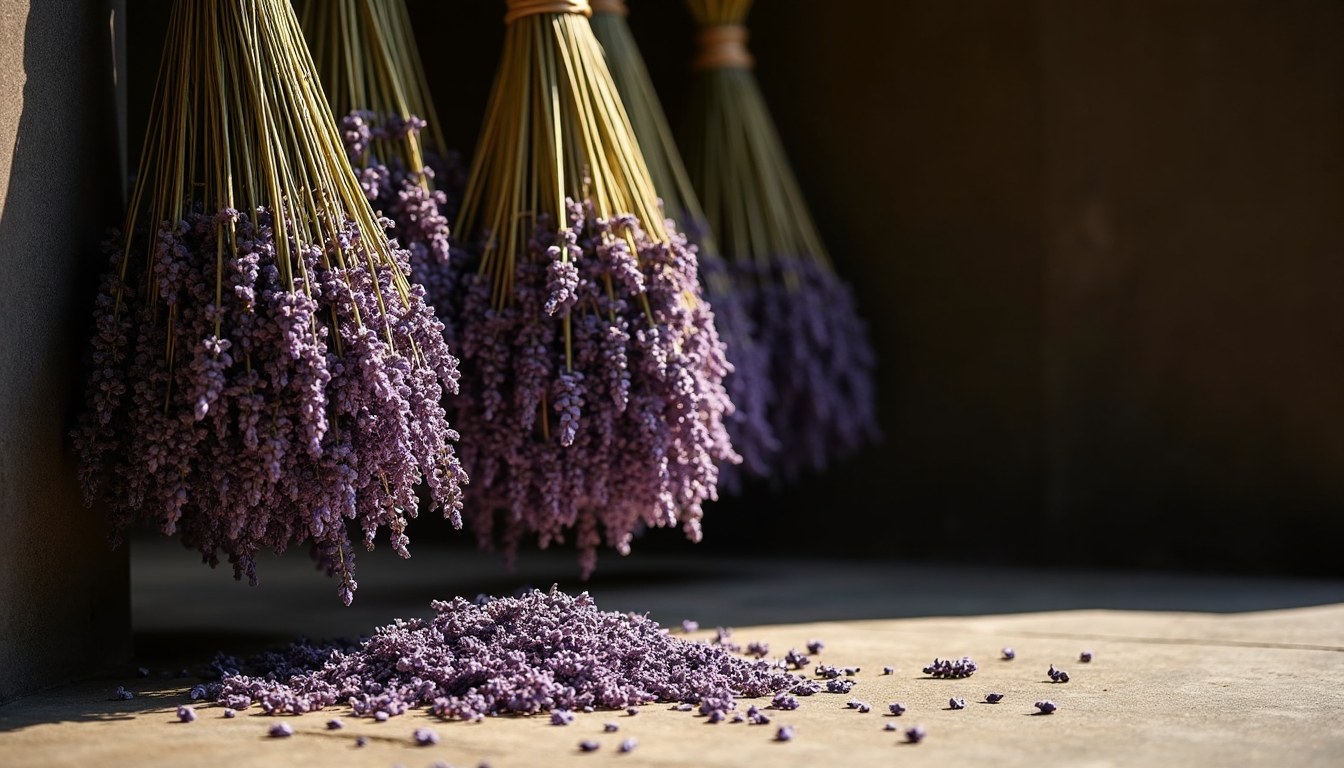
The English word lavender reaches us through Anglo-Norman and medieval Latin lavendula, and the popular explanation traces it to lavare, to wash. Some etymologists argue the real root is livere, to be bluish, pointing at the color of the flower spikes, and the major reference works treat the origin as uncertain, with the washing link at least partly a folk etymology. The question is not settled. What is not in doubt is that the association with washing is old and practical. Lavender went into bathwater, into rinse water and above all into linen, with dried flowers laid between folded sheets in storage chests, both for the smell and because the flowers were believed to keep moths out of stored cloth.
That association survives in the language: in French a lavandière was a washerwoman, and the English "launder" carries the same root. For most of European history lavender was not a luxury note. It was the smell of clean cloth, of the linen press, of a household in order. The modern supermarket accord is less a betrayal of that history than an industrialized continuation of it. The strange part is that the shorthand has almost entirely displaced the original.
Antiquity and the islands
The Greek physician Pedanius Dioscorides, writing his pharmacological compendium in the first century, recorded a lavender under the name stoichas, taken from the Stoechades islands off the southern coast of Gaul, the modern Îles d'Hyères, where the plant grew abundantly. The name survives as the species epithet of Lavandula stoechas, the tufted lavender with a little flag of bracts on top of each flower head. Dioscorides and the herbalists who followed him set down preparations of lavender in detail, alongside the rest of the aromatic plants that reached their hands.
Roman use of lavender in bathing and in scenting rooms and clothes is widely repeated rather than well documented, and the northward spread of the plant under Roman cultivation rests on the same footing. Classical writers also used the word nard for several unrelated plants, so a passage that looks like lavender may not be. The record firms up later: lavender appears in monastic garden lists, among the strewing herbs scattered on floors in medieval and Tudor England, and in the trade in nosegays and sachets that ran to the Victorian era. English growing, centered on Mitcham in Surrey and later Norfolk, produced oil with its own reputation, sweeter and lower in camphor thanks to the cool climate, though the acreage was always small next to France.
Provence, and the making of a landscape
The lavender fields of Haute-Provence are so photographed that it is easy to assume they are ancient. They are not. For most of recorded history Provençal lavender was wild lavender, gathered by hand from high stony slopes above roughly 800 meters by families who cut it in July and August and carried it down to small, often mobile stills. It was sold on to the perfume and soap trade, with the town of Grasse as the principal buyer, and it was supplementary income rather than a crop.
Organized field cultivation took hold in the late nineteenth and early twentieth centuries and expanded between the wars, as demand from soap and perfumery grew and upland farms looked for something that would pay on thin soil. The purple lines across the Valensole plateau, the Sault basin and the Drôme are a twentieth-century agricultural landscape, built on land that would grow almost nothing else profitably. Lavender is not competing with better crops for that ground; it is why the ground is farmed at all.
The commodity story then splits in two, and this split shapes what is in your cupboard today. Where the altitude ranges of Lavandula angustifolia and Lavandula latifolia overlap, the two cross to produce a vigorous hybrid: lavandin, Lavandula x intermedia. It makes much larger plants and far more oil. Because the hybrid is effectively sterile, every lavandin plant must be propagated from cuttings, so a lavandin field is genetically uniform. Mass planting of named varieties took off from around the 1930s, and today a handful of them, with one called Grosso commonly reported as the large majority of French plantings, supply most of the world's industrial lavender-type oil.
The economics are stark. Lavandin commonly yields several times more oil per hectare and grows well at lower altitudes where machinery is easier to run. If you buy anything scented with "lavender" at supermarket prices, the botanical material in it, where there is any, is almost certainly lavandin. That is not a scandal. It is a legitimate crop with its own character. It is simply not the same smell.
Protecting the fine stuff
France responded by ring-fencing the traditional product. The designation, registered under its French legal name Huile essentielle de lavande de Haute-Provence, received appellation d'origine contrôlée status in December 1981 and European protected status in the following decade. The rules map onto the chemistry set out earlier: the oil must come from Lavandula angustifolia raised from seed rather than cuttings, grown at altitude within a zone spanning a few hundred communes across the Vaucluse, Drôme, Hautes-Alpes and Alpes-de-Haute-Provence, and extracted by steam distillation.
The seed-grown requirement is the interesting one. A seed-grown field is genetically diverse, a population rather than a single genotype, and its oil is correspondingly more complex. It also yields less. The appellation is, in effect, a legal instrument for defending a smell against its own more efficient substitute.
The map beyond France
France sets the reference point for what fine lavender should smell like, and it is easy to finish the Provence story and assume the map ends there. It does not. On volume, France has not been the leading source of true lavender oil for over a decade.
That position belongs to Bulgaria, widely reported to have overtaken France around 2014 and to have held the lead since, though some Bulgarian sources date the crossover a couple of years earlier. Published annual tonnages vary a great deal depending on who is counting and on the season. Reporting from the early 2010s put Bulgarian output at roughly sixty tonnes rising through about a hundred and twenty, while trade estimates for recent seasons commonly fall in the 250 to 400 tonne range, with frost damage in 2024 and 2025 reported to have trimmed yields again. The honest statement is that Bulgaria is the largest single origin for Lavandula angustifolia oil by a clear margin, and that the exact number moves with the weather. The plantings are concentrated in the valleys and lower slopes on the southern side of the Balkan range and the Sredna Gora, around Kazanlak, Karlovo and Kalofer, the same ground that carries the country's rose crop, with newer acreage spread north and east into the Plovdiv and Dobrich regions.
The structural difference from France is the crop itself. Bulgarian industrial cultivation is overwhelmingly true lavender, built on Lavandula angustifolia varieties bred domestically from the 1950s onward at the institute for roses and aromatic plants at Kazanlak, with names like Hemus, Druzhba, Sevtopolis and Hebar. Lavandin does not figure in the Bulgarian crop in any comparable way. France runs the opposite way round: true lavender is the smaller crop by tonnage and lavandin the far larger one. Published French figures for 2023 put fine lavender oil at around 90 tonnes against roughly 1,550 tonnes of lavandin, so the hybrid outweighs the true species by well over ten to one by volume. The planted area runs the same direction but nothing like as steeply, at about 8,000 hectares of non-hybrid lavender against roughly 22,000 hectares of lavandin, which is a reminder of how much more oil a hectare of lavandin yields. That tonnage ratio moves with the season, and in a strong lavandin year it has run wider still. So the two countries are not really competing for the same shelf. France produces the appellation-grade material and the bulk of the world's lavandin, while Bulgaria produces most of the world's workaday true-lavender oil.
The profiles differ in ways a trained nose can pick up, though the published numbers support a narrower claim than the trade usually makes. A GC survey of seven industrial Bulgarian lavender absolutes reported linalool between roughly 27 and 38 percent and linalyl acetate between roughly 27 and 37 percent across six of the seven samples, with camphor at one tenth to one third of a percent. The seventh sample sat outside both ranges, at about 21 percent linalool with no linalyl acetate detected at all, because it was produced from spent inflorescences rather than fresh flowers. Distilled Bulgarian oil sits in similar territory: a much cited sample from a plantation near Pomorie ran linalyl acetate at 27.5 percent and linalool at 24.1 percent, and commercial certificates of analysis for Bulgarian oil routinely show camphor around a quarter to a half of one percent, comfortably under the ceiling the standards allow.
What does not follow from those numbers is a clean rule about which of the two dominant molecules leads. Sources contradict each other here. Some describe Bulgarian oil as running richer in linalool relative to its ester and French fine lavender as the reverse, while other published Bulgarian samples and supplier specifications put the ester clearly ahead. The ratio is better understood as something that moves with variety, season and the day of harvest than as something that moves with a border. What does hold up is the camphor. Consistently low camphor is why Bulgarian oil rarely carries the ointment edge, and it is part of why so much of it goes into soap, detergent and functional fragrance, where a clean, predictable, low-camphor lavender is exactly what the formula needs.
Ocimene is worth knowing about, with the caveat that it is a much weaker origin marker than it is often made out to be. It is a light, green, slightly sappy hydrocarbon that turns up in true lavender oil as two isomers, E and Z, and the quantity swings enormously between samples. The Pomorie oil above carried E-ocimene at 7.0 percent and Z-ocimene at 3.2 percent, while the Bulgarian absolutes came in under three percent for the two combined. ISO 3515, the standard for the species, allows cis-ocimene up to around ten percent and trans-ocimene up to around six percent, so a high ocimene reading is squarely within the normal range for true lavender wherever it was grown, and does not by itself point at a country. Where the number happens to be high it does change the smell, giving the opening a fresher, more cut-stem, faintly herbal-leafy lift instead of a rounder sweetness from the first second. Analytical work that does separate lavender oils by origin finds Bulgarian and Chinese samples grouping tightly while French samples scatter across their many cultivars, but that separation leans on enantiomeric ratios and stable isotope measurements rather than on any single constituent, and none of it survives blending.
England is the third piece of the map, and it is a small one. Mitcham in Surrey was the historic centre of English growing and distilling, and the phrase Mitcham lavender oil survived as a quality descriptor long after London's expansion had built over the fields that produced it. Commercial growing moved on, most visibly to Norfolk, where a planting made at Heacham in 1932, six acres and thirteen thousand plants to begin with, grew into something on the order of a hundred acres, and English growing and distilling has continued there since. The scale is worth stating plainly. Set that hundred acres against the Karlovo district in Bulgaria, which alone carries more than five thousand hectares. English producers do not publish oil tonnages, so any figure you see for national output is an estimate. This is not a volume segment. It is a distinct one.
What makes it distinct is climate. A cool, damp, maritime summer at low elevation and high latitude ripens the crop slowly and never delivers the heat that pushes the cyclic, camphorous compounds up, so English oil has a long-standing reputation for very low camphor and a soft, sweet, rounded character with a green herbal edge rather than a cool medicinal one. It is the same effect the Provençal plateaus achieve through altitude, arrived at through latitude and cloud instead. The trade-off is yield. A short, cool, uncertain season on a small acreage produces very little oil per hectare, which is why the English material is sold on provenance and small-batch distillation rather than on price, and why you will meet it as a named single-origin oil far more often than as an ingredient inside something else.
Set the three side by side and the shape of the map is easier to hold.
| Origin | Main crop | Camphor level | Where the oil goes |
|---|---|---|---|
| France | Mostly lavandin, plus fine lavender | Low in appellation oil, high in lavandin | Fine fragrance, and bulk industrial scent |
| Bulgaria | True lavender, almost only | Very low, 0.25 to 0.5% | Soap, detergent, functional scent |
| England | True lavender, tiny acreage | Very low, by reputation | Named single-origin oils |
Beyond these three, China is regularly cited as the other origin of real commercial consequence, usually placed third by volume with something around a tenth of the global market. Its plantings are concentrated almost entirely in the northwest, in the Ili valley of Xinjiang, which is reported to account for the large majority of Chinese lavender ground. The practical upshot is that origin is worth reading on a label, and that it tells you something the species name does not. The species tells you which plant. The origin tells you which version of that plant, because the same seed in Provence, in the Balkan foothills and in a wet Norfolk summer will not give you the same oil.
Natural versus synthetic today
The natural supply is under documented pressure from two directions at once, a plant disease and a changing climate.
Since the 1960s, French lavender and lavandin have been hit by a disease known as lavender decline, now associated with chronic infection by strains of a wall-less bacterium in the phytoplasma group, spread by a sap-feeding planthopper, Hyalesthes obsoletus. Infected plants yellow, shrink and die back over a few seasons as their vascular tissue is obstructed. Growers have had to pull and replant plots, and the disease has been a persistent drag on French yields for decades, compounded lately by drought and heat on the high plateaus. Fine lavender, grown from seed on marginal upland ground, is the more exposed of the two crops.
Natural linalool has its own conservation history. The bois de rose tree it was first isolated from is harvested destructively, since the oil sits in the heartwood, and Amazonian populations were heavily depleted across the twentieth century before the species came under international trade controls. Most natural linalool now comes instead from the linalool chemotype of the camphor tree, Cinnamomum camphora, grown as a renewable coppice crop, chiefly in China. That is a real improvement, and a correction to the assumption that "natural" and "responsible" are the same word.
Adulteration deserves plain speech. Lavender is among the most frequently adulterated raw materials in the distilled-oil trade, and the methods are well known: blending lavandin into fine lavender, topping up a weak oil with synthetic linalyl acetate to hit the specification numbers, or reconstructing the whole thing from aroma chemicals. Laboratories catch these with gas chromatography, isotope ratio analysis and the chiral test described earlier. Without a laboratory, the defenses are unglamorous: know the species, the country and ideally the altitude, and be suspicious of a fine-lavender price that looks like a lavandin price.
Notes that pair with lavender
One of the more instructive contrasts for anyone learning lavender is a rich white floral, because the two occupy opposite corners of the same category. Lavender is a herb reading as a flower; jasmine is a flower with no herbal restraint at all, dense, indolic and expansive in the drydown. Smelling them back to back makes it easy to hear what lavender is actually doing, and our companion piece on what does jasmine smell like takes that note apart the same way. Used together, and sparingly, lavender's green sharpness cuts the white floral and keeps it from cloying.
Citrus is the other obvious partner, for chemical rather than aesthetic reasons: bergamot and petitgrain both carry linalyl acetate, the same ester behind lavender's fruity roundness, so the join is invisible. Lavender extends citrus in a room, and citrus makes lavender read brighter and less herbal, a useful adjustment for anyone who finds fine lavender too much like a garden.
Underneath, lavender needs weight, because on its own in a diffuser it is a sprinter. Soft woods, tonka-type coumarinic materials, light musks and vanillic bases all sit under the hay-like tail and carry it past the point where lavender alone would be gone. For how those foundation materials work, and how they are handled across different machine types, see our guide to carrier oils for diffuser setups, which covers the base end of a blend in detail.
Where this note appears in our range
Two blends in our range are built on lavender, and they use it in different roles. Our lavender diffuser oil follows the profile set out in the drydown section: green and gently camphorous at the top, resolving into the soft, powdery, faintly fruity heart, with hay-like warmth underneath. Lavender is the subject of that composition rather than a component of it, and the balance is held so the camphorous facet does not lead under cold-air atomizing. It falls in the small to medium room range described above.
The lavender spice scent puts the same herb over warm spice. The spice sits behind the lavender as base weight, so the green top falls into something dense instead of thinning out, and the composition holds across a larger volume of air than straight lavender does. Lavender still leads; the spice is the foundation under it.
Our 5-scent sample set is a build-your-own selection with a five-sample minimum, and either lavender blend can be included in it.
Frequently asked questions
Why does lavender smell soapy to me?
Because most of the lavender you have met was probably a simplified synthetic accord built around linalool, the single molecule used at enormous scale in detergents, softeners and cleaners. Linalool on its own smells floral and clean without any of the plant's herbal, camphorous or hay-like facets. Your nose learned that shorthand as the definition of lavender, so the real oil registers as unfamiliar rather than as the original.
What is the difference between lavender and lavandin?
They are different plants. True lavender is Lavandula angustifolia. Lavandin is Lavandula x intermedia, a sterile hybrid of true lavender and spike lavender that is propagated from cuttings. Lavandin yields several times more oil per hectare, grows at lower altitude, and carries substantially more camphor and 1,8-cineole, so it smells sharper, cooler and more penetrating. Most industrial lavender-type oil is lavandin.
Is Bulgarian lavender oil different from French lavender oil?
Both are the same species, but they are not the same material. Bulgaria has been the largest single origin for true lavender oil by volume for over a decade, growing it in valleys and on lower slopes rather than on high plateaus. The difference that holds up in published analyses is camphor, which runs very low in Bulgarian oil, so it tends to read clean and even rather than medicinal. The more common claim, that Bulgarian oil runs higher in linalool relative to linalyl acetate while French runs the other way, is less reliable than it sounds, because published samples contradict each other and the ratio moves with variety, season and harvest date. Ocimene, sometimes offered as a Bulgarian tell, swings widely in samples from both countries. Neither origin is the correct version of the note; they are two settings of the same dial.
Is lavender a floral or a herb?
Botanically it is a woody shrub in the mint family, alongside rosemary, sage and thyme, and it smells like it. Perfumery classes it as the anchor of the aromatic family rather than as a floral. The powdery, sweet, flower-like quality people notice is real but it sits on top of a fundamentally herbal, green, slightly bitter structure. Calling it a herb that flowers is the honest short answer.
Why does lavender smell better in a cold-air diffuser than in a candle?
Heat sorts lavender's molecules badly. A hot wax pool drives the lower-boiling constituents off first, and the sweet linalyl acetate boils higher than any of the sharp ones, so cineole-type materials and camphor lead while the sweetness that should balance them lags behind. Heat also speeds oxidation of linalool into flatter-smelling products. Cold-air diffusion atomizes the oil mechanically without cooking it, so the balance you smell is closer to the balance in the bottle.
What does lavender absolute smell like compared with the distilled oil?
Much darker and heavier. Solvent extraction pulls through coumarin and herniarin that steam distillation largely leaves behind, so the absolute is dominated by a dry, sweet, hay-like warmth with a green, almost savory depth underneath. The bright camphorous top of the distilled oil is largely absent. It is thick, dark green and far less airy, and it is used to weight a lavender down rather than to lift it.
Is real lavender oil purple?
No. Steam-distilled lavender oil is colorless to pale yellow, sometimes with a faint greenish cast. The purple pigment lives in the flower's tissue and does not carry over in distillation. Lavender absolute is dark green rather than purple. Any deep violet liquid sold as lavender oil has been colored, and color is a reasonable first signal that a product is not what it claims to be.
How much lavender is too much in one room?
Lavender is easier to overdo than most notes because it throws quickly and your nose adapts to it faster than the room clears. Short bursts, a minute or two of run time separated by fifteen or twenty minutes off, hold a steady impression better than continuous running. If the note starts reading sharp, that is concentration rather than the oil, and cutting run time usually fixes it.