








Oud smells like warm, dark wood soaked in smoke and resin: dense, slightly sweet, faintly animal, with a medicinal edge that can read like antiseptic or old leather. Depending on origin it leans barnyard, balsamic, or almost honeyed. It is deep, tenacious, and unmistakably heavy rather than fresh.
The first surprise is that it does not smell expensive. Newcomers meeting real distilled agarwood oil neat off a paper strip reach for words like barnyard, antiseptic and spoiled long before they reach for luxury, and most products carrying the word oud on a Western shelf hold a constructed woody-smoky-sweet accord with little or no agarwood in them at all. So the honest answer depends on which of those two things is in front of you. Ask five people who have smelled the real oil what it smells like and you will get five contradictory answers, all of them honest. That is not vagueness or poetic license. It is a consequence of what oud physically is, and once you understand the biology, the disagreement becomes the point.
The short version
- Smells like: Real oil opens sour, medicinal and barnyard rather than woody, then settles after an hour into dense, faintly sweet smoky wood like cooling embers.
- The surprise: An uninjured Aquilaria tree is soft, pale, scentless timber, and oud is only the resin it piles up over years against an injury that never heals.
- The chemistry: Sesquiterpenes in the 204 to 222 gram-per-mole band carry the woody body, while heavier phenylethyl chromones stay silent until heat breaks them into small sweet fragments.
- Where it comes from: Resin-soaked heartwood of wounded Aquilaria and Gyrinops trees, so few of which resinate that overharvesting put the whole group under CITES protection by 2005.
- In a room: Under cold-air diffusion it needs eight to fifteen minutes to arrive, lingers into the next morning, and suits enclosed spaces of roughly 150 to 400 square feet.
- Watch out for: Turning the output up does not just make it louder, it flips the character, because the phenolic and animalic parts cross their thresholds and read antiseptic.
Oud at a glance
Oud is a base note in the woody family, but it is a woody note colonized by three other families at once. There is resin in it, smoke in it, and something faintly animal in it. In the standard map of fragrance families, oud is filed under woods, a filing that is technically correct and practically misleading, because a good oud accord behaves less like cedar and more like a leather, an incense and a balsam arguing in the same room.
- Family: woody, with major resinous, smoky, leathery and animalic facets
- Position in the pyramid: base note, essentially always; it has almost no head
- Natural source: resin-saturated heartwood of Aquilaria trees (family Thymelaeaceae) and the closely related genus Gyrinops
- Key molecules: oxygenated sesquiterpenes such as agarospirol, jinkoh-eremol, kusunol and the agarofurans, plus a large family of 2-(2-phenylethyl)chromones
- How it is captured: hydrodistillation of soaked, ground resinous wood, supercritical carbon dioxide extraction, or no extraction at all when chips are heated on charcoal
- Pairs with: rose, saffron, sandalwood, patchouli, frankincense, labdanum, vanilla, tobacco and dry leather accords
- Tenacity: extreme, measured in days on fabric and hours in a room
What is oud?
Oud is fragrant resin that forms inside a living tree as a defense response to injury and infection. That is the whole definition, and every strange thing about the material follows from it.
The trees belong to the genus Aquilaria, tropical hardwoods native to South and Southeast Asia, with the related genus Gyrinops producing the same material in parts of Indonesia, Papua and Sri Lanka. Recent botanical work counts roughly twenty-one Aquilaria species, with the tribe containing both genera totalling around thirty. Commercially important species include Aquilaria malaccensis across northeast India, Bangladesh and Malaysia, Aquilaria crassna through Cambodia, Laos, Thailand and Vietnam, Aquilaria sinensis in southern China, and Aquilaria subintegra in Thailand.
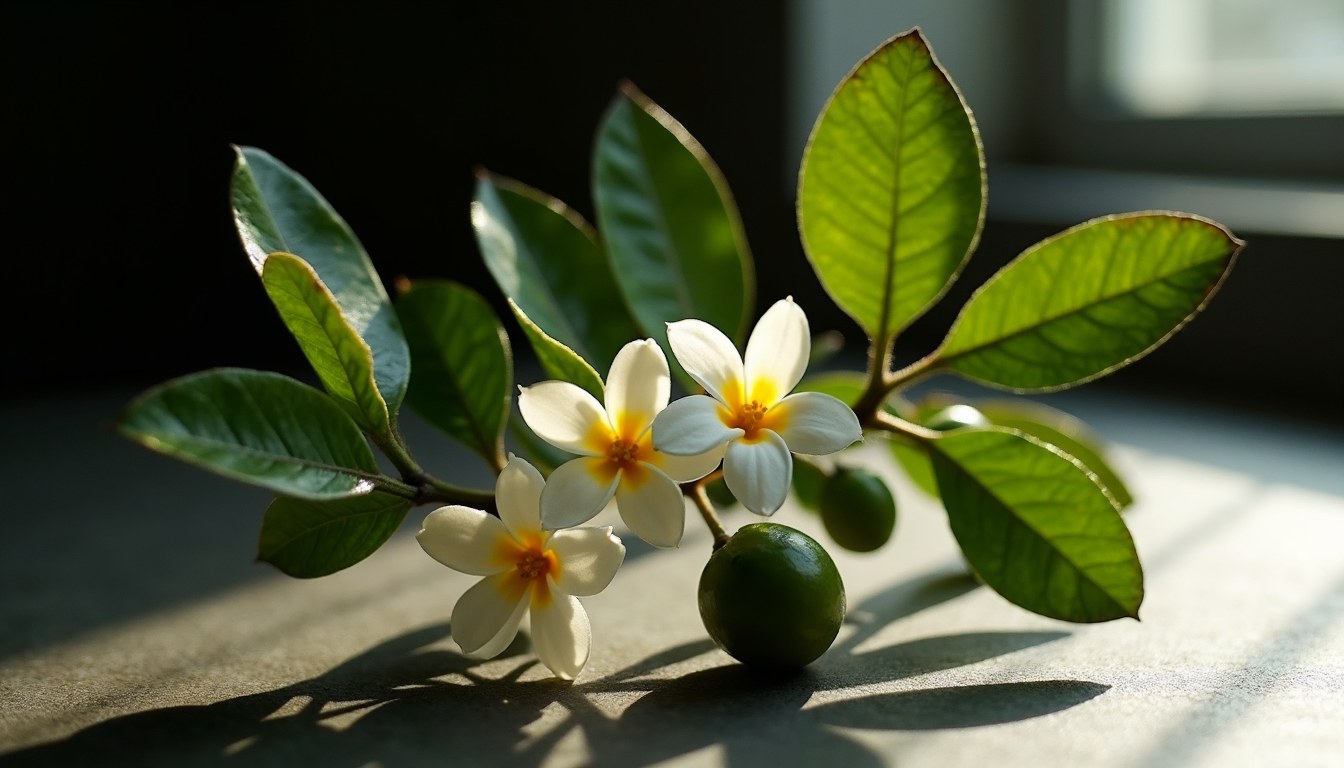
The surprise is where all of this starts. A healthy Aquilaria tree is not fragrant. Its heartwood is pale, light, soft and close to odorless, undistinguished timber nobody would cross a road for. The fragrant material only appears when the tree is wounded, by storm damage, insect boring, lightning or a machete, and the wound is then colonized by fungi. The tree floods the damaged tissue with an oleoresin, a thick mixture of terpenoid and aromatic compounds laid down in and between the wood cells. Over years that resin accumulates, darkens from pale tan to chocolate to near black, and turns the affected wood dense, oily and intensely aromatic.
So the material perfumery calls oud is resin-saturated heartwood, the record of a defense the tree kept mounting for years against an infection it never sealed off. Nothing else in the perfumer's palette works this way. Rose oil is the flower doing what flowers do, and sandalwood is the healthy heartwood of a healthy tree. Oud is a response that never switched off, and the fragrance is the accumulated evidence of it.
The names all mean the same material
Oud and oudh come from the Arabic ʿūd, which simply means wood or stick. Agarwood comes through Hindi agar from the Sanskrit aguru. Aloeswood, agalloch and agallochum descend from the Greek agallochon, a parallel borrowing from the same Indian root as the Hebrew ahalot behind the "aloes" of older English Bible translations, a word with nothing to do with the succulent aloe vera plant. Eaglewood, the form that ran through older European trade records, arrived by a stranger route: Portuguese merchants rendered the same Sanskrit root as aguila, Latin documents turned that into lignum aquilae, and English readers heard a bird that was never in the story. In Chinese the material is chénxiāng, in Japanese jinkō, in Vietnamese trầm hương, all translating roughly as "sinking incense", because wood carrying enough resin sinks rather than floats. That sinking test is one of the oldest quality gauges in the trade and it is still used.
These are therefore one material carrying a separate passport in every language that traded it, and a label that treats "oud" and "agarwood" as different ingredients is selling a distinction botany does not support.
Why usable agarwood is so rare
Only a minority of wild Aquilaria trees ever develop resin worth harvesting, with commonly cited estimates running from low single-digit percentages up to roughly ten percent. And you cannot tell from the outside: a tree loaded with decades of black resin looks exactly like one carrying none. For most of the trade's history the only reliable check was to fell the tree and look, which is precisely how a genus of forest trees ends up on a protected species list.
The scent, decomposed
The opening
Real distilled oud oil does not open the way most fragrance materials open. There is no bright flash, no lift, no head. The first impression arrives at full weight, and for many people it does not register as wood at all. It is sour. Or medicinal, a sharp phenolic bite people compare to iodine, antiseptic or an adhesive bandage. Or frankly barnyard, a warm animal note reading as hay, hide and stable. Underneath, over the first few minutes, comes the wood: dry, dark, slightly bitter, with a resinous stickiness behind it. Some oils carry a dried-fruit or honeyed sweetness that sits oddly and beautifully against the sourness.
The drydown
This is where oud earns its reputation. The phenolic edge softens and recedes, and the animalic facet stops announcing itself and becomes a warm background hum. What is left after an hour is a smooth, dense, faintly sweet woodiness with smoke woven through it, closer to old polished furniture and cooling embers than to anything in a forest. Oud does not so much fade as settle, dropping out of conscious notice for anyone who has been in the room a while even though its actual concentration has barely moved.
A working vocabulary for oud's facets
Because there is no single oud smell, the useful skill is naming facets rather than hunting for one description. These are the axes traders and formulators actually use:
- Animalic: barnyard, hide, stable, warm fur; the facet that most divides new noses
- Medicinal or phenolic: antiseptic, iodine, adhesive bandage, tar; sharp and slightly cooling
- Smoky: embers, charred wood, birch tar, cold fireplace
- Balsamic: honey, dried figs and dates, plum, resinous sweetness
- Leathery: tanned hide, suede, old book bindings
- Green and bitter: damp bark, vetiver-adjacent, slightly earthy
- Creamy-woody: the least common facet, a sandalwood-like roundness found mainly in high grades
Regional shorthand maps loosely onto these. Assamese material from northeast India is often called sweet, fruity and heavily barnyard. Cambodian and Thai wood from Aquilaria crassna has the rounder, more approachable profile, with less animal edge. Malaysian and Bornean material runs cooling, medicinal and resinous, while Papuan and eastern Indonesian material is sharper and greener. These are trade conventions rather than laboratory categories, and individual trees routinely refuse to behave.
What oud does not smell like
It does not smell expensive. Not at first. Given how costly agarwood is against almost anything else in perfumery, people reasonably assume it smells like luxury. Real oud oil smelled neat off a strip is frequently described by newcomers as smelling like a farm, a wound dressing, or something gone off. The refinement is real, but it sits on the other side of a wall and plenty of people never climb it.
It does not smell like the word "oud" on a shelf. Most products labelled oud in Western retail contain a constructed woody-smoky-sweet accord and little or no distilled agarwood. That accord is clean, ambery, faintly leathery and easy to like. It is not what a Gulf perfumery means by dehn al oud, and the two are not close.
It is not sandalwood. Sandalwood is creamy, milky, soft and almost sweet, with an even, forgiving texture. Oud is dry, sharp-edged and unpredictable. They belong to the same family the way a cello and a distortion pedal belong to the same orchestra.
It is not cedar or incense. Cedar is pencil shavings, dry and papery and slightly pungent, with no animal quality at all. Frankincense and myrrh are resins tapped from the bark of living Boswellia and Commiphora trees, bright and lemony and dusty at the opening. Oud is heartwood resin formed internally, and it is the opposite of airy.
It is not one smell. This is the thing worth internalizing above all else. There is no reference oud the way there is a reference lavender. Two oils from the same species, country and distiller can smell like different materials, because the resin is a defense response and no two injuries are identical.
The chemistry: what actually makes oud smell like oud
Agarwood resin is chemically messy in a way a flower absolute is not, and the messiness is the point. Analytical work has consistently identified two structural families as the backbone of the odor.
Sesquiterpenes: the part you smell directly
The first of the two families is the sesquiterpenoid group. A sesquiterpene is a molecule built from three five-carbon isoprene units, giving fifteen carbons in total. Plants assemble these constantly; they are the workhorses of woody, earthy and balsamic smells. What matters for oud is that they are big. A sesquiterpene weighs roughly half as much again as the small terpene behind a citrus peel, and the oxygenated versions, the ones carrying an alcohol, ketone or ether group, are heavier still. That gap is most of the reason oud behaves the way it does in a room rather than on a strip.
The sesquiterpenoids repeatedly flagged as carrying agarwood's character include agarospirol, jinkohol, jinkoh-eremol, kusunol, alpha- and beta-agarofuran, nor-ketoagarofuran, alpha-bulnesene, epoxybulnesene and 9,11-eremophiladien-8-one. Gas chromatography paired with trained human sniffing at the column outlet, which is how chemists separate molecules merely present from ones that actually smell, has pointed at beta-agarofuran as a heavy contributor, alongside smaller aromatic compounds including benzaldehyde and furfural.
Those last two are worth pausing on. Benzaldehyde is the almond-and-cherry-pit smell. Furfural is a sweet, bready, slightly burnt-caramel note that forms whenever plant sugars are cooked. Neither is woody, and their presence is part of why good oud has an odd edible sweetness threaded through material otherwise nothing like food. Phenolic compounds of the guaiacol type, the class responsible for the smell of wood smoke, contribute much of the medicinal and campfire character.
Chromones: the part you only smell when you burn it
The second family is unusual enough to function as a chemical fingerprint. These are the 2-(2-phenylethyl)chromones, along with relatives such as 2-[2-(4-methoxyphenyl)ethyl]chromone. A chromone is a two-ring structure containing an oxygen atom, a common plant scaffold, but the phenylethyl-substituted versions found in resinated Aquilaria wood are close to unique to it, and analysts use them to authenticate and grade agarwood.
Here is the odd part. These chromones are heavier still than the sesquiterpenoids around them, and the hydroxylated derivatives such as agarotetrol are the heaviest things in the resin. They are largely non-volatile at room temperature, so sitting in a piece of wood they contribute very little smell. They matter enormously when the wood is heated, because thermal breakdown cleaves them into smaller, volatile, intensely fragrant fragments.
That single fact explains a persistent puzzle: heated agarwood chips and distilled agarwood oil are genuinely different smells drawn from the same raw material.
The chemical signature
Both families in one place, with the weights that decide how each molecule behaves.
| Molecule | Formula | Molecular weight | Odor character |
|---|---|---|---|
| Alpha-bulnesene | C15H24 | 204.35 | Woody; plain sesquiterpene hydrocarbon |
| Alpha- and beta-agarofuran | C15H24O | 220.35 | Woody, agarwood-like; heavy contributor |
| Agarospirol | C15H26O | 222.37 | Warm woody; spiro-ring alcohol |
| Jinkoh-eremol | C15H26O | 222.37 | Woody; eremophilane alcohol |
| Kusunol | C15H26O | 222.37 | Woody; also listed as valerianol |
| Guaiacol | C7H8O2 | 124.14 | Smoke and the medicinal edge |
| Benzaldehyde | C7H6O | 106.12 | Almond and cherry pit |
| Furfural | C5H4O2 | 96.08 | Sweet, bready, burnt caramel |
| Phenylethyl chromone | C17H14O2 | 250.29 | Almost nothing at room temperature |
| Agarotetrol | C17H18O6 | 318.32 | Non-volatile; the grading marker |
| Benzylacetone | C10H12O | 148.20 | Sweet, floral; formed by heat |
| Vanillin | C8H8O3 | 152.15 | Vanilla; formed by heat from lignin |
Weights are in grams per mole. Guaiacol stands in for the guaiacol-type phenols as a class, and the chromone row is the 2-(2-phenylethyl)chromone described above, shortened for the table. Three things are worth reading off that list. The sesquiterpenoids top out at 222.37, so the woody body of the note is carried by molecules in the 204 to 222 band and nothing heavier. The chromones sit well beyond that, agarotetrol most of all, which is why they sit in the wood contributing so little. And the last two rows are barely in the wood or the oil at any meaningful level: they are manufactured on the spot when the wood is warmed.
Why no two ouds are alike
Resin composition depends on species, tree age, the type and severity of the wound, which fungi and bacteria moved in, soil, climate, and above all how many years the resin sat in the wood before harvest. Agarwood formation is popularly credited to one particular mould, usually Phaeoacremonium parasiticum, and that account is a simplification. Researchers have induced resin using multiple fungal genera including Fusarium, and separate work published in 2014 showed that wounding alone can trigger the sesquiterpene biosynthesis pathway and vessel occlusion in Aquilaria sinensis without a measurable shift in the fungal and bacterial communities around the wound. Injury is the trigger, microbial colonization amplifies and shapes the outcome, and the exact chemistry is a negotiation between a particular tree and a particular insult.
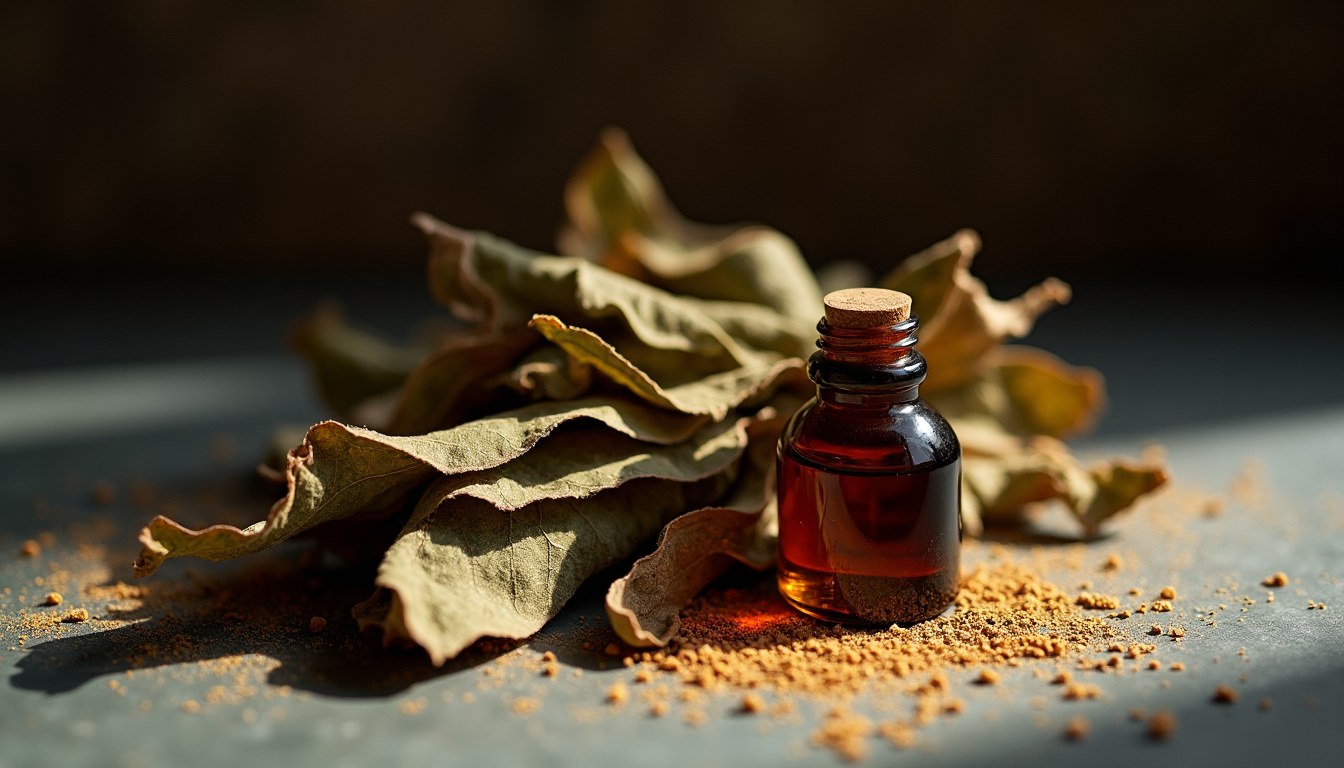
Processing adds another layer. The classical method soaks ground resinous wood in water for days or weeks before hydrodistillation. That soak is a fermentation, generating sour, cheesy and animalic compounds that were never in the wood. Two distillers working the same log with different soak times produce oils that smell like different products. A shorter soak, or carbon dioxide extraction with no soak at all, yields something cleaner and far less barnyard.
Burned wood and distilled oil are two different smells
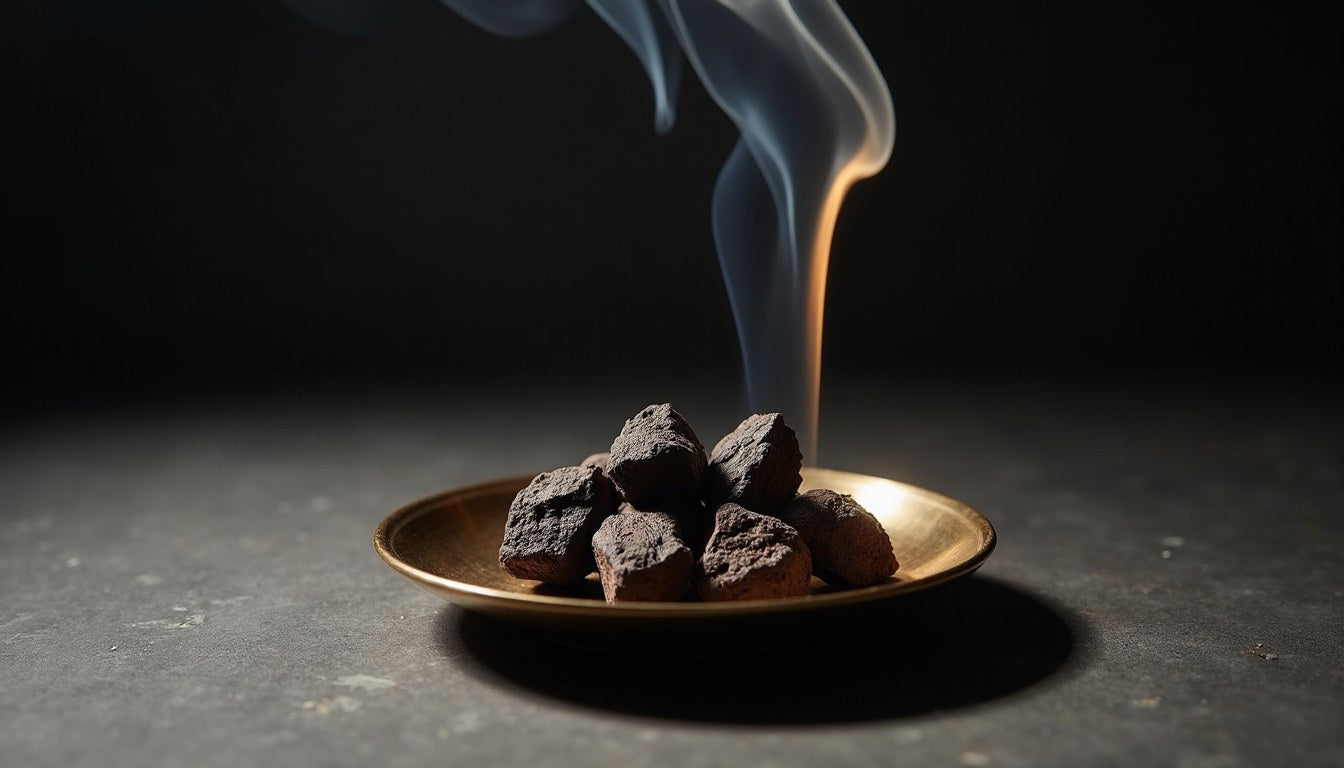
Most modern writing about oud describes the distilled oil, and that is a recent bias. For the great majority of agarwood's documented history the material was not an oil at all. It was a chip of resinous wood put over heat, and the smell people meant when they used the word was smoke. Distillation at commercial scale arrived late in that story. If oud has a reference experience, the burner has a stronger claim to it than the bottle.
The two are not versions of one another. They are chemically distinct outputs, and the split runs along the line between the note's two molecular families.
What heat actually does to the wood
The sesquiterpenoids survive both routes reasonably intact, which is why heated wood and distilled oil share a recognizable woody, resinous core. The chromones do not. As the chemistry section explained, the 2-(2-phenylethyl)chromones are heavy and effectively non-volatile at room temperature, so distillation leaves most of them behind in the still and they never appear in the oil. Heat takes them apart instead.
Published heating work makes the mechanism concrete. Agarotetrol, a chromone derivative used as an index compound for evaluating agarwood quality, was heated in one study to roughly 190 to 200 degrees Celsius, and three cleavage products were recovered from it: benzylacetone, also called 4-phenyl-2-butanone, benzaldehyde, and a benzenepropanoic acid methyl ester. The chromone ring system is thermally fragile, and heating breaks it into small aromatic fragments of exactly this kind. The same study found agarotetrol to be the main compound left behind in the flask after distillation, which is the other half of the picture. A gas chromatography and mass spectrometry study of the smoke of Vietnamese agarwood, published in 1993, found pyrolysis products of the wood itself, among them acetic acid, benzaldehyde and vanillin, riding as a top note above the sesquiterpenes. Researchers have reported that these low molecular weight aromatics show up in the headspace vapor of heated agarwood while being absent from the unheated wood itself.
Read the names of those fragments and the smell explains itself. Benzylacetone is sweet, floral and faintly fruity. Benzaldehyde is almond and cherry pit, present at trace level in the oil but generated in far greater quantity by heat. Vanillin is vanilla, unambiguously, and it arrives by a slightly different road, as a standard product of the thermal breakdown of wood lignin rather than of the chromones. What the burner does is manufacture this sweet layer on the spot, partly out of chromones that had been sitting in the wood contributing almost nothing to its smell, and that is a layer the still cannot produce.
Why the two smell so different
Heated wood therefore reads sweeter and more obviously incense-like, because a top layer of small sweet aromatics is being generated continuously above the woody body. Distilled oil has no such layer. What it has instead is the fermented character produced by the traditional pre-distillation soak, which is where much of the sourness, cheesiness and barnyard depth in neat oil comes from. Those compounds were never in the wood either, and they are not in the smoke.
Each route adds something the other cannot. Neither is a degraded copy of the other, and someone who loves the burner and finds the oil difficult, or the reverse, is not being inconsistent. They are describing two different sets of molecules that happen to share a source.
The tradition of heating without burning
The word burning also oversells what the connoisseur traditions actually do. Both the Chinese and Japanese practices are built on indirect heat. In the Chinese method a piece of charcoal is buried in fine ash, a plate of mica or metal leaf is set above it, and the fragment of agarwood rests on that plate, warmed through the ash rather than ignited. The practice was well established among Song dynasty literati, and incense appreciation is conventionally listed among the four arts cultivated by that class alongside tea, flowers and painting.
Japanese kōdō inherited the same principle and refined the hardware around it. Charcoal goes under a bed of ash, heat rises through a small hole, a mica sheet sits on top, and a sliver of wood a few millimetres square is placed on the mica so that it heats without catching. Appreciation is called monkō, and the practice speaks of listening to a fragrance rather than smelling it, with participants taking a fixed few breaths from the cup, usually described as three, before passing it on. The competitive form, kumikō, is a matching game in which players identify which samples repeat, and in its most familiar version, genjikō, the answers are recorded with a set of figures named after the chapters of an eleventh-century court novel.
The temperature difference is not a technicality. Gentle indirect heat volatilizes the sesquiterpenoids and cleaves the chromones without pushing the wood into full combustion, so you get the sweet aromatic fragments with very little of the ash, char and acrid smoke a flame produces. A chip dropped straight onto glowing charcoal is a legitimately different effect, and the one wanted wherever the point is to perfume a whole room and the clothing in it rather than to examine a single sliver of wood.
The three routes separate cleanly.
| Route | How it is experienced | What the heat does | Resulting character |
|---|---|---|---|
| Indirect heat on mica | A sliver warmed close up, a few breaths | Cleaves chromones, no combustion | Sweet and clean, almost no char |
| Chip on glowing charcoal | Smoke through a room, clothing and hair | Same cleavage, plus full combustion | Hotter, smokier, ashier, pervasive |
| Distilled oil | A drop worn neat, or an accord run cold | No heat, so no pyrolysis at all | Woody and sour, fermented depth |
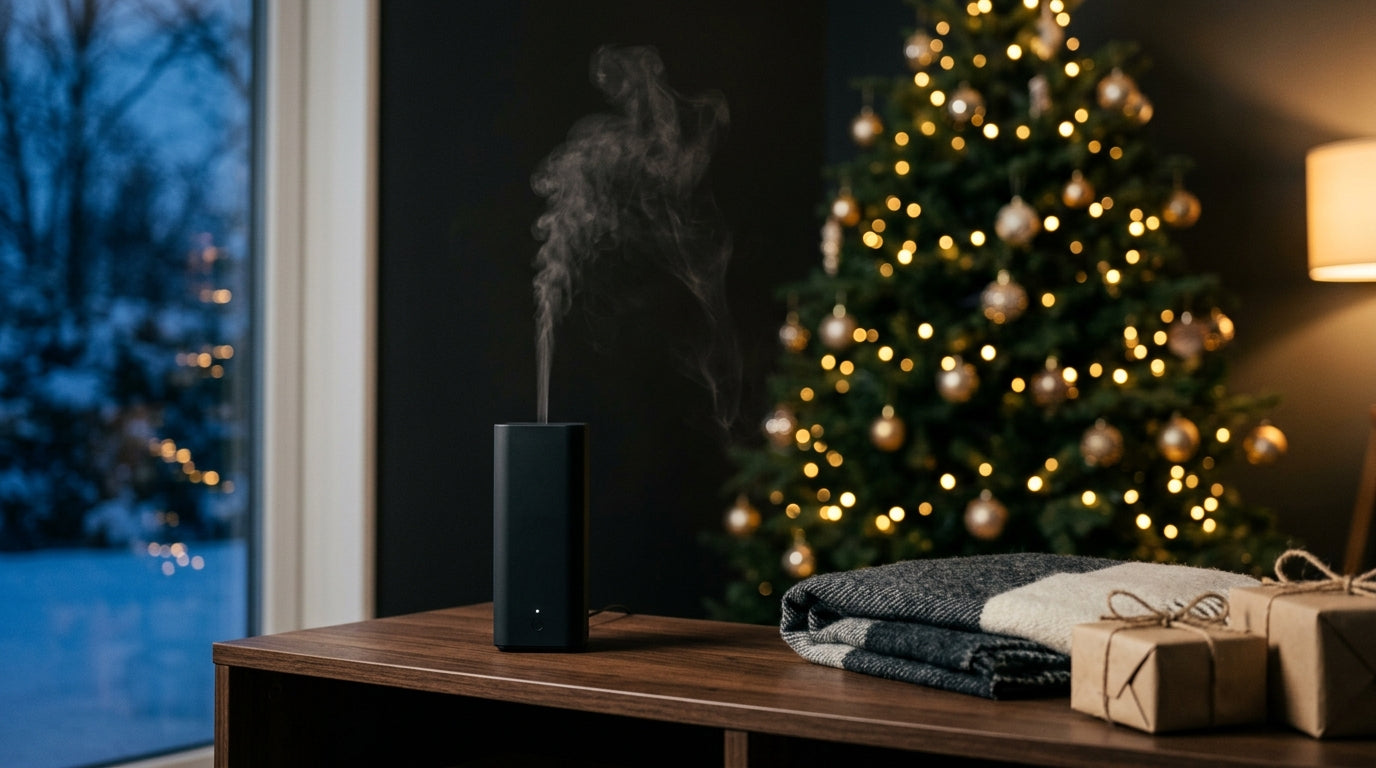
For a cold-air diffuser the implication is direct. No heat means no pyrolysis, so none of those sweet fragments are being created in the machine. Any burner-like sweetness in a diffused woody accord has to be built into the formula as materials that already smell that way, because unlike a charcoal burner the diffuser cannot manufacture them along the way.
The note in a home diffuser
That constraint is where oud becomes a practical engineering problem, because oud-family accords are unusually easy to get wrong in a cold-air diffuser.
Why cold-air diffusion changes the equation
Cold-air diffusion applies no heat, so an oud accord reaches the room at the ratios the formulator set, unedited. Every molecule in it then has to get into the air on its own, at a rate governed by molecular weight, vapor pressure and boiling point. For a citrus or herbal blend that is a trivial requirement. For this note it is the central design problem, because oud's molecules sit at the heavy end of all three measures, and some of them never reach the vapor phase at all before the droplet carrying them lands on a surface.
The weight problem
Citrus and herbal head-note molecules cluster around 136 to 154 grams per mole and boil roughly between 175 and 200 degrees Celsius: limonene weighs 136.23 and boils at about 176, linalool weighs 154.25 and boils at about 198. Oud's sesquiterpenoids are heavier, running from roughly 204 to 222 grams per mole, with the oxygenated ones sitting at the top of that range. Their boiling points are harder to quote honestly, because most of the atmospheric figures published for this group are estimates rather than measurements. What is actually on record for agarospirol is that it distils at 90 to 91 degrees Celsius only once the pressure has been pulled down to a tenth of a torr, which is the laboratory's way of saying it will not boil obligingly at ordinary pressure at all. The direction matters here more than the decimal: every one of these molecules needs far more energy to leave a droplet than a citrus terpene does. The woody-amber synthetics that stand in for agarwood in most commercial oud accords are in the same weight class by design. Three consequences follow, and they define the entire user experience:
- Slow to arrive. In our own testing a citrus blend perfumes a room in a couple of minutes, while an oud accord commonly takes eight to fifteen minutes to reach full presence, because the molecules need that long to move from droplet to air.
- Slow to leave. Once present, it stays. A room scented in the evening will still smell of it in the morning, and soft furnishings hold it for days.
- Cumulative. Because output outpaces clearance, concentration climbs across a session rather than reaching a plateau. Hour three is meaningfully stronger than hour one at identical settings.
How an oud accord unfolds in a room
Because those components differ so widely in weight, they do not arrive together, and the order they arrive in is predictable from the chemistry. What follows is a reasoned map derived from the relative volatility of the molecules in the signature table above rather than a laboratory measurement, so treat the bands as approximate.
- First two minutes. Only the lightest material is airborne: traces of benzaldehyde and furfural, with the guaiacol-type phenols coming up just behind them. All three sit under about 130 grams per mole, but they do not move in step. Furfural boils at roughly 162 degrees Celsius and benzaldehyde at 178, while guaiacol is the slowest of the three at about 205, so the medicinal edge builds a beat after the almond and bready traces rather than alongside them. Either way the room reads thin and faintly smoky, with no wood in it yet. This is the moment most people decide the machine is not working.
- Five to fifteen minutes. The sesquiterpenoids reach the air in quantity, the 204 to 222 gram-per-mole group that carries most of the note's character, and the woody, resinous body fills in behind that sharp opening. This is the first point at which the accord reads the way the formulator built it, which is exactly why judging it at three minutes misleads.
- One to three hours. The room reaches its densest point, since clearance has still not caught up with output. The heaviest woody-amber materials finally register in full, and the sharper phenolic and animalic facets become legible in their own right, so the room tilts sourer than it did at fifteen minutes if the output was set high.
- Overnight and the next morning. The light aromatics are long gone and nothing is regenerating them. What is left is the sesquiterpenoid and woody-amber base held on fabric, plaster and painted surfaces, releasing slowly back into the air. The room reads rounder, quieter and darker than it did at hour three.
One family is absent from that sequence entirely. The 2-(2-phenylethyl)chromones never enter it, because distillation leaves them behind in the still and a cold-air machine applies no heat to break up whatever traces survive.
The mistake almost everyone makes
Someone loads a woody-resinous blend, runs it three minutes, smells very little, and turns the output up. Twenty minutes later the room is saturated. An hour later it reads as sharp, sour and medicinal, and the conclusion is that the oil is bad.
The oil is almost certainly fine. The settings were wrong and the feedback loop lied. With heavy materials the correct instinct is the opposite of intuitive: set output lower than feels right, walk away, and judge the room after twenty minutes rather than three. A practical starting point we have settled on is five to ten seconds of atomizing followed by four to six minutes of rest, adjusting downward if the room still reads heavy after half an hour. Rooms of roughly 150 to 400 square feet tend to suit this family. Open-plan spaces are a poor match, because you run enough output to overload the nearest seating area while the far corner smells of nothing.
The concentration inversion
One counterintuitive property of oud accords is that they do not simply get stronger as concentration rises. They change character. At low concentration you perceive the impression the formulator intended: warm, dry, faintly sweet wood with smoke behind it. At high concentration the phenolic and animalic components cross their own perceptual thresholds and dominate, and the same blend reads as antiseptic, sour and aggressive. This is not damage to the oil. It is a genuine perceptual nonlinearity, and it is why professional formulators dose the phenolic and animalic components in fractions of a percent, even where the woody-amber materials around them run at several percent.
Olfactory adaptation compounds it. Your nose fatigues unevenly rather than uniformly, so the balance you perceive drifts over a session and the person sitting in the room is judging a moving target even at constant concentration, while a visitor walking in gets the full picture at once. For a reliable read, step outside for five minutes and come back in.
Season, temperature and airflow
Ambient temperature changes evaporation rate, which changes everything above. In a warm room at 24 degrees Celsius, heavy materials volatilize faster, so the accord blooms quickly and tilts toward its sharp end. In a cool room at 18 degrees, the same blend releases gradually and holds its rounded character much longer. This is the physical reason oud-family accords belong to autumn and winter and feel oppressive in July. Airflow matters as much: a ceiling fan or open door disperses the aerosol before it accumulates, so you push output higher to register anything. A small enclosed room at low output almost always outperforms a larger ventilated one at high output.
Hardware, viscosity and residue
Woody-resinous blends tend to be more viscous than citrus or floral blends, and viscosity is the enemy of a nebulizing jet. Thicker oil atomizes into larger droplets, larger droplets fall out of suspension sooner, and the fallout builds a sticky film inside the reservoir and around the venturi opening. Left alone, that film narrows the aperture and output quietly drops until the machine seems broken. Units running heavy accords want a rinse with high-proof alcohol more often than units running light ones. The base materials a formulator chooses directly affect how cleanly a blend atomizes, the subject of our guide to carrier oils for diffuser use, worth reading before you blame a machine.
How this differs from a candle or a burning chip
A candle releases fragrance through a heated wax pool, and heat is a selective filter. Lighter molecules volatilize preferentially, heavier ones linger in the melt pool, and some materials are altered by proximity to the flame. A candle version of an oud accord therefore throws its sweeter facets first and holds back much of the deep base, so the balance you smell is not the balance in the formula. Cold-air diffusion has no such filter, which is why the same accord seems darker and more resinous from a nebulizer. Heated chips are the third case and the furthest removed from either, for the pyrolysis reasons given in the section on burning.
A paper strip is the fourth case, and it is where most first impressions are formed. Bulk air dilutes an accord enormously against a strip held under the nose, and a room presents the whole formula at once rather than in the order a formulator layered it. A blend that reads beautifully on a strip can read flat at the far end of a sitting room, or sharp beside the machine and absent by the window, which is why the honest test of a woody accord is walking in through the doorway rather than sniffing the bottle.
Where to place it
Because oud-family accords accumulate and cling, they work well in transitional spaces rather than rooms people occupy for hours: an entry hall, a landing, a study used in short stints, a dining room scented before guests arrive and switched off as they sit down. Put one in a bedroom and you are committing to it, since it will be in the curtains next week. Avoid running two heavy base-note blends in adjacent rooms. Both clear slowly, so they will meet in the hallway, and neither will be legible.
The history: from Assamese forests to the majlis
The engineering is modern. The material is not. Everything above is a problem of the last few decades, machines and settings and room sizes, while the wood at the centre of it was already being traded between continents long before any of that existed. Agarwood is one of the oldest continuously traded aromatics on earth. It appears in early Sanskrit literature as aguru and was recorded in ancient South Asian compendia of aromatic and medicinal materials. It reached the Mediterranean world through the Greek agallochon and the "aloes" of biblical translation. In China it became chénxiāng, a tribute good moving north from what are now Vietnam and Cambodia. Across the Bay of Bengal and the South China Sea it was one of the high-value, low-bulk commodities that made long-distance sailing worthwhile, alongside pepper, camphor and sandalwood.
Japan and the ritualization of a smell
Agarwood arrived in Japan alongside Buddhism and eventually produced a formalized fragrance art with no real equivalent elsewhere. The touchstone object is Ranjatai, a single log held in the Shōsōin repository at Tōdai-ji in Nara, long associated with the eighth-century imperial dedication of 756 CE that founded the repository's collection. That association is now unsettled: radiocarbon work reported by the Shōsōin Office in 2025 dated the tree's growth to the late eighth through late ninth centuries, later than the dedication itself. The log runs roughly 156 centimetres long and weighs about 11.6 kilograms. Three cuttings are marked on the log itself with attached paper tags, naming the shogun Ashikaga Yoshimasa, Oda Nobunaga in 1574, and the Meiji Emperor, though researchers have counted many more cut marks on the wood than those three. Nobunaga handed fragments of his slice out as political gifts, which tells you how this material functioned in the economy of power. Despite frequent claims otherwise, Ranjatai is not kyara, the grade at the head of the traditional hierarchy; its classification is ōjukukō.
Out of this culture came the formalization of kōdō, the way of fragrance, during the Muromachi period. Accounts credit the eighth Muromachi shogun, Ashikaga Yoshimasa, with appointing two specialists to codify what had been a court pastime: the courtier and scholar Sanjōnishi Sanetaka, who classified the aromatic woods then in circulation and whose lineage became the Oie school, and Shino Sōshin, usually dated 1443 to 1523, whose lineage became the Shino school. Both lines are held to have continued unbroken. Kōdō sorts agarwood by rikkoku gomi, "six countries, five tastes": the categories are kyara, rakoku, manaka, manaban, sumotara and sasora, named for the regions the wood was thought to come from, and the tastes are sweet, sour, spicy-hot, salty and bitter. Borrowing the vocabulary of taste to describe smell is not a quaint accident. It solves the problem that dogs every attempt to describe this material: it varies so widely that ordinary description collapses and a coordinate system works better than an adjective.
The Arabian Peninsula and the Gulf
Few places have embedded oud more deeply than the Arabian Peninsula. Chips of agarwood, often soaked in perfume oils to make bakhoor, are heated over charcoal in a burner called a mabkhara, and the smoke scents clothing, hair and the room. In many households the burner travels from guest to guest around the majlis, the sitting room where visitors are received, and being handed it is an act of welcome rather than decoration. Distilled agarwood oil, dehn al oud, is used neat in quantities considered eccentric anywhere else, and often layered directly with rose. That rose-and-oud pairing is the region's signature accord, since borrowed by essentially the entire global fragrance industry.
The commodity story, and the crash
Through the twentieth century, rising wealth in the Gulf and East Asia pushed demand for wild agarwood far past what forests could supply. Harvesting was speculative: fell the tree, split it, hope. Enormous numbers of Aquilaria were cut and discarded for being clean. Add habitat loss across Southeast Asia and the outcome was predictable.
Aquilaria malaccensis was listed in CITES Appendix II in 1995, meaning international trade required permits and evidence it was not damaging wild populations. That single-species listing proved insufficient, partly because material was relabelled as a different species. At the thirteenth Conference of the Parties in Bangkok in 2004, on a proposal from Indonesia, all remaining Aquilaria species and the entire genus Gyrinops were added to Appendix II, entering into force on 12 January 2005. Several individual species also carry serious IUCN threat assessments.
Natural versus synthetic today
The regulatory squeeze did not shut the trade down. It accelerated a plantation industry that had been developing anyway, and that industry now supplies most legally traded agarwood.
Plantation agarwood and induced resin
The logic is straightforward. Grow Aquilaria in managed stands, then deliberately induce the wound response instead of waiting for a storm and a lucky fungus. Early methods were crude and are still widely used: drilling and plugging holes, driving nails or bamboo pegs into the trunk, burning, or inoculating drilled holes with cultured fungi. Yields were inconsistent, and the resin often stayed confined to a narrow zone around each wound.
A more systematic approach published in 2013, the whole-tree agarwood-inducing technique, uses the tree's own transpiration stream as a delivery system. A small hole is drilled low on the trunk, a transfusion line feeds an inducer solution into the xylem, and the tree distributes it upward through its own plumbing, producing resin throughout the trunk rather than in isolated pockets. Published results reported roughly 2.4 to 5.9 kilograms of resinous wood per tree, four to twenty-eight times the yields of existing induction methods, with the wood sampled at one week, six months and twenty months after treatment.
Plantation oil is not identical to wild oil. The trade consensus is that it is cleaner, sweeter and less deep, missing some of the strange sourness and animal weight that decades of slow resination produce. It is also far more available and far cheaper. Trade sources commonly quote plantation distillate in the low thousands of dollars per kilogram against tens of thousands for wild material, though this is a market with thin public data and enormous spread.
What is actually in most "oud" products
At consumer price points, an oud-labelled fragrance almost never contains a meaningful amount of distilled agarwood oil. The arithmetic does not work. What it contains is a reconstruction: an accord built to reproduce the perceptual impression of oud from materials costing a tiny fraction of the real thing.
Those accords are assembled from woody-amber synthetics, leather materials, smoky phenolics and a trace of something animalic. The woody-amber backbone is often built around an octahydronaphthalenyl ethanone abbreviated OTNE, a velvety, dry, persistent woody molecule patented in 1975 by the fragrance chemists John B. Hall and James M. Sanders; that patent has long since expired and the molecule is now made worldwide under many names. Leather comes from quinoline-family materials such as isobutylquinoline, or from birch tar and cade distillates. Smoke and the medicinal edge come from guaiacol-type phenols, sweetness and depth from labdanum, styrax, vanillin and patchouli. Animalic traces once supplied by castoreum and civet now come from synthetics that involve no animals.
A well-built oud accord is formulation craft in its own right, reproducible batch to batch in a way wild agarwood never is, and every kilogram of it is a kilogram of pressure not applied to a protected forest tree. What misleads is labelling that implies the bottle holds distilled agarwood when it does not.
Notes that pair with oud
Whether a formula is built on distilled resin or on a reconstruction of the kind just described, the note is almost never used alone. The same few partners keep recurring, and none of them is decoration: each one is answering a specific problem oud creates.
Rose is the canonical partner, and the pairing is not arbitrary. Rose is dominated by light, diffusive molecules, so it occupies the perceptual space oud leaves empty, and its honeyed and faintly spicy facets bridge into oud's balsamic side so the two do not read as separate layers. Saffron works through its leathery, hay-like, bitter character, which sits on oud's leather facet and amplifies it.
Sandalwood is the smoothing agent. Its creamy, milky woodiness fills the gaps in oud's jagged profile and softens the medicinal edge without covering it. If you want the gentler end of the woody family, the natural next question is what does sandalwood smell like, and the answer is a useful counterweight to everything above.
Patchouli shares oud's sesquiterpene-heavy chemistry and its weight class, so it extends the base rather than competing for a different slot, bringing damp earth, dark chocolate and camphor-adjacent coolness. Readers working out how much a blend can carry usually want what does patchouli smell like next, because it has its own reputation problem and its own overdose threshold. Frankincense supplies dry, lemony smoke that lightens oud without sweetening it, while labdanum and vanilla round the phenolic bite for anyone who finds neat oud austere.
Where this note sits in our range
There is no oud blend in our range. Distilled agarwood is priced well outside what a home diffuser format supports, and it varies enough between batches that the same blend would not smell the same twice.
The adjacent territory is the woody, resinous and balsamic end of our diffuser oils: warm wood, dry smoke and amber depth, with the same slow-to-arrive, slow-to-clear base-note behaviour described in the diffuser section above. Those blends are formulated for cold-air diffusion, which is a different balance from a formula built for a wick, a wax melt or a charcoal burner, since it is aimed at the bulk air of a whole room.
The 5-scent sample set contains five scents chosen at the time of ordering, which allows several woody blends to be compared side by side in the room they will be used in.
Frequently asked questions
Are oud, oudh, agarwood and aloeswood the same thing?
Yes. They are the identical material named in different languages. Oud and oudh come from Arabic, agarwood from Sanskrit by way of Hindi, aloeswood and agalloch from Greek, eaglewood from an older European trade name, and the Chinese, Japanese and Vietnamese names all mean roughly "sinking incense". Any product treating them as separate ingredients is using marketing language, not botany.
Why is oud so expensive?
Because supply is limited by biology rather than farming effort. Only a small minority of wild Aquilaria trees ever form resin, you cannot tell which from the outside, resin takes years to decades to accumulate, and the genus is now CITES-protected after heavy overharvesting. Then a large quantity of resinous wood yields a very small quantity of oil. Scarcity is stacked at every stage.
Does real oud smell bad?
Many people think so at first. Neat distilled agarwood oil frequently opens barnyard, sour or sharply medicinal, and newcomers often describe it as smelling spoiled. That opening softens substantially over the following hour into something warm, smooth and dark. Whether you find the journey worth taking is genuinely personal, and it is entirely normal to prefer a diluted or reconstructed accord to the raw material.
What is the difference between oud wood and oud oil?
They smell like different things despite coming from the same source. Heating chips triggers pyrolysis, which fragments the heavy chromone molecules into smaller volatile pieces such as benzaldehyde and benzylacetone, while the wood itself contributes further smoke aromatics including vanillin, so the smoke carries a sweeter, smoother, more incense-like top layer that the wood did not contain before it was heated. Distillation captures the sesquiterpenoids without that thermal transformation, leaves most of the chromones behind, and often adds fermented, animalic character from the traditional pre-distillation soak. The connoisseur traditions in China and Japan heat the wood indirectly on a mica plate above ash-buried charcoal rather than igniting it, which releases the fragrance without full combustion.
Is the oud in most fragrances real agarwood?
Usually not, and at ordinary consumer prices essentially never. Most oud-labelled products use a constructed accord built from woody-amber synthetics, leather materials such as quinoline derivatives, smoky phenols in the guaiacol family, and resins including labdanum and styrax. Those accords are formulation work in their own right, and they reduce pressure on protected forest trees.
Is oud a masculine or a feminine note?
Neither, and the question is largely a Western retail habit. In Gulf perfumery, where oud has been used continuously for centuries, it is used by everyone and the rose-and-oud pairing is entirely unisex. The gendered framing came from twentieth-century marketing categories rather than from the material itself. In a home diffuser the question disappears completely, since a room has no gender.
How much oud accord should I run in a home diffuser?
Less than you think, and then wait. Heavy woody accords commonly need eight to fifteen minutes to reach full presence, so judging output after three minutes will mislead you. In our own testing, starting around five to ten seconds of atomizing per four to six minutes of rest in a room of roughly 150 to 400 square feet works well: leave it half an hour, then step outside and walk back in to assess honestly.
Is harvesting agarwood legal and sustainable?
Legal international trade exists but is regulated. Aquilaria malaccensis entered CITES Appendix II in 1995, and the rest of the genus plus Gyrinops followed after the 2004 Conference of the Parties, effective 12 January 2005, so permits are required. Wild harvesting remains a conservation problem in several range states. Managed plantations using deliberate induction now supply most legal material.