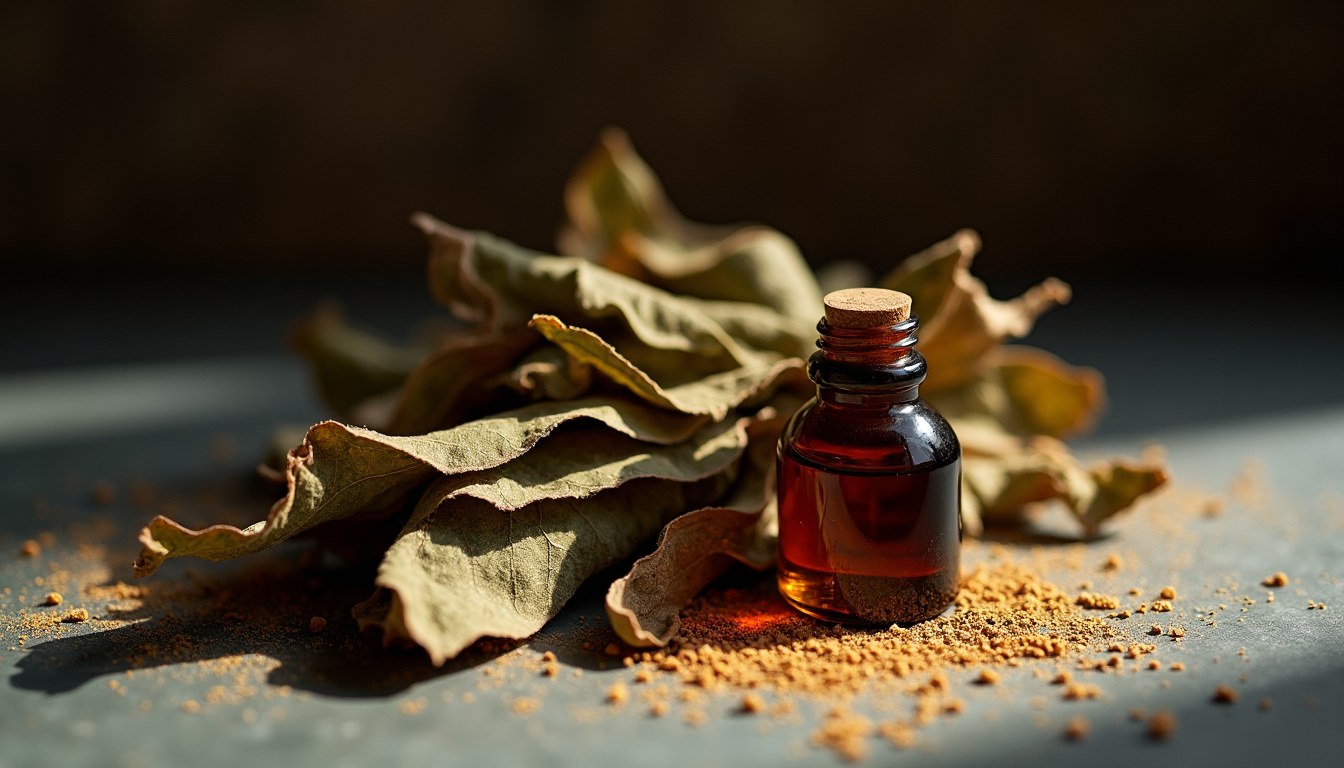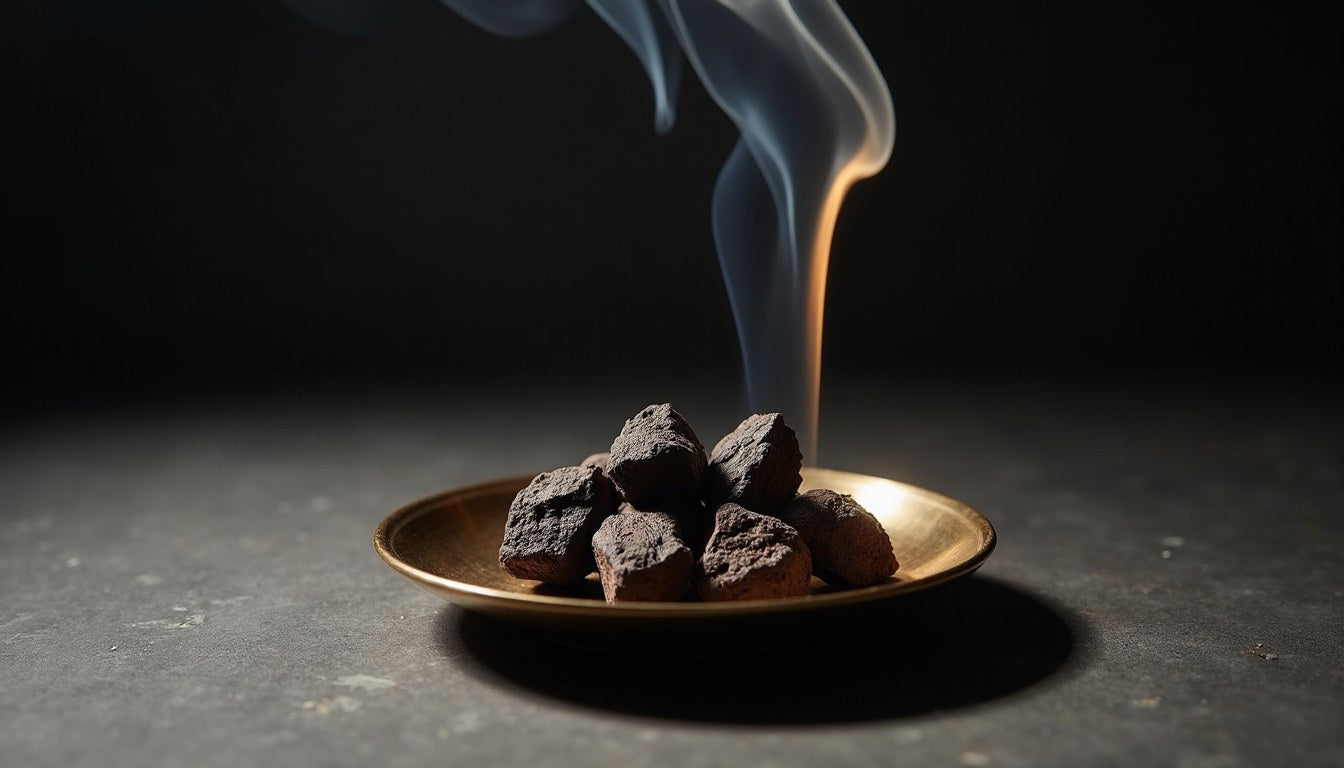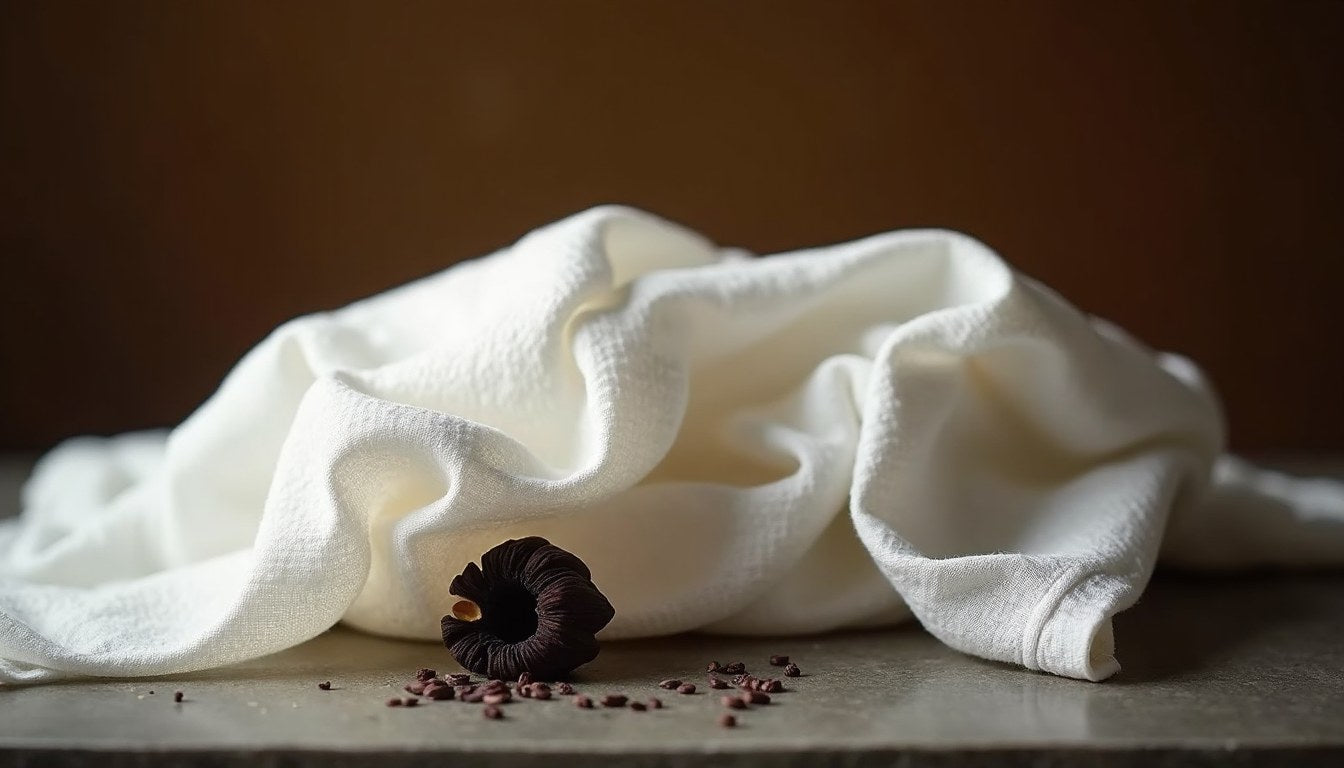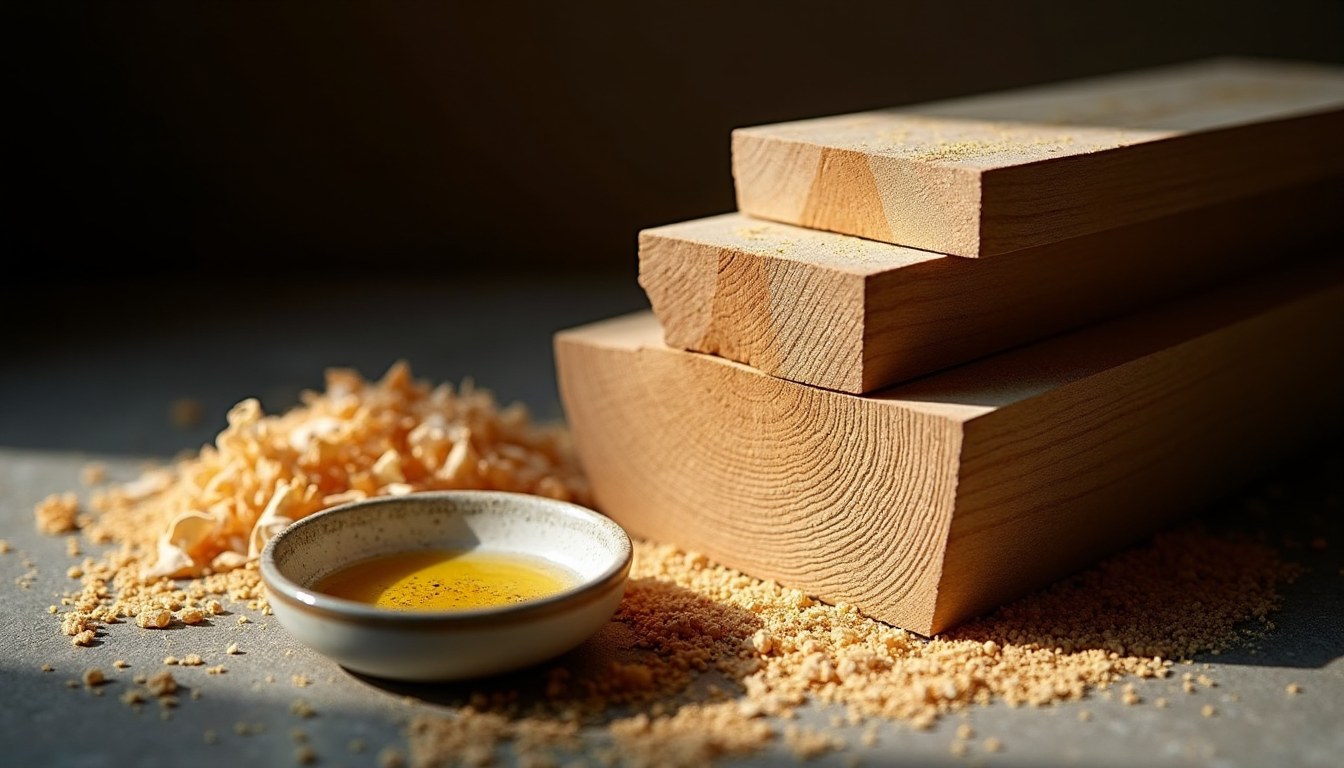









Musk smells warm, soft and skin-like: a low, slightly sweet, faintly powdery smell that most people read as clean laundry or warm cotton rather than as a perfume. It has almost no sharp edge. Some people cannot smell certain musk molecules at all. Its real job is to sit underneath other notes and make them last longer.
Most people who think they dislike musk are describing something else. Almost every strong association the word carries, that it is musty, that it is dirty, that it is heavy, that it belongs to men, describes something musk is not. It is the rare note whose entire reputation is built out of mistaken identity, and the misconceptions are worth taking apart one at a time.
It is also the one note where two people in the same room can honestly disagree about whether anything is there. That is not poetic license. It is receptor biology, and it is the other half of what makes musk hard to talk about.
The short version
- Smells like: Almost nothing for ten to fifteen minutes, only a rounding-off of everything sharper, then a low, warm, faintly powdery reading of clean cotton and folded laundry.
- The surprise: A meaningful share of people cannot detect a given musk molecule at all, which is why professional accords blend four to eight musks across more than one family.
- The chemistry: No single molecule owns this smell, since muscone carries the deer material while nitro, polycyclic, macrocyclic and alicyclic families reach the same effect from unrelated structures.
- Where it comes from: Historically the gland of male musk deer in the Himalaya, restricted from international trade since 1979, now synthetic in mainstream use, with ambrette seed the significant botanical.
- In a room: Cold-air diffusion needs forty-five to ninety minutes before musk arrives, after which it holds into the next day, suiting textile-rich spaces of 800 to 1,500 square feet.
- Watch out for: White musk names a style rather than a material, so two scents described that way may share no molecules at all.
Musk at a glance
Musk is a base-note material and, in practical terms, an odor family of its own. It is unusual among the classic notes because it is defined by a smell rather than by a structure or a plant. Rose is a flower. Sandalwood is a tree. Musk is a sensation that at least four unrelated families of molecules happen to produce. It behaves more like a structural component than like a single ingredient, appearing in the base of compositions across nearly every category. Our guide to fragrance families shows how it quietly underpins categories that look nothing alike on paper.
- Family: musk, a base-note family in its own right, adjacent to amber and powdery materials
- Position in the pyramid: base, and the most widely used fixative class in the industry
- Historical natural source: the glandular secretion of mature male musk deer (genus Moschus)
- Botanical sources: ambrette seed (Abelmoschus moschatus) and angelica root (Angelica archangelica)
- Signature molecules: muscone, ambrettolide, pentadecanolide, ethylene brassylate, galaxolide, tonalide
- Character: low intensity, very high persistence, almost no sharpness
- Pairs with: white florals, sandalwood, iris, vanilla, suede, citrus, lavender
What is musk, exactly?
The word does three separate jobs, and most confusion about musk comes from people using it for one meaning while hearing another.
First, musk is an animal material. In its original sense, musk is the dried secretion of a gland found on mature male musk deer, small hornless deer of the genus Moschus that live across the Himalaya, the Tibetan plateau, parts of central China and the Siberian taiga. The males carry downward-curving tusk-like canines instead of antlers, and the gland sits on the underside of the abdomen. The secretion starts as a pale, cream-colored liquid and matures into dark reddish-brown grains, which is why the trade dealt in "musk grains" and in the dried "musk pod" that held them. Undiluted, the material is overpowering rather than attractive: sharp, ammoniacal, intensely animalic. Diluted heavily, it becomes the warm, radiant, softly enveloping smell that made it valuable.
Second, musk is a chemical family. Since 1888 the word has also described a large group of synthetic molecules, several hundred of them, that produce a musky odor. They share no common backbone. Some are nitrated aromatic rings, some fused polycyclic structures, some very large single rings, some a small ring joined to a long ester chain. Chemists have spent more than a century looking for what they have in common, and the honest answer is that there is no simple shared feature. Musk is a smell in search of a structure, the opposite of how most odor families work.
Third, musk is a consumer word. When "musk" appears on a bottle, a laundry pack or a fragrance description today, it almost always means a blend of synthetic musks, usually several at once, with no animal material in it at all.
The word itself traveled: English took it from Late Latin muscus, which came through Greek and Persian from Sanskrit muṣka, a diminutive of the word for "mouse" that was applied to a part of the male anatomy the deer's pod was thought to resemble. Because the smell was so recognizable, Europeans then attached the word to anything carrying a hint of it, which is why musk mallow, musk rose, muskrat and muskmelon all take their names from a deer gland in the Himalaya.
The scent, decomposed
Musk breaks the rules that make other notes easy to describe, because it has no top. On a blotter, lemon or mint tell you almost everything in the first two seconds. Musk tells you nearly nothing, and only becomes legible after ten or fifteen minutes. The opening impression is negative rather than positive: you notice an absence of edge. Sharp materials get rounded, bright materials get muted, sweet materials get softened and stretched. Only once the top has burned off does the musk arrive as a smell in its own right, and by then it reads as the inside of a wardrobe of clean clothes, or a bath towel dried in the sun, or the warm air of a room where laundry has just been folded.
The facet vocabulary
Because musk is a family and not a molecule, professionals do not say "musk" on its own. They specify a facet, and each of these maps onto a real chemical difference you can learn to detect.
- Soapy or laundered: the clean, fabric-conditioner reading, largely from polycyclic musks
- Powdery: a dry, fine, slightly cosmetic quality, often reinforced by iris or heliotrope
- Warm and close: soft, faintly salty and low-lying, the most flattering facet in the family and the hardest to put into words
- Sweet-fatty or lactonic: a soft milky roundness, typical of large-ring lactone musks
- Fruity-pear: a distinctive facet contributed by the newer alicyclic ester musks
- Woody-nutty: a dry, almost cedar-adjacent shade some polycyclic musks throw
- Animalic: warm fur, leather, a whiff of the barnyard, the facet of the original material and of related large-ring ketones
What musk does not smell like
Four misconceptions do most of the damage, and each is worth taking apart properly. Musk is not musty. English speakers slide between "musky" and "musty" constantly, and the two describe opposite things. Musty is damp cardboard and cellar air, largely geosmin and mold metabolites. Musk is dry, warm and clean. Musk is not loud or dirty. People who say they dislike it are usually picturing the raw animal material, or a heavy 1970s style of men's product built on nitro musks. The musks in a modern composition are the quietest materials in the bottle.
Musk is not inherently masculine. That association is a marketing accident of the late twentieth century, when a wave of masculine products used the word in their names while soft white musk compositions were sold almost exclusively to women. The molecules have no gender. Musk is also not ambergris, civet or castoreum. Ambergris is marine, mineral and sweet-salty. Civet is sharp in concentration and honeyed in dilution. Castoreum is leathery, smoky and slightly tarry. Musk is the roundest and softest of the four. They get lumped together as "animalic" but are not interchangeable.
What does white musk smell like?
White musk smells clean, soapy, powdery and faintly sweet, like warm cotton straight out of a dryer or a freshly laundered towel. It is transparent rather than heavy, with none of the animal warmth of the original material, and it usually carries a faint floral shimmer behind the softness.
The first thing to know is that white musk is not a molecule. There is no plant called white musk and no ingredient with that name on a chemist's shelf. It is a style term, describing an accord built from synthetic musks with the animalic facets edited out, in current practice usually polycyclic, macrocyclic and the newer alicyclic materials together, often with a touch of aldehyde or soft floral material on top. A working white musk accord generally stacks several materials drawn from more than one of the structural families described below, chosen for how clean and how persistent each one reads. Two products labeled white musk can therefore be built from entirely different molecules and both be honestly described that way, and on an ingredient list the constituent materials appear under their own names or under a general fragrance designation. The phrase describes a result, not anything that exists as a single substance.
The term is commercial rather than technical in origin, and its spread is usually traced to 1981, when a British cosmetics retailer put a low-priced scent of that name on shelves. The timing was almost perfect. Trade in the animal material had just been restricted, synthetic musks were already cheap and familiar, and a soft laundered musk that owed nothing to a deer was exactly what the moment wanted. It sold in very large numbers through the 1980s and 1990s, and the phrase escaped the product that carried it to become the general label for any clean, animal-free musk. The color word carries the whole positioning: the deer material was dark, so "white" reads as its visual opposite and as a promise of laundry rather than fur.
White musk versus dark or animalic musk
"Dark musk", also written as black musk, is the counterpart term, and it is exactly as much a style label as white musk is. It describes accords pointed the other way: warm, faintly leathery, a little sweet, unmistakably animal in reference, and built from musk materials chosen for warmth rather than for cleanliness, usually with resins, woods or a trace of smoke behind them. Published descriptions of the style are consistent about the direction and vague about the formula, which is what you would expect of a marketing word rather than a technical one. In mainstream commercial practice nothing in a dark musk accord comes from an animal, though small artisan and traditional markets still trade in tinctures of the real material. The darkness is a direction of composition rather than an ingredient, and the same holds for the whiteness of the other term.
Both color words are recent in the English fragrance vocabulary, and for most of the note's history there was nothing to distinguish. Musk meant one material, that material was animalic, and no qualifier was needed. The vocabulary only became necessary once synthetics had split the family into readings so different that a single word could not carry both.
The two styles behave differently in a room, which is the practical reason to keep them straight. A white musk accord leans on materials with strong fabric affinity, the polycyclics above all, so it settles into textiles and reads as an even, low, laundered background that changes very little hour to hour. A dark musk accord leans on warmer, rounder materials, macrocyclic ketones among them, which read less soapy and more legible as a smell in their own right, so it sits higher in the composition and disappears under other notes less completely. Neither direction is inherently stronger, since odor thresholds vary from material to material rather than from style to style. What separates them is how much room they leave for everything above.
Why white musk reads as "clean" is not chemistry but learned association. Polycyclic musks arrived in the 1950s and 1960s, and they turned out to be stable in detergent chemistry and unusually tenacious on fabric, holding through a wash cycle. They went into laundry products at enormous volume, and several generations grew up learning that this smell means "just washed". The molecule did not arrive smelling clean. We taught ourselves that it does.
Why two people disagree about musk: specific anosmia
Many people have a normal sense of smell overall but a blind spot for one molecule or a small group of related ones. That is specific anosmia: normal olfaction with a hole in it, documented for dozens of odorants. Musk is the textbook case, because the effect is so large. A person with a musk blind spot does not smell a weaker version of the note. They smell nothing at all, while someone beside them finds the same blotter obvious.
The mechanism is now reasonably well understood. Human olfactory receptors are proteins encoded by around four hundred working genes, and most odors activate a broad combination of them. Musk receptors are unusually narrowly tuned. One in particular, OR5AN1, responds strongly to macrocyclic ketones such as muscone and civetone and to some of the old nitro musks, but not to polycyclic musks such as galaxolide and tonalide. Most large-ring lactones are read instead by a second receptor, OR5A2, which also carries the polycyclic and alicyclic families, and a third receptor, OR1N2, appears to be involved in the perception of the natural lactone ambrettolide. So even inside the macrocyclic family the ketones and the lactones do not run through the same hardware. Because so few receptors carry the signal, one common variation in the gene has an outsized effect. A 2023 study in the journal Chemical Senses examined a variant at position 289 of OR5AN1 and found that genotype tracked with muscone detection thresholds in one panel and with perceived intensity of several macrocyclic musks in a separate panel of 530 people. The same paper also found a genotype association for the perceived intensity of galaxolide, which does not activate OR5AN1 in laboratory receptor tests, so the map from one receptor to one perception is not perfectly clean even in the best-studied case.
Two practical consequences follow. First, the class matters, not the note. Because different musk families reach different receptors, someone who genuinely cannot smell muscone may smell galaxolide perfectly well, and the reverse happens too. A person who says "I can't smell musk" almost always means one family of musks and may never have found out which. This is why professional compositions rarely use a single musk. A working accord typically stacks four to eight musks from more than one structural family, partly to fill different points on the evaporation curve and partly as insurance: the more families included, the better the odds it registers for any given nose.
Second, estimates of how many people are affected deserve suspicion. Figures from a few percent up to around a third of the population get quoted, and both extremes have some support depending on the molecule tested, the concentration and how detection was defined. There is no single correct number because there is no single musk. The reliable claim is qualitative: for any given musk molecule a meaningful minority will not perceive it. None of this is a defect. It is ordinary variation in a receptor gene.
The chemistry: four families, one smell
Musk is the only major note organized by effect rather than by structure. Four generations of musk molecules have appeared since 1888, each with a recognizable house style, and learning to hear the difference between them is the fastest way to stop finding musk confusing.
The four generations at a glance, before the detail on each.
| Class | Arrived | Current status | Odor character |
|---|---|---|---|
| Nitro | 1888 | Historical, key members prohibited | Powerful, heavy, the first soap musk |
| Polycyclic | 1950s and 1960s | Permitted, under scrutiny | Clean, sweet, floral, woody edges |
| Macrocyclic | Structure solved 1926, cheap later | Wide use, breaks down readily | Soft, round, warm, faintly powdery |
| Alicyclic, or linear | Around 1990 | Current use, breaks down readily | Light, clean, fruity pear lift |
Nothing in that first column shares a chemical backbone with anything else in it, which is the whole oddity of the family: four unrelated structures arriving at one smell, and each generation solving the previous one's problem while creating its own.
Nitro musks, 1888 to the 1990s
The first synthetic musk was an accident of explosives chemistry. In 1888 the German chemist Albert Baur was working on nitrated aromatic compounds, the same chemical territory that produces trinitrotoluene, when he noticed a strong musky odor from a nitrated tert-butyl toluene derivative he had made. It is still remembered as Baur's musk, and it had no structural relationship whatsoever to anything in a deer gland, which nobody could have known at the time: the structure of the natural material would not be worked out for another thirty-eight years.
Musk xylene, musk ketone, musk ambrette, musk moskene and musk tibetene followed over the next decades. They were cheap, powerful and, crucially, stable in the harshly alkaline conditions of soap manufacture. That is why nitro musks went into soap and later detergent for most of the twentieth century, and why "clean" and "musk" first became linked in the public nose. One naming trap is worth knowing: musk ambrette is a nitro musk and has nothing to do with ambrette seed. It was named for a resemblance in smell, and the error trips up a lot of otherwise careful writing.
The family fell apart on environmental and safety grounds rather than on smell. Nitro musks proved persistent and bioaccumulative, and some ran into regulatory trouble on other grounds. Musk ambrette was added to the European list of substances cosmetics must not contain by an amending directive in 1995, and musk tibetene and musk moskene were added by a further amending directive in 1998. The International Fragrance Association prohibited musk xylene in 2009, and that compound is listed under European chemicals regulation as a substance of very high concern, judged very persistent and very bioaccumulative. The class is a historical one now, remembered for what it made possible rather than for how it smelled.
Polycyclic musks, the laundry reading
The second generation arrived in the 1950s and 1960s: molecules built from fused rings rather than nitro groups. Phantolide came in the early 1950s, celestolide and tonalide followed, and galaxolide was introduced in the mid-1960s. Chemists usually shorten the last two to AHTN and HHCB, because the systematic names run to a dozen syllables.
These are the musks most people under sixty in Europe and North America actually mean when they say "musk". The polycyclic smell is clean, sweet, slightly floral and distinctly woody at the edges, with tremendous substantivity, the industry word for how tenaciously a material clings to fabric or hair. Galaxolide became one of the highest-volume fragrance ingredients on the planet, and by the 1990s the two leading polycyclics are reported to have held roughly ninety-five percent of the European polycyclic musk market between them. If you have smelled clean laundry in the last fifty years, you have smelled this family.
A practical detail that surprises people: galaxolide is a thick, syrupy liquid, normally supplied to formulators as a roughly fifty percent solution in a carrier solvent because the neat material is too viscous to handle, so a number on a formulation sheet often refers to the solution rather than the pure molecule. The class is also under continuing environmental scrutiny, being persistent and measurable in wastewater, sediment and fish tissue in industrialized regions, and the industry's direction of travel has been away from it for some years now.
Macrocyclic musks, the round and warm ones
The third family is the one closest to the original material, and it carries the most interesting chemistry in this article.
Muscone is the principal odorant of deer musk: a fifteen-membered carbon ring carrying a ketone group and one methyl branch, formally 3-methylcyclopentadecanone. It makes up only a small fraction of the dried grain, commonly reported at between half a percent and a few percent, the rest being proteins, steroids, waxes and related odorants. The structure was elucidated in 1926 by Leopold Ružička, then working in Switzerland between an ETH Zurich post and a fragrance house in Geneva, and the result was genuinely shocking: the prevailing view held that carbon rings larger than about eight members were too unstable to exist. Ružička showed they not only exist but occur in nature, then prepared macrocyclic ketones from nine to twenty carbons and described what each smelled like. The pattern is one of the tidiest structure-to-odor relationships in the field: nine to twelve carbon rings smell camphoraceous, thirteen smells woody, and fourteen to twenty smell musky, with the materials that later reached commerce clustered at fifteen, sixteen and seventeen. He shared the 1939 Nobel Prize in Chemistry for this work.
A year later, in 1927, the chemist Max Kerschbaum found the plant side of the story. He identified large-ring lactones, meaning ring-shaped esters, as the musky principle in two botanical materials: ambrettolide in the seed oil of ambrette (Abelmoschus moschatus, a hibiscus relative also called musk mallow), commonly reported at somewhere around five to twelve percent of that oil depending on origin and processing, and pentadecanolide, also written cyclopentadecanolide, a sixteen-membered lactone ring built from a fifteen-carbon chain, in angelica root oil. This proved musk is not an exclusively animal phenomenon and gave the industry a botanical model to copy.
Ethylene brassylate is the workhorse of the family and probably the musk you meet most often without knowing it: a seventeen-membered cyclic diester formed by joining brassylic acid, a thirteen-carbon diacid derived from long-chain plant fatty feedstocks, with ethylene glycol. It smells soft, sweet and slightly powdery, with a faint vanilla-like tail and a suggestion of warm linen, and it is far cheaper to make than muscone. Macrocyclics were historically expensive for a geometric reason: closing a large ring is hard, because the ends of a long floppy chain are likelier to meet a neighboring molecule than each other, and the workaround is high dilution, which is slow and low-yielding. Modern routes brought the cost down enough for everyday products.
Alicyclic musks, the fourth generation
The newest family appeared around 1990 and broke the pattern again. These are neither the fused ring systems of the polycyclics nor the big single rings of the macrocyclics. They pair a small saturated six-carbon ring with an open ester side chain, and it is the extended chain rather than a large ring that carries the musk effect, which is why they are also called linear musks. The ring is not decorative either: rotational spectroscopy of this family finds the molecules folded into horseshoe shapes held in place by contact between the side chain and the ring, so the ring earns the name the class carries even though the chain does the odor work. The first commercialized example, helvetolide, reached the market in the early 1990s and introduced a facet musk had never had: a clear fruity pear character on top of the softness, arriving exactly as fruity compositions became fashionable. They are lighter, break down more readily than the polycyclic generation, and are inexpensive to produce.
Chemical signature
The molecules named above, gathered in one place. The useful pattern is how narrow the range is: almost the entire family sits between 238 and 297, and that weight is the first fact that governs how musk behaves in air.
| Molecule | Formula | Molecular weight | Odor character |
|---|---|---|---|
| Muscone | C16H30O | 238.4 | Warm, sweet, animalic: deer musk itself |
| Pentadecanolide | C15H28O2 | 240.4 | Musky, sweet, soft and milky |
| Ambrettolide | C16H28O2 | 252.4 | Soft, musky, from ambrette seed |
| Galaxolide, or HHCB | C18H26O | 258.4 | Clean, sweet, floral, woody edges |
| Tonalide, or AHTN | C18H26O | 258.4 | Clean, laundered, high volume |
| Ethylene brassylate | C15H26O4 | 270.4 | Soft, sweet, powdery, vanilla tail |
| Helvetolide | C17H32O3 | 284.4 | Light, clean, fruity pear |
| Musk xylene | C12H15N3O6 | 297.3 | Powerful, heavy, the nitro archetype |
The table repays a second look. Galaxolide and tonalide are the same formula and the same weight, structural isomers that a nose can nonetheless tell apart, which is a compact demonstration that odor follows shape rather than composition. And muscone, the molecule named after the note rather than the other way round, is the lightest thing on the list, though weight alone does not decide the order in which these reach a room. Shape and polarity matter as well, which is why the alicyclic ester sitting near the heavy end of the table lifts into a room ahead of several molecules lighter than it is.
Musk in a cold-air diffuser
Almost everything written about musk describes how it behaves in a personal fragrance. Cold-air diffusion is a genuinely different physical situation, and the molecules set out above account for very nearly all of the difference.
Why musk is the last thing to leave the room
With no heat anywhere in the process, what reaches the room is governed almost entirely by each molecule's own volatility, and musk sits at the extreme low end of that range. Limonene, the main component of cold-pressed citrus peel oils, has a molecular weight of about 136 and boils at 176 degrees Celsius. Musk molecules are roughly twice that size, as the table above shows, and far harder to push into the air. Muscone boils at about 328 degrees Celsius at ordinary atmospheric pressure, and several of the others are so reluctant to vaporize that reference works quote them only under vacuum: ethylene brassylate is usually listed at 138 to 142 degrees Celsius at one millimeter of mercury, a pressure roughly seven hundred and sixty times lower than the air in your living room. Their vapor pressures at room temperature are orders of magnitude below a citrus top note's.
Two things keep musk in a room long after everything else has gone. The first is sheer weight. Musk barely participates in the first two minutes of diffusion: everything light leaves first, while the musk stays behind and concentrates in the residue that settles on curtains, rugs, upholstery and painted walls, then releases very slowly over hours. Musk is not what you smell when the machine turns on. It is what you smell walking back in at eleven at night. The second is by design, since the fabric affinity engineered into the polycyclic family does not switch off in a diffuser, and what lets a detergent musk cling to a shirt lets a diffused musk cling to a sofa. Your soft furnishings are a slow-release reservoir.
How a musk-forward blend unfolds in a room
What follows is a reasoned map derived from the relative volatility and molecular size of the materials involved, not a laboratory measurement, so every time band is approximate: a warm, still, textile-heavy room runs faster than a cool, drafty room of glass and tile.
- 0 to 2 minutes. No musk at all. What reaches you is whatever sits above it in the blend, the citrus and the aromatic material, and the room reads as top notes and nothing else. The only evidence the musk is even there is negative: the sharp edges of those top notes are already slightly rounded off.
- 5 to 15 minutes. The lightest material begins to thin, and the first musk signal appears at the edges. This is usually the alicyclic ester, the most radiant member of the family, carrying its fruity pear lift up into the top of the blend. The room still does not read as musk. It reads as a top note with something soft standing behind it.
- 45 to 90 minutes. The arrival. Polycyclic and macrocyclic material is properly airborne now, and this is the point where someone walking in from outside would name the room's smell as musk: low, warm, clean, faintly powdery. It is also the reason a musk blend wants a head start rather than a last-minute run.
- The rest of the evening. The airborne level plateaus rather than climbing, because output from the machine is now roughly balanced by loss to surfaces. The character drifts from soapy toward warm, as more of the polycyclic material binds itself to fabric and the rounder macrocyclics are left carrying the air. Your own nose stops reporting any of this accurately somewhere in this window.
- Next morning. Almost nothing is left suspended in the air. What you smell walking back in is fabric-bound residue releasing slowly, weighted toward the polycyclics because they cling to textiles best. It reads drier, lower and more laundered than it did the night before.
- Day three, if you run it daily. The reservoir is now doing more work than the machine. This is the point at which people conclude the blend has become heavier, when what has actually happened is that the curtains have been loading up since Monday.
Throw, timing and run cycles
Musk is a poor choice when you want a fast result and an excellent one when you want a lasting one. If someone is arriving in five minutes, a musk-forward blend will not have arrived yet. Give it the head start the timeline above implies, forty-five to ninety minutes, and it will be exactly right, and still right four hours later. That front-loading is the single most useful adjustment most people can make to how they run a diffuser.
The cycling advice inverts too. Citrus and herbal blends reward frequent short bursts, because they dissipate quickly and the room genuinely empties between runs. Musk-forward blends accumulate, so they want short runs with long gaps between them and a lower total run time. The common mistake is to put a musk blend on the same schedule as a fresh one, return three days later, and find a heavy base layer that will not air out. By that point the musk is no longer suspended in the air. It is bound to the textiles. Oil use follows the same logic: a musk-anchored blend generally consumes less per hour of perceived scent, because you are topping up a reservoir rather than replacing the whole atmosphere.
Rooms, square footage and furnishings
Musk suits rooms with soft surfaces and steady occupancy, and it suits large spaces better than small ones provided you accept the slow onset. Bedrooms, dressing rooms and walk-in closets are its natural home, full of textiles and wanting continuity rather than announcement. Living rooms with rugs, curtains and upholstery hold it very well. Entry halls work if there is a runner or a coat rack, since musk at the door reads as a house that smells cared-for rather than one that has been sprayed. Open-plan spaces in the 800 to 1,500 square foot range are well within reach, because you are relying on accumulation rather than saturation, and accumulation scales.
Hard-surface rooms are the exception. A tiled bathroom or a stone and glass kitchen holds musk much less effectively, because there is little for the heavy molecules to settle onto and release from. The fix there is not more oil. It is a different blend with more mid-note structure, or an accepted shorter effect.
How musk layers
Musk is a poor solo act and an outstanding anchor. Diffused on its own it reads thin and faintly soapy after fifteen minutes, because there is nothing above it to give the composition shape. Underneath other things it works in four specific ways. Under white florals, it stops the composition going shrill: indolic flowers such as jasmine and tuberose have a sharp, almost mentholated brightness at room concentration, and musk absorbs that edge while extending the flower by hours. Under woods, it supplies the impression of moisture, since dry woods can read dusty in a heated room. Under citrus, it gives the composition a tail, so the room does not smell abruptly empty ninety minutes after the machine stops. Under leather and suede, it turns a potentially harsh accord into a well-worn jacket rather than a tannery. Musk should be structurally present and perceptually invisible: if you can pick it out as a separate thing in a finished room scent, there is too much of it.
How this differs from musk in a candle or a reed diffuser
In a candle, the melt pool is warm, and heat is a shortcut past low volatility. Heavy molecules that would sit still at room temperature get pushed into the air much earlier, so a candle presents its musk sooner and reads warmer and sweeter, closer to soft wax. It also consumes the material as it burns, so the effect ends with the flame. Cold-air diffusion presents musk later, cleaner and drier, and keeps presenting it long after the machine stops.
The candle trade has a pair of terms for this. Cold throw is what you smell from an unlit candle sitting on a shelf, and hot throw is what fills the room once the wick has been going for a while. Musk is the note where those two readings diverge most sharply. An unlit musk-heavy candle can smell like almost nothing at all, because the molecules are far too heavy and too soluble in wax to leave it unaided, and the same candle can read rich and enveloping twenty minutes after lighting. Cold-air diffusion has no equivalent shift, since it runs at room temperature from the first second to the last, which is why a musk blend arrives on the room's schedule rather than on the machine's.
Reed diffusers make the third comparison, and they suit musk least well of the three formats. A reed relies on capillary action to draw oil up a porous stick and on ambient air to evaporate it from the exposed length. Light molecules make that journey easily. Heavy ones travel slowly, evaporate slowly once they arrive, and tend to collect in the reed itself rather than in the air. A musk-anchored blend in a reed diffuser will often smell bright and correct for the first fortnight and then flatten out, with much of the base material still sitting in the sticks. Turning the reeds restores it briefly. Replacing them restores it properly.
Setting the level when a household disagrees
If a household includes someone with a blind spot for the musks in a blend, a musk-forward scent is the likeliest of all fragrance types to cause an argument about whether the diffuser is working. The person who cannot smell it keeps turning the output up, and everyone else finds the room heavier by the day. Judge a musk blend by how the room smells the following morning, and let whoever smells it most strongly set the level.
A pair of habits keeps that from becoming a standoff. Set the output once, at a level the most sensitive nose in the house calls slightly too low, and leave it there for a full week before adjusting, because a musk blend is still building on day three. Then read the room cold, walking in from outside rather than judging from a sofa you have been sitting on for an hour, since the nose adapts to a steady low note within minutes and stops reporting it accurately.
Arguing over a dial in a bedroom is an ordinary domestic problem, and it is a very long way from the trade that first put this smell into circulation.
The history: a Himalayan luxury that ended up in the laundry aisle
The material that now settles quietly into sofa cushions spent most of recorded history as one of the most valuable substances in the world by weight, and it traveled further than almost any other aromatic. It came out of the mountains: the Tibetan plateau, the Himalayan slopes of what are now Nepal, Bhutan and northern India, the forests of Sichuan and Yunnan, the taiga of Siberia and Mongolia. Hunters took the gland from mature males, dried it, and sold it into a trade network running west through central Asia and Persia. Musk was compact and nearly indestructible in storage, close to ideal for long overland trade. Arabic geographic and medical writing of the ninth and tenth centuries discusses it in detail and grades it by origin, consistently ranking Tibetan material highest, and Chinese materia medica recorded it from antiquity. In these traditions it was traded as a medicine as well as a perfume material, and the surviving price lists treat the two uses as a single market.
The economics were brutal in the way of all wild-harvested luxury commodities. Only mature males produce the secretion, a single pod holds tens of grams, and musk deer are slow-reproducing animals in difficult terrain. Nineteenth-century demand from European perfumery, on top of centuries of demand in Asia, ran well ahead of what wild populations could support, and even in the modern era raw grains have been reported trading around forty-five to fifty thousand US dollars per kilogram. Regulation arrived late. All Moschus species came under the Convention on International Trade in Endangered Species in 1979, and the populations of Afghanistan, Bhutan, India, Myanmar, Nepal and Pakistan carry the stricter Appendix I protection, which prohibits commercial international trade in wild-sourced material from those ranges. Every other population sits in Appendix II, where trade is allowed but monitored under the convention's conditions, so the legal picture is a patchwork by geography rather than a single global ban. China began domestication trials in 1958 and now operates farms where the secretion is collected from live males, mainly for traditional medicine markets rather than perfumery.
By then the fragrance industry had already left, for economic reasons rather than ethical ones. Baur's 1888 accident and the nitro musk boom that followed meant that by the 1920s a perfumer could buy a musk effect for a rounding error rather than a fortune. Once musk was cheap it went into soap, and once polycyclic musks arrived it went into the wash itself, at industrial scale. A substance once traded across Asia in sealed pods for the courts of Baghdad and Chang'an became, in about seventy years, the background smell of a suburban linen closet.
The result is a genuine oddity. Musk is at once the most-worn and least-noticed note in the world, sitting in the base of the great majority of fine fragrances and in most detergents, fabric conditioners, shampoos, deodorants and surface cleaners. A person in an industrialized country meets several musk molecules before breakfast and can almost never name one. It does the most work for the least credit, which is exactly what a fixative is for.
Natural versus synthetic today
For musk more than any other note, this conversation has an unusually clear answer. There is no meaningful natural animal musk supply for home fragrance. Deer musk is trade-restricted, extremely expensive and irrelevant to the economics of a room scent. A home fragrance product that suggests otherwise is describing a synthetic.
Botanical musks are real, and limited. Ambrette seed is the significant one. Steam-distilled and carbon-dioxide-extracted ambrette are genuine perfumery materials with a soft, musky, slightly winey, faintly pear-like smell, and they are among the more expensive botanicals in common use because seed yields are low. Angelica root oil carries related lactones. Neither can supply a mass market, and neither smells like the polycyclic "clean" musk most people picture.
The sustainability picture is more interesting than the usual natural-good-synthetic-bad framing, because with musk the environmental questions have run in both directions: the natural material was harvested past what wild populations could bear, and each generation of synthetic has then raised a different question of its own. Nitro musks were phased out largely because they persisted and accumulated in organisms, polycyclic musks remain permitted at current exposure levels but are persistent enough to be detected routinely in wastewater and sediment, and the two newer families break down more readily, which is where formulation work has been heading.
A molecule of muscone made in a reactor is the same molecule as one made in a deer. Where synthesis and nature differ is the supporting cast: a natural extract carries dozens of minor components that round the material out, while a synthesized single molecule is exactly itself. That is why good musk accords are built from several materials, and why a composition assembled from known molecules holds steady batch to batch in a way a wild-harvested one never could.
Notes that pair with musk
Musk goes under nearly everything, which is why it appears in the base of compositions from every family. Three pairings are worth knowing. The simplest is iris, because musk and iris already live in the same low, dry, powdery register, and stacking them gives the soft dressing-table effect some people love and others find dated.
Sandalwood is the classic partner and the most instructive. Both materials are heavy and slow, and both work at the bottom of the composition, but they solve different problems: sandalwood supplies creamy, milky woodiness with real body, while musk supplies diffusion and length. Together they hold a room for a very long time without either dominating. Our note profile on what does sandalwood smell like covers that woody half in the same detail as this one.
Jasmine is the opposite kind of pairing: a bright, indolic, high-impact floral sitting directly on a soft base. Jasmine alone in a diffuser can be beautiful for an hour and then turn sharp. Over musk it keeps its lift and gains an evening's worth of extra persistence, and the relationship runs both ways, since the floral gives the musk something to sit underneath. Our companion piece on what does jasmine smell like explains where that indolic edge comes from.
Where musk appears in our range
Musk in a home blend works as an anchor, so it shows up wherever a composition needs length and softness at the bottom. Two blends carry it in clearly different roles.
Our black suede scent uses musk as the base of a leather accord. Suede and leather materials read dry and slightly smoky at the edges on their own, and the musk underneath is what turns that into a soft-grained, worn-in reading. In a room with rugs and upholstery it takes about an hour to settle, then holds a low, warm register through the evening.
The barber shop scent uses the note for a different job. That composition is built from bright aromatic materials, lavender-adjacent freshness and a clean soapy finish, and the soapy finish is musk. Without it the accord would read as sharp herbal air and drop away inside the hour. With it, the clean-shaven character holds for several hours.
Musk-anchored blends are also sold in sample size through our 5-scent sample set, which has a five-sample minimum.
Frequently asked questions
Why can some people not smell musk?
Because musk receptors are unusually narrowly tuned, one common variation in a single receptor gene can leave a person unable to detect certain musk molecules while their sense of smell is otherwise normal. This is called specific anosmia, and it is class-specific: someone who cannot smell muscone may smell polycyclic musks perfectly well. It is ordinary genetic variation, nothing more.
Is white musk a real ingredient?
No. White musk is a style term, not a material. It describes a clean, soapy, powdery accord built from synthetic musk molecules, polycyclic, macrocyclic and alicyclic among them, with the animalic facets left out. Two products described as white musk can contain entirely different ingredients, because the phrase names an effect rather than a formula. Its commercial spread is usually traced to a British cosmetics retailer's 1981 launch of a scent under that name, and "dark musk" or "black musk" is the counterpart term for accords pointed the animalic way.
Is musk still taken from animals?
Not for mainstream fragrance. All musk deer species have been covered by international trade regulation since 1979, with the strictest protection applied to the Himalayan-region populations, whose wild-sourced material cannot be traded commercially across borders at all. The fragrance industry moved to synthetics far earlier, beginning in 1888, and did so mainly on cost. Musk in a modern perfume, detergent or diffuser oil is synthetic.
Why does musk smell like clean laundry?
Because we were taught that it does. Polycyclic musks arrived in the 1950s and 1960s and proved both stable in detergent chemistry and tenacious on fabric, holding through a wash. They were dosed into detergents and fabric conditioners in enormous quantities, and several generations learned to read that exact smell as "freshly washed". The association is learned, not inherent to the molecule.
Is musk a masculine or a feminine note?
Neither. The masculine association comes from a wave of men's products in the 1970s that used the word in their names, while soft white musk compositions were marketed to women in the same decades. The molecules carry no gender, and musk in fact appears in the base of fragrances of every description.
How long does musk last in a room?
Longer than any other note category, usually many hours and often into the following day. Musk molecules are large and evaporate very slowly, and they bind readily to textiles, so a musk-anchored blend keeps releasing from curtains, rugs and upholstery long after the diffuser stops. Ventilation clears light top notes in minutes and accumulated musk over days.
Can you diffuse musk on its own?
You can, but it is rarely satisfying. A solo musk goes flat and slightly soapy within the first quarter hour, because nothing sits above it to give the composition shape and the nose adapts quickly to a single unchanging low note. Musk works as an anchor beneath florals, woods, citrus or leather, adding length and softening edges.
What is the difference between musk and ambergris?
They are unrelated materials with different smells. Musk was originally a glandular secretion of male musk deer and reads warm, soft and faintly powdery. Ambergris originates from sperm whales and reads marine, mineral, salty and sweet. Both are now supplied to fragrance almost entirely by synthetic molecules, and both act as fixatives, but they smell nothing alike.