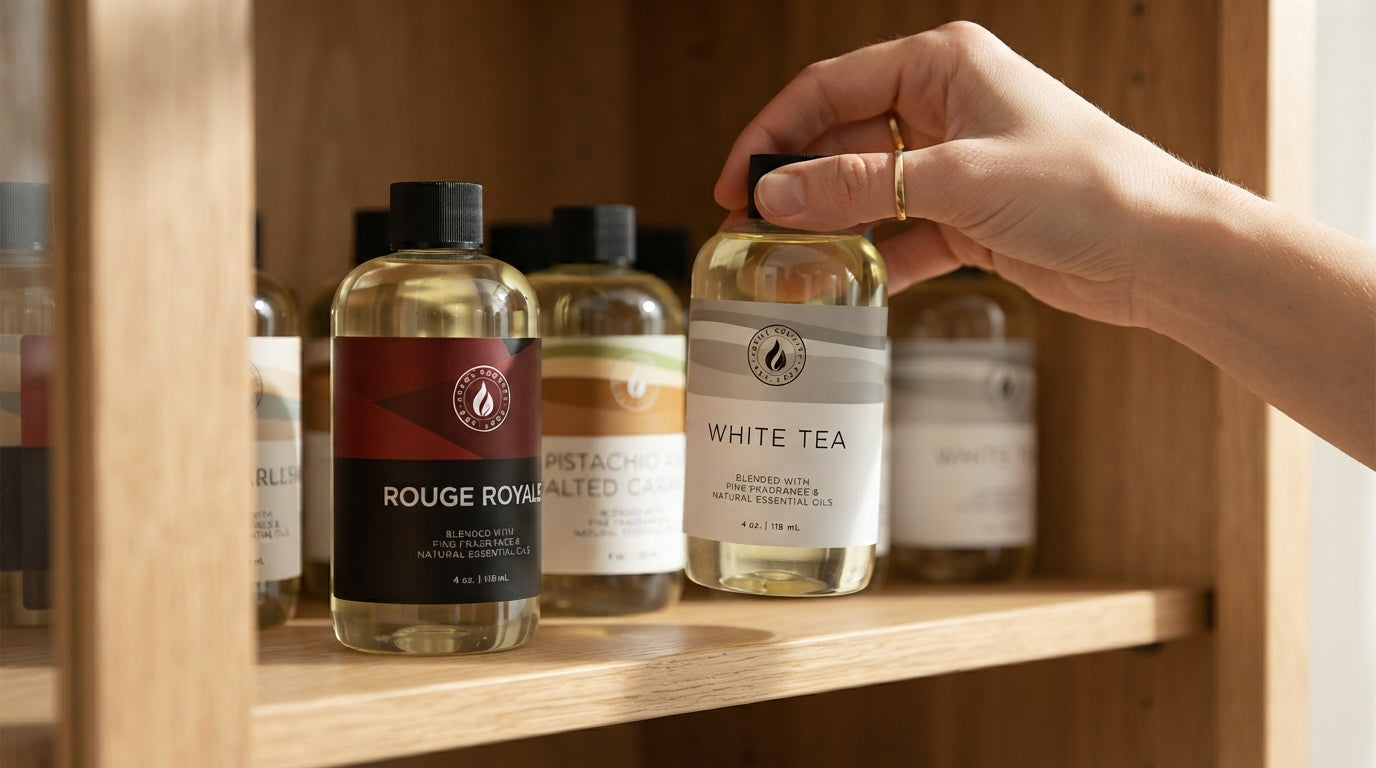









Sandalwood smells like warm, creamy wood: soft and milky rather than sharp, with a faint sweetness, a whisper of rose, and a dry, powdery earthiness underneath. It is quiet on first contact and grows rounder over hours. Where cedar is pencil-dry and crisp, sandalwood is smooth, low, and almost edible.
Start with what it is not, because almost everyone arrives with the wrong picture. The word usually reaches people first on a cheap incense stick, so the expectation is smoke and heavy spice. That smell belongs to the burning, not to the wood: distilled sandalwood carries no smoke at all. It is not the dry pencil-shaving sharpness of cedar either, and it is not sweet the way vanilla is sweet. Take those three away and what is left is stranger and more interesting: a wood that behaves like a cream, a base note that can read floral, a commodity whose supply nearly vanished and then reappeared on another continent, and one of the most confused terms in modern fragrance vocabulary.
The short version
- Smells like: soft, milky and faintly sour before it reads as wood at all, with almost no top note, then a rosy facet fills in and holds for hours.
- The surprise: a 2021 survey of six oils sold as sandalwood found none met the international standard's composition ranges, and only three labels described what was actually inside.
- The chemistry: two sesquiterpene alcohols, alpha- and beta-santalol, plus minor relatives account for roughly 90 percent of high-grade Indian oil, and flipping a single bond in alpha-santalol erases the smell.
- Where it comes from: the slow-forming heartwood of Santalum album, and Karnataka's reported output fell from around three thousand tonnes in the late 1970s to roughly twenty by the early 2000s.
- In a room: heavy santalols mean a cold-air blend needs fifteen to forty-five minutes to reach full presence, lingers for hours after shutoff, and suits four hundred to twelve hundred square feet.
- Often confused with: santal, which is just the French word for the same tree rather than a different plant, and red sandalwood, an unrelated timber with essentially no aroma.
Sandalwood at a glance: the quick profile
Sandalwood belongs to the woody family, and within it to the soft or creamy woods rather than the dry, resinous, or smoky ones. Picture that family as a spectrum from arid to lush: cedar and cypress anchor the arid end, vetiver and patchouli sit in the earthy middle, and sandalwood occupies the lush, lactonic end almost by itself. Knowing where a note sits on the broader map of fragrance families tells you a great deal about how it behaves in a room, and with sandalwood the family placement all but dictates the pace.
In the classical scent pyramid it is a base note, and not a borderline one. It is among the heaviest and least volatile materials in common use, so it arrives late, stays long, and works underneath whatever else is in the blend. Perfumers use it the way a cook uses stock: rarely the thing you notice first, almost always the thing that makes the rest cohere.
- Family: woody, soft or creamy woods subgroup
- Pyramid position: base note, very high substantivity
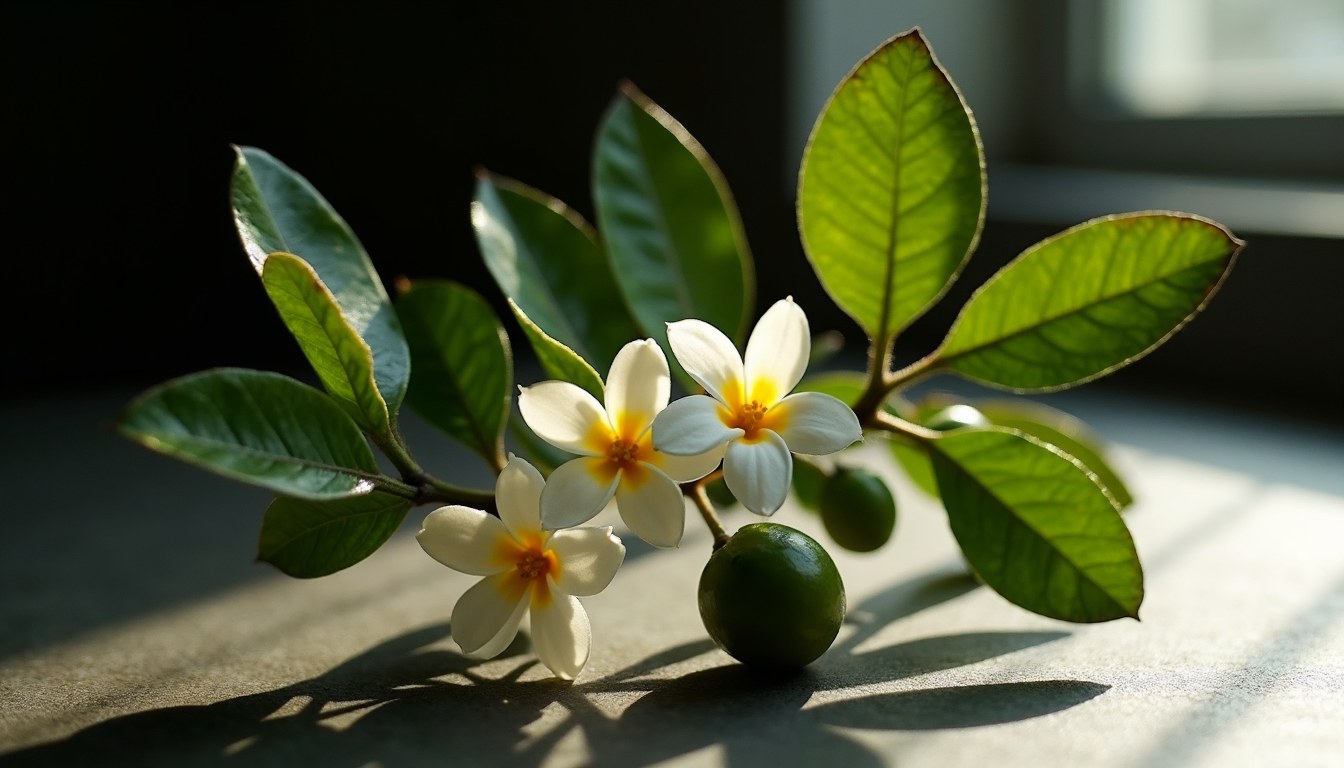
- Botanical source: heartwood and roots of Santalum album (Indian sandalwood) and Santalum spicatum (Australian sandalwood)
- Extraction: steam distillation of milled heartwood
- Key molecules: (Z)-alpha-santalol and (Z)-beta-santalol, both sesquiterpene alcohols
- Character: creamy, milky, soft-woody, faintly rosy, powdery, slightly balsamic
- Pairs with: rose, jasmine, iris, vanilla, cardamom, oud, musk, vetiver
One structural fact governs everything downstream. The fragrance is not in the leaves, bark, flowers, or sapwood. It is in the heartwood, the dense inner core that a tree only begins forming after roughly a decade and that is not worth harvesting until the tree is fifteen to thirty years old. There is no fast version of this material, and that constraint explains what sandalwood costs, why its supply collapsed, and why the industry spent seventy years building synthetic alternatives.
The scent, decomposed
With the outline in place, the note is worth taking apart in the order a nose actually meets it: what arrives in the first seconds, what fills in behind it over the following hour, and the handful of words perfumers use for the parts.
The opening impression
Smelled straight from a bottle of distilled sandalwood, the first impression is not woody at all. It is soft and slightly sour-sweet, closer to warm milk or the inside of a fresh coconut than to a log. There is a faint green edge in the first seconds, like a freshly split branch, and underneath it a powdery quality some people read as sandalwood soap and others as old books.
What is missing is just as telling. No sparkle, no lift, no citrus brightness, no cool bite. Sandalwood has essentially no top note of its own. When a blend labeled sandalwood opens bright and sharp, what you smell in that first minute is almost always something else: a citrus, a spice, or one of the modern synthetic woods designed to give sandalwood the projection it naturally lacks.
The drydown
Sandalwood does not so much dry down as fill in. Over the first half hour the sourness recedes, the milkiness thickens, and a soft rosy facet emerges that surprises almost everyone. That rosy quality is a genuine feature of the material rather than the power of suggestion: it is consistently reported in the santalol fraction itself, which is why sandalwood and rose have been paired for centuries and why the combination feels less like two ingredients than one.
Past the first hour the note settles into its long plateau, and this is what defines it. Good sandalwood becomes almost featureless in the right way: warm, smooth, unhurried, with the texture of sun-warmed wood and the faint sweetness of condensed milk. It does not evolve dramatically after that. It simply persists, dimming by degrees, for many hours.
The facet vocabulary
Lactonic is the important term. It means milky or creamy, the smell family that includes warm dairy, coconut flesh, ripe peach, and sandalwood. Perfumers use it constantly and the rest of us almost never hear it, but once you can name the lactonic facet you can pick sandalwood out of a blend instantly. Balsamic means resinous and slightly sweet, the smell of tree gum rather than tree wood. Powdery names the soft, dusty quality sandalwood shares with iris and violet. Animalic is the faintest facet, mainly in older Indian material: a barely-there warmth that reads as soft and lived-in rather than anything unclean.
What sandalwood does not smell like
It does not smell like incense. Enormous numbers of people believe it does, for a simple reason: their first encounter with the word came from a mass-market incense stick, typically a charcoal and bamboo base carrying a heavy synthetic accord with smoke and spice notes sandalwood does not contain. Burning anything produces smoke, and smoke smells like smoke. Distilled sandalwood is not smoky at all.
It does not smell like cedar. Cedar is dry, thin, sharp, and slightly astringent, the smell of a pencil shaving or a lined closet. Sandalwood is thick, soft, and low. They are both woods the way lemon and grapefruit are both citrus, which is to say the family name conceals more than it reveals. If a product marketed as sandalwood scratches slightly at the back of the nose, you are probably smelling cedar or a cedar-adjacent synthetic.
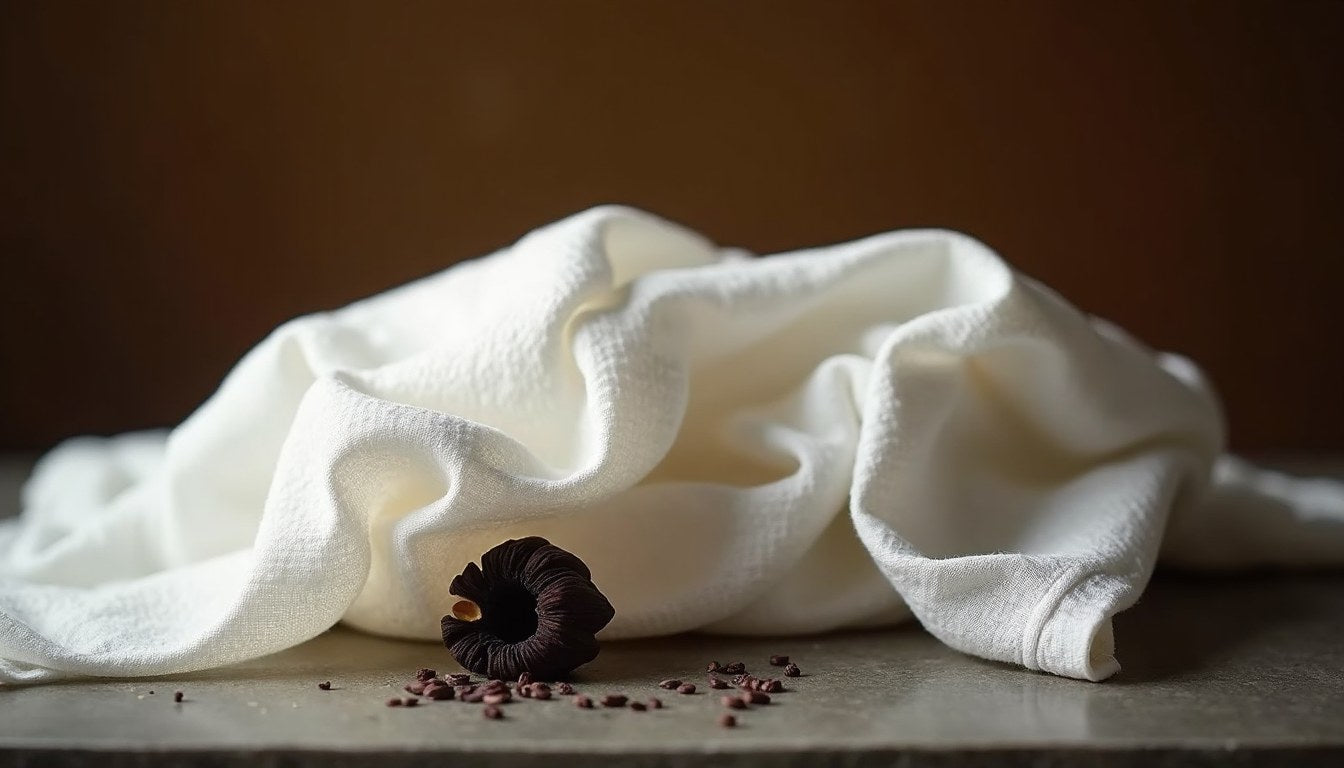
It is not the same as red sandalwood. Red sandalwood, or red sanders, is Pterocarpus santalinus, an unrelated tree in the pea family valued for dense red timber and dye. It has essentially no aroma. Any product listing it as a fragrance source is mislabeled.
It is not sweet the way vanilla is sweet. The sweetness is a texture, creaminess without sugar. If a blend reads candied or dessert-like, that is vanilla, tonka, or an amber accord sitting on top of the sandalwood, not the wood itself.
Santal vs sandalwood: what is santal, and is it the same thing?
Here is the plain answer the internet makes oddly hard to find: santal is simply the French word for sandalwood. Same tree, same wood, same molecules, different language. There is no botanical distinction whatsoever.
Where the word comes from
The etymology is a small map of the trade route. The Sanskrit word is chandana. It traveled west through Persian and Arabic as sandal, entered medieval Latin as santalum, and split into the modern European forms: santal in French, sandalo in Italian and Spanish, and sandalwood in English, where the second half is just the English word for wood bolted onto the borrowed first. The genus name Santalum preserves the Latin.
What "santal" signals in modern fragrance
In practice, santal and sandalwood have quietly diverged in usage, and the difference is real even though it is a marketing convention rather than a botanical one.
Sandalwood tends to signal the classical reading: creamy, milky, lactonic, soft, close to what steam-distilled Indian heartwood actually smells like. It is the older word and it carries the older associations.
Santal tends to signal the modern reading: drier, brighter, cleaner, more transparent, often with a spicy or leathery edge and noticeably more projection. Santal compositions are usually built with a much higher proportion of synthetic sandalwood molecules, which is precisely why they smell that way. They cut through air faster and read as contemporary rather than devotional.
Resist the instinct to treat the creamy version as the real one and the dry version as an imitation. The creamy reading is closer to raw distilled heartwood. The dry reading is closer to what most people today actually mean when they say they like sandalwood, because it is the profile they have met in contemporary interiors. They are different portraits of the same subject.
A practical test: think of the last sandalwood-labeled thing you liked and ask whether it felt closer to warm milk or to clean, dry, sunlit wood. Warm, soft, and slightly sweet means you want the classical reading. Crisp, airy, faintly peppery, and noticeable from across the room means you want the santal reading.
The chemistry: alpha-santalol, beta-santalol, and why sandalwood smells creamy
Sandalwood is unusually satisfying to explain chemically. Unlike most natural materials, where dozens of trace compounds interact in ways nobody fully models, its smell is dominated by two molecules.
The two santalols
The odor carriers are alpha-santalol and beta-santalol, both of them sesquiterpene alcohols. Sesquiterpene simply means the molecule is built from fifteen carbon atoms, one and a half times the ten-carbon terpene unit behind lighter materials like the limonene in citrus peel. That extra size matters enormously for how sandalwood behaves in air.
Those molecules, and the synthetic materials built to stand in for them, are worth keeping in one place.
| Molecule | Formula | Molecular weight | Character |
|---|---|---|---|
| (Z)-alpha-santalol | C15H24O | 220 g/mol | Soft-woody, the body of the oil |
| (Z)-beta-santalol | C15H24O | 220 g/mol | Rich, creamy, true sandalwood |
| Isobornyl cyclohexanol | C16H28O | 236 g/mol | Synthetic, woody-ambery, soapy |
| Campholenic aldehyde | C10H16O | 152 g/mol | Synthetic, pine-derived precursor |
The last two entries belong to the synthetic side of the story, set out further down. The trade grades natural oil on how much of the first two it contains: with related minor sesquiterpenes, the santalols commonly make up around 90 percent of high-grade Indian oil.
Alpha-santalol is the more abundant, typically two to three times as plentiful, and carries the broad soft-woody body. Beta-santalol is the minority component, and it is the one responsible for the character most people are chasing: it is widely regarded as carrying the rich, creamy, distinctly sandalwood quality at greater intensity than its more abundant sibling. This is why two oils with similar total santalol content can smell noticeably different. The ratio, not just the sum, decides whether an oil reads generically woody or unmistakably creamy.
Why the geometry matters
Both santalols exist in two geometric forms, Z and E, differing only in how a side chain is oriented across a double bond. Same atoms, same connections, different three-dimensional arrangement. The Z form of alpha-santalol smells of sandalwood. The E form does not. Your olfactory receptors read molecular shape at a finer resolution than most people assume, and one flipped bond erases the note entirely.
The commercial species, side by side
Two species supply almost all of the sandalwood in trade, and they are not interchangeable. A third row belongs in the comparison, because the Indian species is now grown on plantations in Australia as well as in India, and planted wood is a different proposition from old wild timber.
| Species | Origin | Santalol content | Character |
|---|---|---|---|
| Santalum album, wild | India, old Mysore stands | 41 to 55% alpha, 16 to 24% beta | Creamy, milky, faintly rosy |
| Santalum album, planted | Ord River, Western Australia | 44 to 50% alpha, 18 to 20% beta | Same profile, less margin |
| Santalum spicatum | Western Australia, wild | Lower total santalols, more farnesol | Drier, nuttier, more resinous |
The first row is the reference point in every sense: the international standard for Indian sandalwood oil is written around those ranges, and the planted figures are measurements taken from sixteen-year-old trees and read against it. The column that decides everything for a buyer, though, is the last one. Species is not a grading ladder, it is a different smell: an oil can be genuine, legal, and competently distilled and still not deliver the creaminess people mean when they say sandalwood, simply because it came from a different tree.
Who worked it out, and when
The santalols were characterized across the first third of the twentieth century, during the great era of terpene chemistry. Structural work on alpha-santalol is generally credited to the German chemist Friedrich Wilhelm Semmler around 1910, and the structure of beta-santalol was established in the 1930s by Leopold Ruzicka, the Croatian-Swiss chemist whose terpene work earned him a share of the 1939 Nobel Prize in Chemistry.
Making the santalols proved far harder than identifying them. Early attempts gave poor yields and imprecise stereochemistry, meaning chemists could assemble the right atoms but not reliably the right three-dimensional shape, which as we have seen is the difference between sandalwood and nothing. Stereoselective routes did not appear until several decades later, and even then cost too much to compete with distilling wood. Chemically synthesized santalol has never become a commercial fragrance material at scale, which left the industry, when demand later outgrew the trees, to solve the problem by a route that had nothing to do with copying these molecules.
From tree to oil
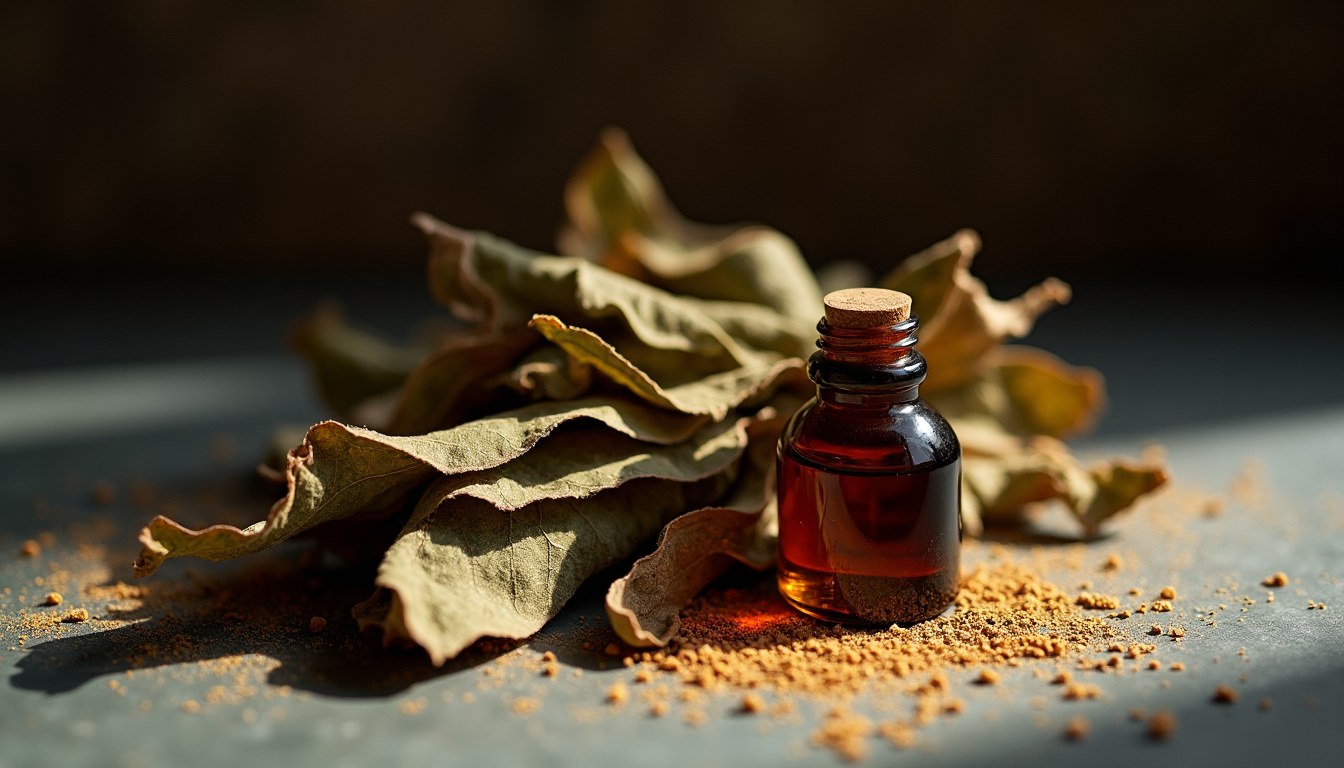
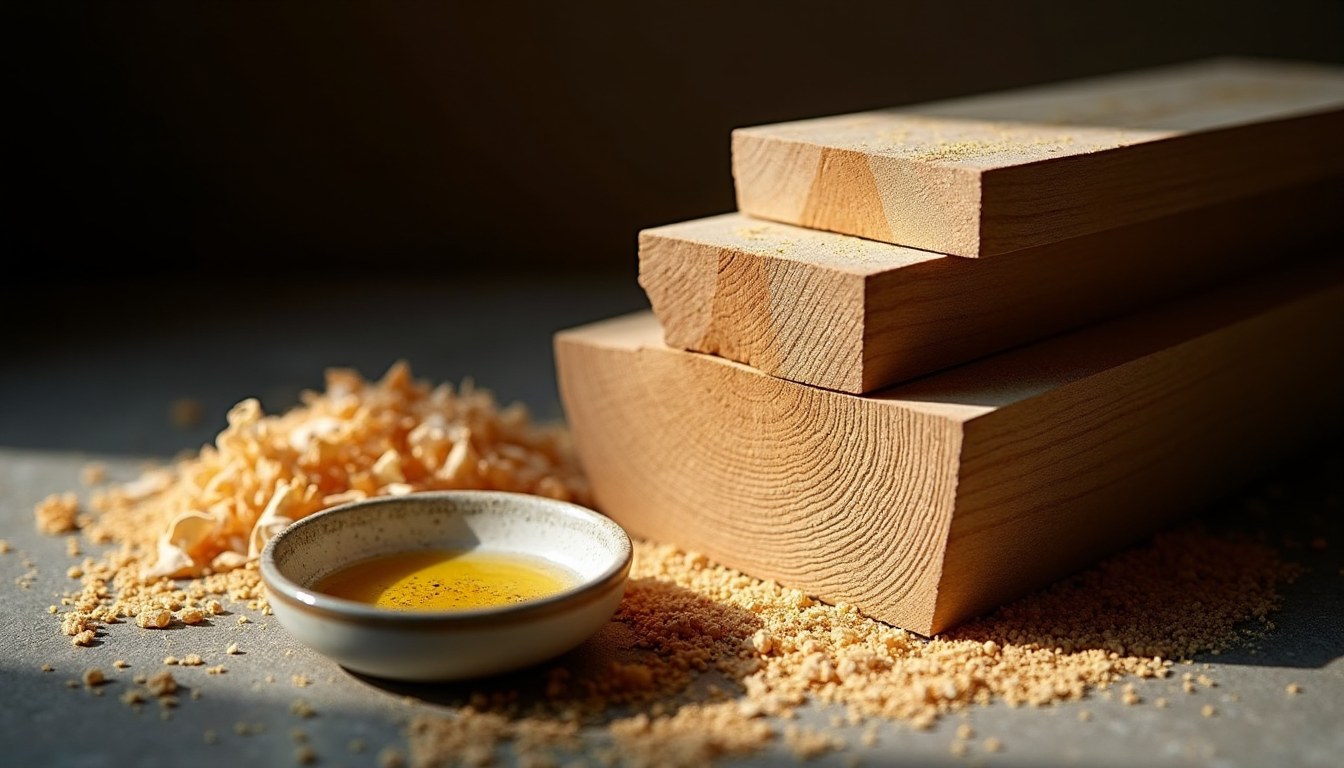
Mature heartwood and roots are harvested, the pale sapwood stripped away because it carries little oil, and the fragrant core milled to a coarse powder. That powder is steam distilled, often for very long cycles compared with lighter botanicals, because the santalols are heavy and reluctant to travel with steam. Reported yields commonly fall between two and a half and six percent by weight, varying with tree age and heartwood density. Roots carry a higher concentration than trunk wood, which is why sandalwood has historically been uprooted rather than felled: a felled tree can regrow from a stump, while an uprooted one cannot.
The parasite problem
Santalum album is a hemiparasite. It photosynthesizes normally but cannot thrive alone: it sends out root structures called haustoria that attach to neighboring plants and draw off water and nutrients including nitrogen, phosphorus, and potassium. Researchers have recorded a wide range of host species, with figures around three hundred commonly cited. A sandalwood plantation is therefore never a monoculture. Growers must maintain a sequence of companion hosts, ending with a long-term leguminous tree still alive fifteen years later.
Sandalwood in a home diffuser: how the note behaves in cold air
Everything so far happens inside the tree and inside the still. What happens next happens in a room, and sandalwood is one of the notes most changed by how it is delivered into one. The reason comes down to a single physical property of the molecules carrying it.
Why molecular weight changes everything
Return to the molecular weights above: the santalols weigh about 220 grams per mole. Limonene, which makes orange peel smell like orange peel, weighs about 136. Linalool, the soft floral molecule in lavender and coriander, weighs about 154. Sandalwood molecules are substantially heavier than the materials that give a blend its opening lift, and their boiling points are correspondingly high: above 300 degrees Celsius at ordinary atmospheric pressure. Much lower figures circulate for these molecules, and they are almost always measurements taken under vacuum, which pulls a boiling point down by well over a hundred degrees. Compare like with like, or the numbers stop meaning anything.
Heavier molecules with higher boiling points have lower vapor pressure, the measure of how eagerly a substance leaves the liquid and enters the air. Low vapor pressure means slow evaporation, and slow evaporation means a note that arrives late and leaves late. Everything sandalwood does in a room follows from that one property.
What cold-air diffusion does differently
Any heat-based method sorts a blend by volatility. A candle flame or a wax warmer drives off light molecules first while the heavy ones sit in the melt pool and get left behind, which is why a sandalwood candle so often smells sweet and generic at the start and then flattens. The heaviest and most characterful molecules in this particular note are precisely the ones least willing to travel on heat alone.
Because a nebulizer breaks the oil into droplets mechanically rather than evaporating it thermally, that sorting never happens. The santalols leave the machine in roughly the proportion they were formulated in, then hang in the air as suspended micro-droplets and evaporate gradually from every surface they land on. For a note this heavy, that is the difference between hearing the whole composition and hearing only its treble.
How fast it throws, and how long it stays
Sandalwood builds slowly. You will notice a citrus or mint blend within a minute or two of the machine starting. A sandalwood-dominant blend usually takes fifteen to forty-five minutes to reach full presence, filling in steadily across that window rather than announcing itself. If you switch one on and immediately conclude it is weak, you judged it too early. This is the most common mistake people make with heavy base notes.
The other end of the cycle is equally distinctive. Sandalwood persists for hours after the machine stops, because those droplets have settled onto textiles, rugs, curtains, and upholstery and are still evaporating from all of them. Soft furnishings act as a reservoir, which is why the tail on a sandalwood blend outlasts a citrus blend's several times over.
The practical consequence is accumulation. Sandalwood stacks day over day in a way light notes do not. A setting that feels right on day one can feel heavy by day four, not because the machine changed but because the room has been steadily loading.
How a sandalwood blend unfolds in a room
Because one property governs the note, the shape of an evening is fairly predictable. What follows is a reasoned map derived from the relative volatility and boiling points of the molecules involved rather than a laboratory measurement, and every time band is approximate: room size, blend, output setting, and air movement all shift them. The sequence is the part that holds, because the order is set by physics rather than by preference. Light molecules leave first, heavy ones leave last, and the santalols sit at the heavy end of almost anything a diffuser handles.
- 0 to 2 minutes. Whatever is lightest in the blend arrives first: citrus, pink pepper, cardamom, a green top note. The santalols are already in the room as suspended droplets, but very little has evaporated off them yet, so the wood itself barely registers. A sandalwood-dominant blend can smell like almost nothing at all in this window.
- 5 to 15 minutes. The light material thins and the first real santalol vapor reaches you. The change is more textural than aromatic: a sense of weight arriving underneath whatever opened the blend, soft and slightly milky. The rosy facet usually shows up somewhere in here.
- 15 to 45 minutes. Full presence. The lactonic body is completely out, the creaminess reads as creaminess rather than as vagueness, and the blend smells the way it was built to smell. Anything sharp in the opening has generally burned off, which is why the same blend reads warmer at half an hour than at two minutes.
- 1 to 3 hours. The plateau, long and flat by design. Beta-santalol boils at about 311 to 313 degrees Celsius at ordinary atmospheric pressure, and alpha-santalol, an isomer of identical weight, sits in the same region, so both leave a settled droplet at a crawl. The note stops evolving and simply holds, losing a little strength at a time rather than turning into anything else.
- After the machine stops, and the next morning. Every soft surface in the room has been collecting droplets the whole time and keeps releasing them with nothing running. In a fabric-rich room an evening's diffusion is often still faintly readable at breakfast, and that reservoir is where the accumulation comes from.
Intensity, run cycles, and rooms
All of that points one direction: run sandalwood at lower intensity and shorter on-cycles than a citrus or green blend. Where a bright citrus blend wants longer bursts to maintain a presence that is constantly dissipating, sandalwood wants the opposite. Short bursts with generous gaps let the note establish itself and then coast on its own persistence. Many people find a sandalwood blend at low output reads as richer than the same blend at high output, where it stops being a scent and becomes a weight.
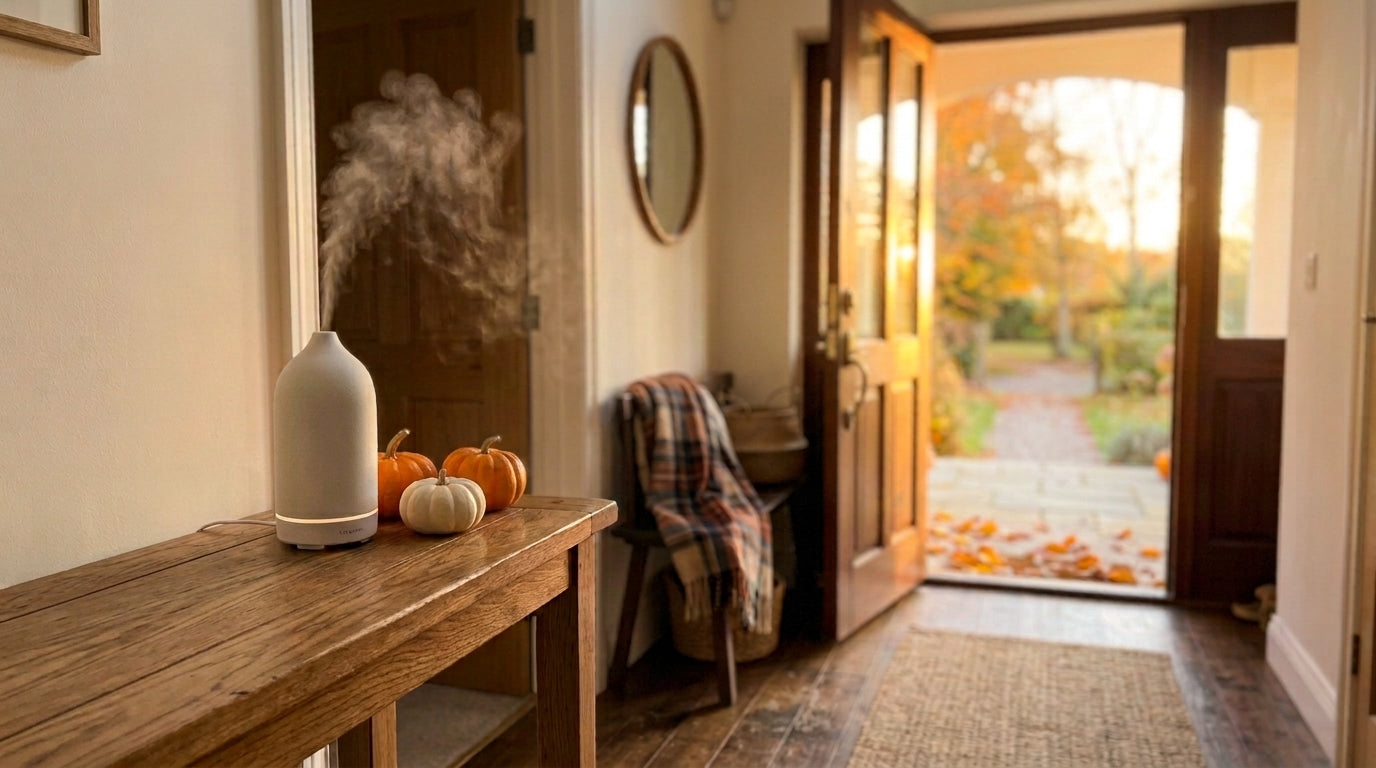
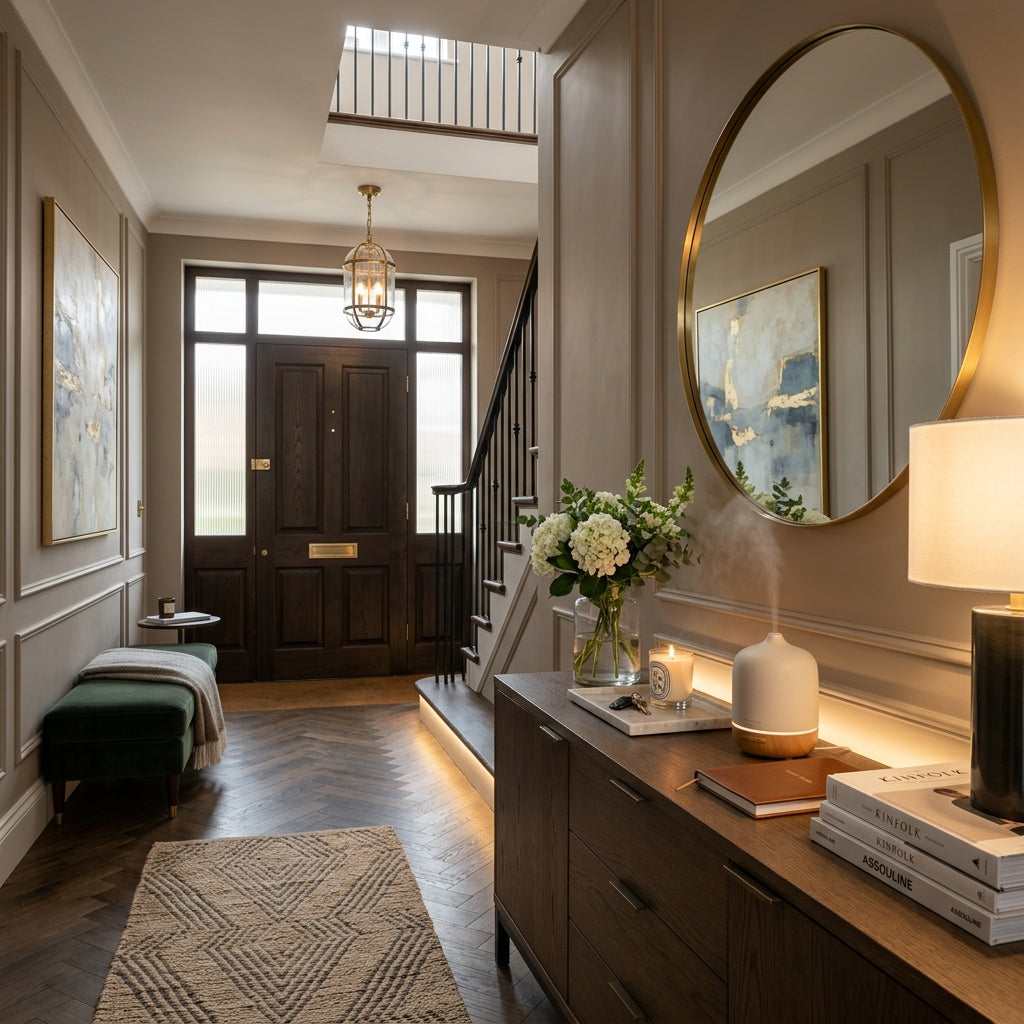
Room selection follows the same logic. Sandalwood is a room-anchoring note and wants volume to spread into: living rooms, great rooms, open-plan kitchen and dining areas, entryways, and stairwells where air moves between floors. An entryway suits it particularly well, since the slow build and long persistence establish a baseline rather than hitting arrivals with a spike. Four hundred to twelve hundred square feet is the comfortable range. In very small enclosed spaces, sandalwood goes from present to oppressive quickly and needs the lowest output setting and short cycles. Bedrooms are a matter of preference: some people love the persistence, and others find that a note still there in the morning is one note too many.
Layering with other notes
Sandalwood is a floor, not a feature. In a room-scale blend it does what a bass line does in music, giving everything above it somewhere to stand. Pair it with a citrus top and the citrus reads warmer and less thin. Pair it with rose or jasmine and the floral gains body. Pair it with cardamom or black pepper and you get the dry contemporary santal reading. Pair it with vanilla, tonka, or amber and you get something closer to a gourmand wood.
The combination to approach carefully is sandalwood with other heavy bases at full strength. Sandalwood plus oud plus patchouli plus vetiver in a small room is four slow, persistent, accumulating materials competing for the same space, and the result is muddy rather than luxurious.
Diffused sandalwood versus a candle
In a candle, the melt pool sits somewhere around fifty to seventy degrees Celsius, and that heat sorts the material. Light molecules leave first, and the santalols, boiling above three hundred degrees at ordinary pressure, are the last to move. Sandalwood in wax therefore reads sweeter and thinner than the oil does on its own, with the creamy weight arriving late if it arrives at all, and the fragrance load is capped by what wax can carry without spoiling the burn. Without heat, no such sorting happens. Nothing separates the heavy fraction from the light one on the way out, which is why the lactonic, milky character that defines the note survives delivery instead of being left behind in a pool of wax.
Three practical notes
First, sandalwood-heavy oils tend to be more viscous than citrus or herbal blends, and viscosity matters in a nebulizing machine because the oil must travel through fine passages to reach the atomizing nozzle. Heavy blends run more reliably when the machine is cleaned on a regular schedule. Second, expect olfactory adaptation: your nose stops registering a constant, low-intensity smell quickly, and sandalwood is exactly that kind of smell. You will stop noticing your own long before guests do, and compensating by turning the output up is how people end up with a room far stronger than they realize. Trust the setting, not your nose. Third, placement counts for more with a slow note than with a fast one: tucked into a corner behind furniture, a sandalwood blend reads weak and tempts you into pushing output higher than the room needs, while on an open surface near a doorway or the main path people walk, the same blend reads full at a lower setting and has time to spread evenly.
The history: temples, monopoly, and a tree that outlived its own supply
The machines are recent, and so is the habit of thinking about a note in terms of settings and placement. The behavior all of it is working around is not, and neither is the demand for it. Sandalwood has been valued for the same slow warmth for at least two thousand years, and the reason it is scarce and costly today is written into that long record rather than into anything recent.
South Asian origins
Sandalwood appears in Indian literature for well over two thousand years, under the Sanskrit name chandana. Its uses were material, ritual, and economic at once. The wood is dense, fine-grained, nearly knot-free, and insect-resistant, which made it prized for carving temple doors, panels, boxes, and figures that stayed fragrant for generations after cutting. Ground to a paste with water on a stone, it was applied in Hindu ritual practice and used in temple worship, a role the earliest surviving texts already record. It was burned as incense across South Asia, sandalwood billets were added to cremation pyres, and Sanskrit compendia of the first millennium listed chandana among the valued materials of their day.
The trade reach was extraordinary for a heavy, slow-growing commodity. Sandalwood moved north into the Himalayan Buddhist world, east into China where it became a central incense material, and west along Indian Ocean routes into Arabia and eventually Europe. By the medieval period it was a luxury good in several civilizations at once.
The Royal Tree and the Mysore monopoly
The modern supply story begins in 1792, when the state of Mysore declared sandalwood a royal tree, asserting state ownership of the resource regardless of whose land it grew on. That principle survived the end of princely rule and passed to the successor Indian states. For most of the twentieth century, harvesting, processing, and sale in Karnataka, Tamil Nadu, and Kerala were government monopolies, and Mysore sandalwood oil became the global benchmark grade against which everything else was measured.
The monopoly had a second effect that is easy to miss. State ownership of trees on private land removed any incentive for a farmer to grow, protect, or even tolerate sandalwood: a tree appearing on your land was legally not yours, was a magnet for thieves, and brought the forest department onto your property. Landholders quietly removed seedlings. Meanwhile the state harvested natural stands without a matching replanting program, and a phytoplasma infection known as spike disease, which has no cure, thinned remaining populations further.
The collapse figures commonly cited are stark: Karnataka's recorded production is frequently reported as falling from around three thousand tonnes in the late 1970s to roughly twenty tonnes by the early 2000s. Whatever the precise numbers, the direction is not in dispute. In 1998 the species was assessed as Vulnerable on the IUCN Red List, with wild stands of large mature trees reported as much reduced. The shortage of sizable timber has gone far enough that the wood's former use for fine woodworking has largely ended, since what remains standing in the wild skews young and has not yet built much heartwood. For a material whose quality improves with age, the loss of large old trees is the whole problem.
India restricted export of sandalwood timber, which is often loosely described as a CITES restriction. That is not quite accurate: the controls governing Indian sandalwood are national and state forest law rather than the CITES appendices. The tree most people are thinking of when they mention CITES and sandalwood together is red sanders, the unrelated non-aromatic timber described earlier, listed on CITES Appendix II since the 1990s.
Policy has moved since, slowly. The Karnataka Forest (Amendment) Act of 2001 made a landholder the legal owner of sandalwood grown on their own land, though sale and transport stayed regulated, and rule changes in 2022 widened who cultivators may legally sell to. Private cultivation has expanded, though the fundamental constraint has not changed: anyone planting today is betting on a market fifteen to thirty years out.
The Australian chapters
While Indian supply contracted, a parallel industry had run across the Indian Ocean for over a century. Western Australia has its own native species, Santalum spicatum, whose commercial exploitation is commonly dated to 1844, when settlers in the Avon Valley shipped a trial consignment of logs and found a ready market. The buyers were largely Chinese merchants operating through Singapore and Shanghai, who wanted the wood powdered for incense.
The scale is easy to underestimate. Sandalwood is commonly described as colonial Western Australia's second largest export by value in the nineteenth century, with shipments running into thousands of tonnes in single years (around 9,600 tonnes are reported for 1882) and cumulative exports running into the tens of thousands of tonnes across the life of the trade. Wild spicatum harvest continues under state quota.
The more consequential development came much later. Beginning in 1999, growers in the Ord River Irrigation Area near Kununurra, in far northern Western Australia, planted Santalum album itself, the Indian species, under irrigation on tropical alluvial soils. It was a long and expensive bet, made harder by the host-plant requirement and the fifteen-plus year wait before any return. By the late 2000s a few thousand hectares were established, and the region has since become the largest planted resource of Indian sandalwood anywhere. That plantation oil is the single biggest reason the note is available at all outside the rarefied end of the market.
Natural versus synthetic sandalwood today
A shrinking supply of a wood the whole world wanted left the fragrance industry one obvious problem to solve, and it could not be solved by planting, since planting takes a working lifetime to pay off. What happened instead was a second sandalwood, arrived at in a laboratory, and almost everything sold under the name today is some proportion of the two.
Why synthetics exist
The industry did not build synthetic sandalwood to cut corners. These materials exist because by the mid-twentieth century demand plainly exceeded what mature trees could supply, and no amount of money makes a tree grow faster. Chemists then discovered that certain terpene-substituted cyclohexanols, molecules with no structural relationship to the santalols, nonetheless smell convincingly of sandalwood. That finding, generally credited to mid-century work on terpenylcyclohexanols, taught a real lesson: the shape a receptor recognizes can be reached by more than one chemical route.
The main synthetic families, and a newer third route
The first commercially important family of synthetic sandalwood molecules is the isobornyl and isocamphyl cyclohexanols, made by reacting camphene with guaiacol over a Lewis acid catalyst, then hydrogenating the intermediate. Routes of this type appear in the patent literature from the early 1950s, with the commercially dominant version patented in the late 1960s, and the materials became workhorses: inexpensive, extremely long-lasting, and woody-ambery rather than truly creamy. They are why a certain kind of generic sandalwood accord smells slightly flat and slightly soapy.
The second and more interesting family is built from campholenic aldehyde, a ten-carbon aldehyde obtained by rearranging the epoxide of alpha-pinene. Alpha-pinene comes from turpentine, itself a byproduct of the pulp and paper industry, so this entire branch of sandalwood chemistry starts from pine residue. Through aldol condensation, alkylation, and reduction it becomes a large family of sandalwood alcohols, and the modern members are remarkable: some are detectable at extraordinarily low concentrations, and the strongest carry a genuine milky-woody character rather than a merely woody one.
A third route is emerging. Engineered yeast can be induced to produce santalene hydrocarbons by fermentation, which are then oxidized to santalols. This is biotechnology rather than petrochemistry or forestry, and it yields molecules that are structurally the real thing rather than lookalikes. It is also the first route other than distilling wood to put actual santalol molecules into commercial supply, which is why it matters out of proportion to its current volume: every synthetic that came before it worked by reproducing the smell with a different molecule, never the molecule itself.
How they actually smell different
Synthetic sandalwood materials are generally brighter, more transparent, and far more diffusive than distilled heartwood. They project, they cut through other materials, and they give a composition a legible woody signature from across a room, which distilled sandalwood alone struggles to do. What they usually lack is lactonic depth: the sour-milky, faintly animalic, faintly rosy complexity that comes from an oil containing dozens of minor components alongside the two main ones. A synthetic accord smells like the idea of sandalwood in high resolution; distilled oil smells like a specific piece of wood with a history.
Most blends today use both. Synthetics provide projection, consistency, and supply security. Distilled sandalwood provides depth and roundness no single molecule has yet reproduced.
The sustainability picture
The position is mixed. Wild old-growth Santalum album remains a genuinely depleted resource. Plantation-grown Indian sandalwood from Australia and from newer Indian private cultivation is a real improvement: planted, tracked, and harvested on a managed cycle rather than taken from wild stands. Campholenic-derived synthetics start from a forestry byproduct that would otherwise be waste. Fermentation-derived santalols use agricultural sugar and no trees at all. None is perfect, and all are better than uprooting thirty-year-old wild trees, which is what the twentieth century did.
Plantation sandalwood and the paper trail behind it
Synthetics answered the question of volume. They did not answer the other one, which is where genuine distilled oil comes from now that the old stands are gone, and how anyone buying it can tell. Both answers land in the same place: trees somebody planted, on a recorded date, with documents that follow the wood to the drum.
The Australian plantings reach harvest
The Ord River planting described earlier was a bet placed in 1999 that could not be checked for fifteen years. The answer arrived in September 2013, when the first commercial harvest of plantation Santalum album began on roughly 144 hectares planted in 1999 and 2000. The cutting ran across two seasons and finished in 2014, and the first commercial plantation oil followed in that same year, which is why some accounts date the milestone to 2013 and others to 2014. Either way it is the hinge in the modern supply story. For the first time since the Mysore stands thinned, meaningful volumes of Indian sandalwood oil were coming from trees somebody had deliberately put in the ground, on a known date, in a known place.
Scale followed, and then contracted. Figures reported for the peak of the northern Australian estate run to more than twelve thousand hectares and several million trees, spread across the Ord River irrigation country in Western Australia, the Douglas Daly and Katherine districts of the Northern Territory, and a small holding in the Burdekin in Queensland. The largest grower entered receivership in April 2024, by which point its established plantations were reported at around seven thousand eight hundred hectares and roughly three million trees. The estate was put up for sale, broken up into separate parcels, and some plantation land has been reported as cleared and returned to other crops, with cotton named as the likely successor in the Ord. Growers in the Ord have described oil prices falling steeply and then partially recovering. Plantation forestry solved the biological problem and did not solve the financial one: a crop with fifteen years between the spending and the revenue is exposed to every price swing in between, and that remains the central risk in this material's supply.
What plantation wood means for the oil
Two things change when the heartwood comes from a plantation rather than a wild stand. The age is known, and the age is younger.
Both the amount of oil in the heartwood and the santalol share of that oil tend to rise with tree age, which is the technical reason old wild trees earned their reputation and the reason a fifteen-year rotation is a genuine compromise rather than a free lunch. The published measurements suggest the compromise is a workable one. A study of thirty-two sixteen-year-old Indian sandalwood trees planted near Kununurra reported mean oil concentration in the heartwood of about 5 percent, roughly 0.28 kilograms of oil per tree, with both santalols sitting inside the ranges the international standard sets. Those are the plantation figures in the species table earlier, and they show that wood at sixteen years can hit specification. It does not have the margin that a fifty-year wild tree had, and hitting the standard is an outcome rather than a guarantee. A 2021 survey of oils sold commercially as sandalwood makes that point from the other direction. The single sample in that survey which actually contained both santalols measured 37.1 percent alpha-santalol and 22.0 percent beta-santalol, short of the roughly 41 percent alpha minimum the international standard sets. That sample was sold as natural sandalwood oil from India, not as plantation material, so it says nothing about Australian plantation wood specifically. What it does show is that an oil can be genuinely Santalum album and still miss specification, which is why buyers test parcels instead of trusting labels.
Consistency is where plantation material has the clearer advantage. A wild parcel is an assortment: mixed ages, mixed provenance, mixed handling, often mixed species once the wood has been reduced to billets and powder. A plantation block has one planting date, one seed or clonal source, one irrigation and fertilizer regime, and usually one distillation facility at the end of it, which makes batch-to-batch variation something a producer can measure and narrow instead of something a buyer absorbs. That is the practical meaning of plantation supply for anyone formulating with the note: not that the oil is better than the legendary old-growth material, which is a comparison against a memory that can no longer be bought, but that this year's drum can be expected to resemble last year's.
Certification and legal chain of custody
Sandalwood's legal position is more tangled than the shorthand suggests, and the CITES version of the shorthand is usually wrong. As noted earlier, Santalum album is not on the CITES appendices. Two of its trade relatives are. Red sanders, Pterocarpus santalinus, the unrelated non-aromatic timber, has been on Appendix II since 1995. East African sandalwood, Osyris lanceolata, had its East African populations added to Appendix II at the 2013 conference of the parties, and osyris wood is one of the materials reported as substituted for true sandalwood in the oil trade, which is where those two facts meet.
For Indian sandalwood itself, legality is a matter of national and state forest law rather than an international permit. Export of the timber is restricted at the national level, and within India the trees remain governed by state rules covering ownership, felling, transport, and sale, the framework that grew out of the royal tree doctrine and was loosened rather than removed by the reforms of 2001 and 2022. The document that proves a piece of Indian heartwood is legal is a state permit, not a CITES certificate.
Above that legal floor sits voluntary certification, and this is where the modern supply chain does most of its work. Forest Stewardship Council forest-management certification has been reported for the largest Australian plantations of Indian sandalwood, and the Western Australian agency that manages the wild Santalum spicatum harvest reports environmental-management certification to ISO 14001 together with a PEFC chain-of-custody certificate covering its sandalwood production chain. The distinction between the two kinds of certificate matters. A forest-management certificate says a stand is grown and cut to a published standard. A chain-of-custody certificate is what allows an identified drum of oil to be tied back through distillation, milling, and harvest to the block of trees it came from, with every custodian in between accounted for. Plantation producers have described tracing individual oil batches back to the planting that produced them, which is a claim wild-collected material structurally cannot make.
Analysis is the check on all of it, because paperwork travels separately from the liquid. Gas chromatography reads an oil's composition against the expected profile, and the results in the open literature are sobering. The 2021 survey mentioned above examined six oils sold as sandalwood and found that none of them matched the composition ranges in the international standard: three carried the marker compounds of amyris, Amyris balsamifera, a cheaper and unrelated wood, one was dominated by benzyl benzoate at close to three quarters of the sample, one was built from synthetic sandalwood alcohols while being advertised as Santalum album, and one contained real sandalwood oil but fell below the standard anyway. Only three of the six labels described their contents correctly. A tracked chain of custody and a chromatogram are the two things that separate a documented material from a described one.
Notes that pair with sandalwood
Assume for a moment that the oil in front of you is what the label says. Sandalwood is then among the most cooperative materials in perfumery. It has no sharp edges to clash with, and it improves the texture of nearly anything placed on top of it.
Rose and jasmine. The classic partnership, and a logical one given the rosy facet consistently reported in the santalol fraction. Sandalwood gives florals a body they otherwise lack in a diffused room, where thin floral blends easily read as soapy.
Oud. The two great resinous-woody materials of the Indian Ocean trade, frequently combined and frequently confused. Oud is darker, more animalic, more medicinal, and far more polarizing, while sandalwood is the smoothing agent that makes oud approachable to people who find it too much alone. If you are curious where the line falls between them, what does oud smell like covers that note in the same depth.
Musk. The natural companion to any creamy wood, and the pairing that produces the soft, faintly powdery effect that reads as clean and expensive in interiors. Musk extends sandalwood's persistence and softens its woody edge. For the full picture, including why modern musks are a completely different class of molecule from the historical source, see what does musk smell like.
Cardamom, pepper, and iris. The dry route. Green cardamom and pink pepper add lift without sweetness, and iris contributes a cool, powdery, slightly metallic quality that keeps the whole thing from going soft. This trio is essentially the recipe for the modern santal reading.
Where this note appears in our range
We make two sandalwood blends, and they sit on opposite sides of the santal-versus-sandalwood split described earlier.
Our santal sandalwood is the contemporary reading: drier, brighter, and more diffusive, with a clean woody spine and a faint spiced lift over the top. It establishes itself quickly for a heavy wood and holds a large open volume at a moderate setting, which is the behavior entryways, high-ceilinged living rooms, and open-plan spaces call for.
Our sandalwood diffuser oil is the classical reading the name chandan points at: creamier, milkier, rounder, and slower, built around the lactonic character of distilled heartwood, with the soft rosy warmth that emerges in the drydown. It runs long at low settings, and it suits rooms with rugs, books, and upholstery, where soft furnishing holds the note and releases it slowly.
Both readings are also available in the 5-scent sample set, which has a five-scent minimum.
Frequently asked questions
What does sandalwood smell like in simple terms?
Warm, creamy wood. Softer and rounder than cedar, with a milky quality some people compare to warm dairy or coconut flesh, a faint rosy sweetness, and a dry powdery finish. It is not smoky, not sharp, and not sweet the way vanilla is sweet. It is subtle at first and becomes richer the longer it stays in the air.
What is santal, and is santal the same as sandalwood?
Santal is the French word for sandalwood, and both terms refer to the same trees, chiefly Santalum album. Botanically there is no difference at all. In modern fragrance marketing, santal usually signals a drier, brighter, more contemporary woody profile, while sandalwood signals the creamier classical one. Same origin, two different stylistic readings of it.
What does santal smell like compared to sandalwood?
Santal compositions typically smell cleaner, drier, and more transparent, with more projection and often a spicy or leathery edge. Sandalwood compositions typically smell creamier, milkier, and softer, closer to raw distilled heartwood. The difference comes mainly from how heavily each leans on modern synthetic sandalwood molecules versus distilled natural oil from the tree.
Why is sandalwood so expensive?
The fragrance lives only in the heartwood, which a tree does not begin forming until roughly ten years old and which is not commercially worthwhile until the tree is fifteen to thirty years old. The trees are hemiparasitic and need companion host plants to thrive. Decades of unreplenished wild harvesting in India depleted old-growth stands, and no cultivation method shortens the wait.
Does sandalwood smell like cedar?
No, though both are woods. Cedar is dry, thin, sharp, and slightly astringent, the smell of pencil shavings or a lined closet. Sandalwood is thick, creamy, and low, with a milky softness cedar completely lacks. If something labeled sandalwood smells sharp and scratchy, cedar or a cedar-type synthetic is likely doing most of the work.
How long does sandalwood last in a cold-air diffuser?
Longer than almost any other category. Because the santalol molecules are heavy and evaporate slowly, sandalwood takes fifteen to forty-five minutes to reach full presence, then persists for hours after the machine stops, since droplets keep evaporating from fabrics and surfaces. In a room with rugs and upholstery it is often faintly detectable the next morning.
What scents pair well with sandalwood?
Rose and jasmine gain body from it. Musk extends and softens it. Cardamom, pink pepper, and iris pull it toward the dry contemporary reading. Vanilla, tonka, and amber pull it toward warmth. Citrus tops sit comfortably above it. Avoid stacking several heavy bases together at full strength in a small room, which tends to read muddy rather than rich.
Is Australian sandalwood the same as Indian sandalwood?
They are different species. Indian sandalwood is Santalum album, whose santalols and related sesquiterpenes commonly make up around ninety percent of the oil, giving the creamy classical profile. Australian sandalwood is usually Santalum spicatum, with substantially lower total santalols and noticeably more farnesol, producing a drier, nuttier, more resinous character. Confusingly, Santalum album is now also grown on plantations in northern Australia.